 Bellingham Exterior
 Siding Built for the Way Sudden Valley Actually Sits
Sudden Valley homes sit in a different microclimate than a house a few miles away in downtown Bellingham. The tree canopy is heavier, the lots are shadier for longer stretches of the day, and homes closer to Lake Whatcom deal with a steady supply of moisture in the air that never fully burns off during the wetter months. Add in Whatcom County's broader pattern of driving rain and marine-influenced weather systems moving through the region, and you get siding conditions that punish anything that isn't installed correctly the first time.
This page is about one job: installing siding correctly on a Sudden Valley home. Not a general overview of siding, not a sales pitch for a product line — just what this specific community's homes need, what a correct installation actually involves, and why the contractor you hire for it matters more here than in a lot of other neighborhoods.
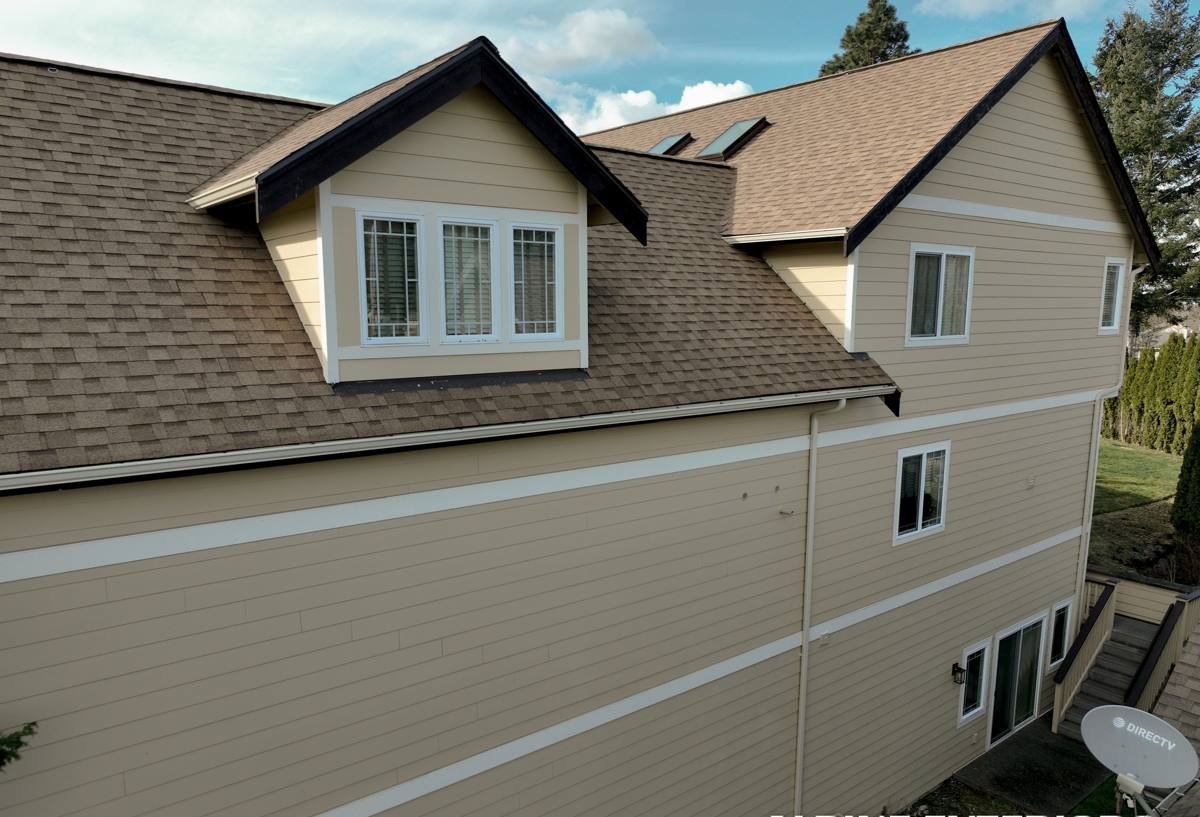
What Sudden Valley's Climate Does to Siding Over Time
Shade and Moss
Heavy tree cover keeps siding wet longer after every rain. Surfaces that would dry out in an hour in full sun can stay damp for a day or more under a Sudden Valley canopy. That extended damp window is exactly what moss and algae need to take hold, and once moss establishes itself on a siding surface, it holds moisture directly against that surface around the clock. On a material that can't tolerate sustained moisture contact, that's the beginning of a slow failure.
Driving Rain and Wind-Driven Water
Whatcom County storms don't always fall straight down. Wind-driven rain gets pushed sideways into wall assemblies, working its way behind poorly flashed trim, into gaps at butt joints, and around openings that weren't sealed to spec. A siding installation that looks fine from the curb can still be letting water into the wall cavity if the flashing and sealing details underneath weren't done right.
Humid, Cool, Shaded Air
Combine the shade, the lake proximity, and the region's marine air pattern, and you get long stretches where humidity sits high and temperatures stay moderate — ideal conditions for mold, mildew, and slow rot in any material that absorbs water rather than shedding it.
Why This Matters More for Siding Choice Than People Expect
A lot of siding failures aren't really installation failures — they're material failures that installation just delayed. Wood-based products, even well-treated ones, are dealing with an uphill battle in a shaded, moisture-heavy lot like the ones common in Sudden Valley. Moisture gets absorbed, swelling happens, paint or finish cracks at the swell points, and water gets behind the surface. Once that starts, it's a maintenance cycle that never really ends — recoating, caulking, patching, and eventually replacing sections that have gone soft.
This is a core reason we install James Hardie fiber cement siding exclusively and don't install vinyl, LP SmartSide, primed wood, or cedar. Fiber cement doesn't absorb and swell the way wood-based products do, and it isn't vulnerable to the heat distortion and impact brittleness that come with vinyl. For a shaded, damp lot near Lake Whatcom, that difference compounds year after year.
What a Correct Siding Installation Involves Here
The material matters, but the install determines whether that material actually performs the way it's supposed to. On a Sudden Valley home, we pay particular attention to a few things that get skipped or rushed on lower-quality jobs:
- Proper weather-resistive barrier installation behind the siding, lapped correctly to shed water downward and outward
- Flashing at every window, door, and roof-to-wall transition, installed before siding goes on — not caulked over after the fact
- Correct fastening per the manufacturer's installation instructions, including nail placement and spacing that keeps panels performing as engineered
- Proper clearance between the bottom of the siding and grade, decks, and roof lines, so water has somewhere to go instead of wicking upward
- Factory-finished panels installed with the specified gaps and sealants at joints, so the finish isn't compromised at the seams
- Ventilation behind the cladding where the wall assembly calls for it, so moisture that does get in has a way to dry out
Every one of these steps matters everywhere, but they matter more on a lot that stays wet longer. A flashing detail that's "close enough" on a sunny, open lot can be a real problem on a shaded lot near the lake where the wall never fully dries between rain events.
Why Hire a Crew That Already Works This Neighborhood
Sudden Valley isn't a typical suburban grid. Lot access, tree clearance, terrain, and setback from the lake all vary house to house, and a crew that's worked the area already knows what to expect before they show up. That matters for practical reasons — staging materials on a sloped, tree-lined lot is different from staging on a flat city lot — and it matters for judgment calls in the field, like where extra flashing attention is worth the time versus where it isn't.
It also matters because a contractor familiar with the community has already seen what happens to different products and installation shortcuts in this specific setting. That's not a marketing claim — it's just what happens when a crew works the same type of terrain and tree cover repeatedly. Patterns become obvious: which details hold up, and which ones don't.
Why We Install Only James Hardie Fiber Cement
We don't install vinyl, LP SmartSide, Cemplank, Allura, primed spruce, or cedar, and we're upfront about why. Each of those products has genuine strengths — vinyl is inexpensive and low-maintenance in the right climate, wood-based products have a look some homeowners want, and other fiber cement brands are reasonable products in their own right. But for the moisture load, shade, and driving rain that come with a property like a Sudden Valley home, we standardized on James Hardie specifically because of how it holds up over decades, not just years.
James Hardie's fiber cement is non-combustible, resists moisture-driven swelling and rot far better than wood-based alternatives, and its ColorPlus factory finish is engineered to hold color and resist the fading and chalking that shaded, damp environments accelerate on field-applied paint. Hardie's HZ5 product line is specifically engineered for wetter, harsher climates like the Pacific Northwest, and the manufacturer backs it with a strong, transferable warranty when the installation is done to spec — which is exactly why correct installation, not just correct material, is the whole point of this page.
Cost Factors for a Sudden Valley Siding Project
Every home is different, but a few factors consistently move the price on a project like this one more than they would on a flat, open lot elsewhere in the county:
| Factor | Why It Affects Cost Here |
|---|---|
| Tree cover and access | Limited staging space and overhead branches can slow material handling and require extra care around landscaping |
| Existing siding condition | Moisture damage found during tear-off (soft sheathing, hidden rot) needs to be addressed before new siding goes on |
| Home elevation and terrain | Sloped lots near the lake often need additional scaffolding or fall-protection setup |
| Flashing and trim detail | Homes with more window and roof-to-wall transitions require more flashing labor, which is where correct installation earns its keep |
| Siding profile and color | Lap width, shake-style panels, and factory color options all price differently within the Hardie product line |
We walk every property in person before quoting, because a phone estimate can't account for tree clearance, terrain, or what's actually going on behind the existing siding.
What to Look for When Vetting a Siding Contractor
Whether you go with us or someone else, a few basics separate a contractor who will do this correctly from one who won't:
- They inspect the wall assembly before quoting, not just the visible siding surface
- They can explain their flashing and moisture-management approach without being asked twice
- They're licensed and insured to work in Washington, and can show it without hesitation
- They install to the manufacturer's written specifications, since that's what protects the product warranty
- They give you a straight answer about trade-offs between products instead of just pushing whatever they stock
A siding job that's installed wrong can look fine for a year or two before problems show up, so a contractor's process matters as much as their price.
Get a Straight Answer for Your Home
If you're dealing with moss buildup, soft spots, fading, or siding that's just reaching the end of its life on a Sudden Valley property, we're glad to come take a look and give you an honest read on what's going on and what it would take to fix it right. There's no pressure and no obligation — just a straightforward estimate based on what your home actually needs. Use the form below to get started.