 Bellingham Exterior
 Exterior Work Built for Blaine's Coastline
Blaine sits at the northwest corner of Whatcom County, right on the water and right on the border. Homes here take a different kind of beating than houses twenty miles inland. Semiahmoo Bay and Drayton Harbor push salt-laden air onshore almost daily, wind-driven rain comes in sideways off the water during winter storms, and the long gray stretch between fall and spring gives moss and algae months to get established on anything shaded or north-facing. We work throughout Whatcom County, and Blaine is one of the areas where we see exterior failures show up faster and more visibly than almost anywhere else we service.
That's not a knock on the town — it's just physics. Salt air is corrosive to fasteners and coatings, constant moisture keeps wood-based products wet longer than they're rated for, and coastal wind loads stress roofing and siding attachment points that inland homes never have to deal with. An exterior contractor who understands that combination, and builds for it, is worth more here than almost anywhere else in the county.
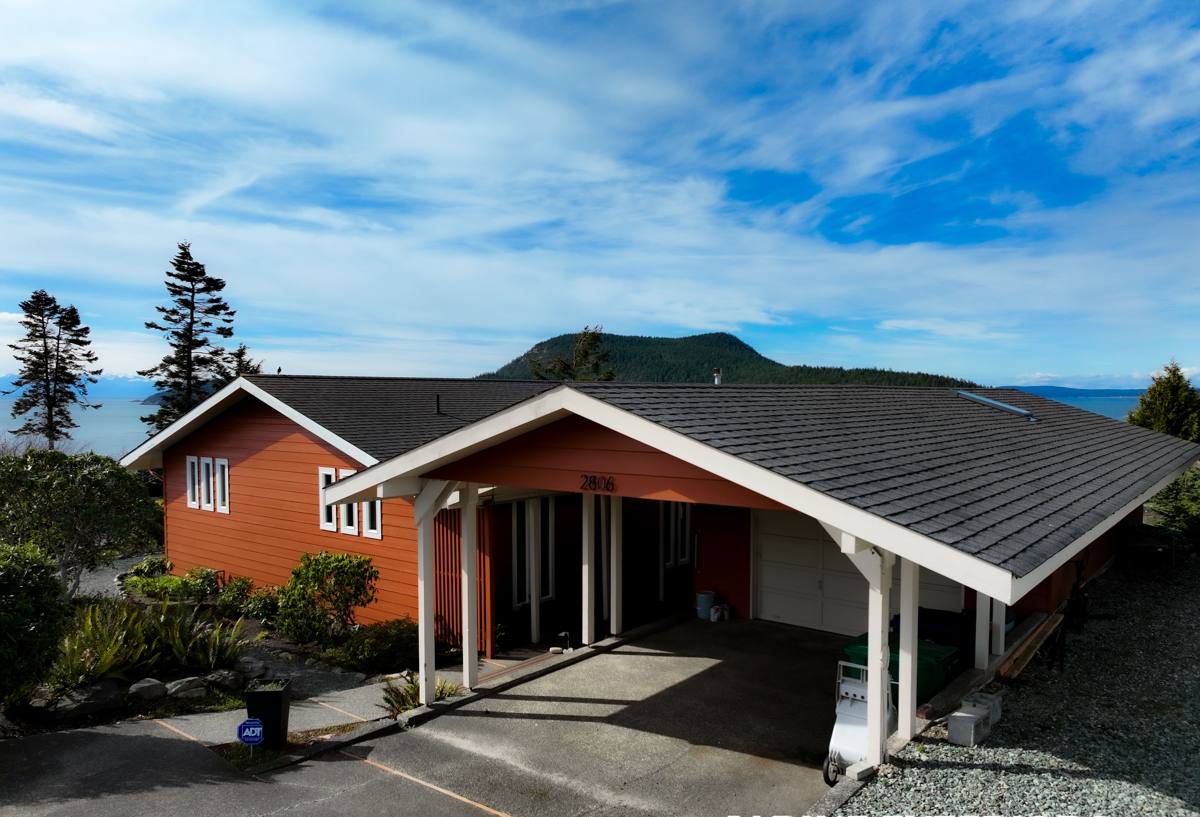
What Blaine's Climate Actually Does to a House
Salt Air and Metal Fatigue
Airborne salt accelerates corrosion on anything metal — fasteners, flashing, gutter hardware, and trim screws. On homes close to Semiahmoo Bay or Drayton Harbor, we routinely see corrosion on exterior metal components well before it would show up on a comparable house even a few miles inland. This is why fastener choice and flashing detail matter more here than the brand of siding itself.
Wind-Driven Rain
Storms coming off the Strait of Georgia and the Salish Sea don't just drop rain straight down — they push it horizontally into wall assemblies, around window and door openings, and up under poorly lapped siding. Any gap in the water-resistive barrier, any short flashing, any siding installed without the right clearances becomes an entry point. Once water gets behind the cladding, drying time in this climate is slow, which is exactly when rot and mold get their foothold.
Moss, Algae, and Extended Damp Seasons
Blaine's tree cover, shaded lots, and long wet season give moss and algae plenty of time to establish on roofs, siding, and deck boards — especially on north-facing walls and low-slope roof sections that never get direct sun. Moss holds moisture against the surface it's growing on, which shortens the life of roofing materials and can trap dampness against siding long after a storm has passed.
Siding in a Coastal, High-Moisture Environment
We install James Hardie fiber cement siding exclusively, and in a town like Blaine that's not a marketing preference — it's a practical one. Fiber cement doesn't rot, doesn't feed moss and algae growth the way wood does, and it holds up to repeated wet-dry cycling without the swelling, cupping, or seam failure that plagues wood-based and engineered-wood products in coastal climates.
We don't install LP SmartSide, cedar, primed spruce, vinyl, or other fiber cement brands like Cemplank or Allura. Each of those has a legitimate use case somewhere, but in a saltwater-adjacent, high-rainfall town like Blaine, the trade-offs stack up fast:
- Wood-based composite siding relies on factory sealing at cut edges and joints staying intact for decades — a single missed field-seal in this climate becomes a moisture entry point.
- Cedar and primed wood need ongoing refinishing and are more vulnerable to moss and algae staining in shaded, damp coastal settings.
- Vinyl siding can warp and fade under repeated temperature swings and doesn't offer the fire resistance or long-term rigidity of fiber cement.
- Other fiber cement brands are reasonable products, but we've standardized on Hardie's HZ5 formulation and factory ColorPlus finish for consistency of installation and warranty coverage across every job we do.
James Hardie's HZ5 product line is engineered specifically for climates with high moisture exposure and freeze-thaw cycling, which describes Whatcom County's coastline well. The ColorPlus factory finish is baked on under controlled conditions, which holds up better against salt air and UV than field-applied paint, and it comes with a long manufacturer warranty that transfers to a new owner if the home sells.
Roofing That Handles Wind, Rain, and Moss Together
A roof in Blaine has to do three jobs at once: shed wind-driven rain without backing up under shingles, resist the uplift from coastal wind gusts, and not turn into a moss farm within a few years of installation. We pay close attention to underlayment quality, ice-and-water shield at vulnerable transitions, proper flashing at every penetration, and ventilation that keeps the roof deck dry from the underside — because a roof that stays wet on both sides ages twice as fast.
Moss prevention starts at installation, not after the fact. Proper ventilation, tree-canopy awareness, and material choice all reduce how quickly moss takes hold, and we build that into the plan rather than treating it as a maintenance afterthought.
Windows: The Weak Point in Wind-Driven Rain
Windows are one of the most common places we find water intrusion on coastal Whatcom County homes, and it's almost never the window unit itself — it's the flashing and integration with the wall assembly around it. In a town where storms push rain horizontally into the wall, a window installed without correct head flashing, sill pans, and integration with the water-resistive barrier will eventually leak, regardless of how good the window itself is. We treat window installation and replacement as a whole-assembly job, not just a swap-the-unit job.
Decks in a Salt-Air, Shade-Heavy Environment
Decks in Blaine face the same combination of salt exposure and slow-drying shade that affects siding and roofing. Fasteners corrode faster near the water, boards that don't get afternoon sun stay damp longer, and moss on deck surfaces becomes both a maintenance issue and a safety issue underfoot. We factor board spacing, fastener grade, and structural ventilation underneath the deck into the build so it isn't fighting the climate from day one.
Cost Factors for Exterior Work in Blaine
| Factor | Why It Matters Here |
|---|---|
| Proximity to water | Homes closer to Semiahmoo Bay or Drayton Harbor see faster corrosion and need corrosion-resistant fasteners and flashing detail |
| Tree canopy and shade | Shaded, north-facing surfaces need moss-resistant materials and ventilation planning, which affects labor and product choice |
| Existing moisture damage | Coastal homes are more likely to have hidden rot behind siding or roofing that needs repair before new material goes on |
| Home age and construction type | Older homes may need updated water-resistive barriers and flashing details to meet current best practice |
| Wind exposure | Open, water-facing elevations may need upgraded fastening patterns for roofing and siding attachment |
Why a Local Crew Matters in Blaine
A contractor who mostly works inland can miss the details that matter on a coastal job — the right fastener spec for salt exposure, the flashing detail that actually stops wind-driven rain, the roof ventilation choice that keeps moss from coming back within a couple of years. We work across Whatcom County, including Blaine, Birch Bay, and the surrounding coastal areas, so the crew showing up at your house has actually dealt with this exact combination of salt air, storm exposure, and shade before — not as a one-off, but as routine work.
Local also means being reachable after the job is done. If a storm rolls through and you want something checked, or a warranty question comes up years down the road, you're calling a crew that's still working in the same county, not chasing down a company that only passed through once.
A Simple Pre-Storm-Season Checklist
- Walk the roofline and look for moss buildup, especially on north-facing and shaded sections
- Check visible flashing around chimneys, vents, and roof-to-wall transitions for gaps or lifted edges
- Look at siding seams and corners for cracking, gapping, or soft spots, particularly near ground level and under windows
- Inspect window trim and caulking for cracking or separation, which can let wind-driven rain behind the frame
- Check deck fasteners and board ends for corrosion or early rot, especially in shaded areas
- Clear gutters and downspouts before the heavy fall rains start, since backed-up water finds every weak point in siding and trim
What Working With Us Looks Like
We start with an honest look at what's actually happening on your home — not a sales pitch. That means identifying where moisture has already gotten in, where the current materials are struggling with the coastal climate, and what a straightforward, well-built fix looks like using James Hardie siding, a properly detailed roof system, correctly flashed windows, or a deck built to handle salt air and shade. No pressure, no upsell to products we don't stand behind.
If you're dealing with moss, a suspicious soft spot on your siding, a window that's been leaking during storms, or you're just planning ahead before the next wet season hits, we're happy to come take a look. Reach out for a free, no-pressure estimate — the form below gets you started.