 Bellingham Exterior
 Why Two Bids for the Same House Can Look So Different
Ask three contractors to quote the same Bellingham home and you'll often get three different numbers, sometimes further apart than homeowners expect. That's not necessarily a sign that someone is overcharging or underbidding — it usually means each contractor is pricing different assumptions about material, scope, and what they'll find once the old siding comes off. Understanding what actually drives the number lets you compare bids on the merits instead of just picking the lowest line item.
This page walks through the real cost factors in order of how much they typically move a project, so you know what to ask about before you sign anything.
Material Choice Is the Biggest Lever
More than anything else, the siding product you choose sets the range your project falls into. It's worth understanding what you're actually paying for with each option, not just the sticker price.
Vinyl
Vinyl is the cheapest material to buy and install, which is exactly why it's everywhere. The trade-off is durability and appearance over time — it can warp or fade in strong sun, it cracks in hard impacts, and Whatcom County's damp winters can push moisture behind panels if the water-resistive barrier and flashing details aren't done right. A low upfront number can mean a repeat expense down the road.
LP SmartSide
LP SmartSide is an engineered wood product — strand board with a resin-treated surface — and it costs less than fiber cement while looking closer to real wood than vinyl. The catch is that it's still wood at its core. Any breach in the factory coating, whether from a nail gun mistake, a woodpecker, or years of driving rain finding a seam, gives moisture a path into a material that swells and deteriorates when it gets wet. In a climate like ours, with a long wet season and moss growth on anything shaded and damp, that's a real ongoing risk we've decided isn't worth passing on to homeowners.
Fiber Cement (James Hardie)
Fiber cement costs more than vinyl and more than LP SmartSide, but it's cement, sand, and cellulose fiber — it doesn't rot, it doesn't feed pests, and it holds paint and factory finish far longer than wood-based products. It's also non-combustible, which matters increasingly for insurance underwriting. This is the only siding material we install, and we'll explain why in more detail below.
Cedar and Primed Wood
Real cedar and primed spruce siding sit at the high end of material cost, and they need the most ongoing maintenance of any option — repainting or restaining on a regular cycle, careful caulking, and vigilance about moisture intrusion. In a marine climate with salt air and long stretches of grey, wet weather, that maintenance burden is steep and unforgiving if it slips.
Home Size, Shape, and Number of Stories
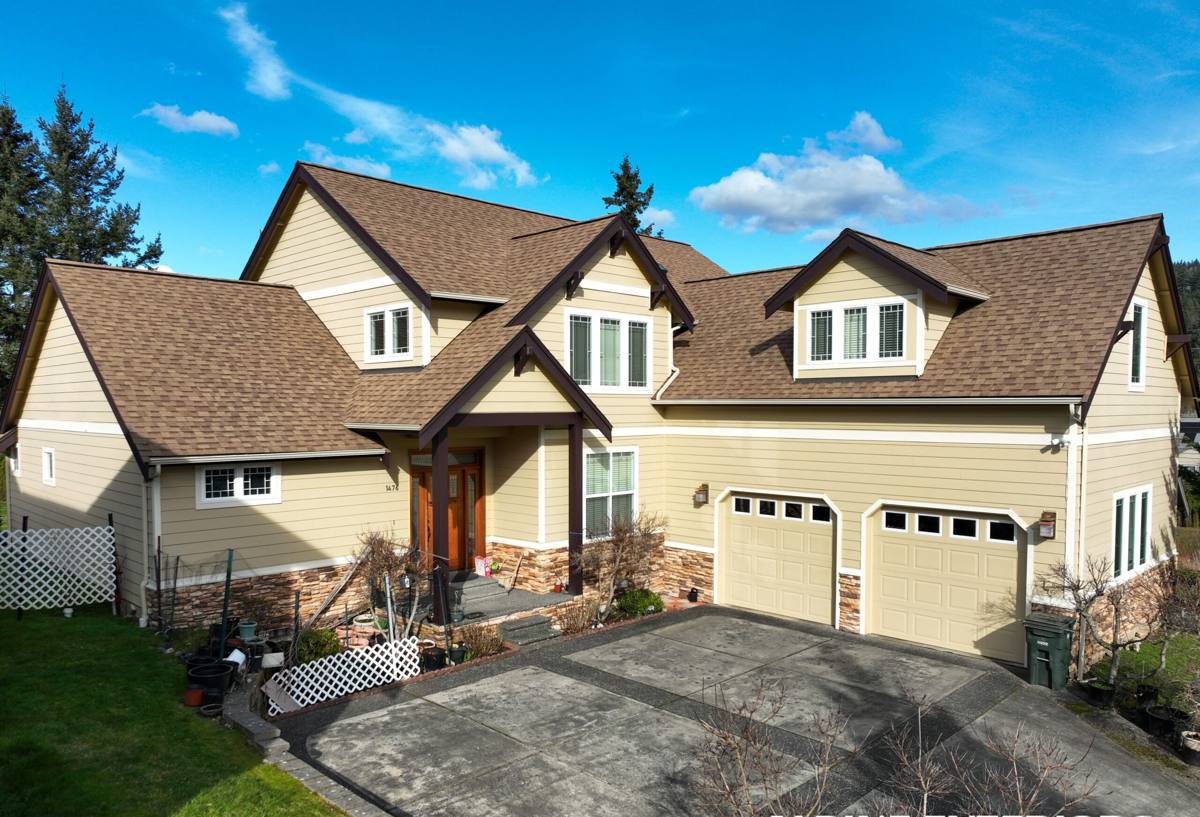
Square footage of exterior wall area is the base multiplier for any siding job — more wall, more material and more labor hours, in a roughly linear way. But shape matters as much as size. A simple rectangular ranch home is far cheaper to side than a house with the same square footage broken up by dormers, bump-outs, multiple gables, and varied roof lines, because every inside corner, outside corner, and transition takes extra cutting, fitting, and flashing time.
Story height adds cost too. Second- and third-story work requires scaffolding or lift equipment, slower and more careful material handling, and more time per square foot than ground-level walls. A two-story Bellingham home with a complex roofline can cost meaningfully more per square foot than a single-story home of the same total size.
What's Underneath: Tear-Off, Sheathing, and Moisture Damage
This is the factor that causes the most bid surprises, because it's the one nobody can fully quote until the old siding is off the wall. Once a crew strips the exterior, they're looking at the sheathing, the house wrap or building paper, and the framing behind it. In a region with as much annual rainfall as Whatcom County gets, older homes — especially those with wood siding, poorly flashed windows, or gaps around penetrations — often have hidden water damage that only becomes visible at tear-off.
Rotted sheathing has to be replaced. Damaged framing has to be sistered or repaired. A compromised weather-resistive barrier has to be redone properly before new siding goes on, because installing new siding over a bad moisture plane just locks the problem behind a fresh wall. A contractor who quotes a single flat number with no allowance for this is either assuming the house is in great shape or not being upfront about what happens if it isn't.
- Ask whether the quote includes a contingency line or unit price for sheathing/framing repair
- Ask how the contractor documents and communicates what they find at tear-off
- Ask whether they inspect and address the water-resistive barrier as part of the scope, not as an afterthought
Trim, Accessories, and Detail Work
Siding is rarely just flat panels. Corner boards, window and door trim, fascia and soffit work, frieze boards, and transition flashing all add labor and material cost, and they're also where water intrusion problems most often start if done poorly. Homes with a lot of architectural detail — multiple trim profiles, decorative banding, varied siding textures on different elevations — cost more not because the flat wall area is expensive but because the detail work around it is time-consuming to do correctly.
This is also where cutting corners shows up fastest. Trim and flashing details that look fine on installation day are exactly what fails first when driving rain and wind — which this area gets plenty of in fall and winter — starts testing every seam.
Labor, Crew Experience, and Installation Quality
Fiber cement in particular is installation-sensitive: it requires correct fastener spacing and type, proper joint treatment, minimum clearances from grade and roofing, and specific handling to avoid cracking during cutting and installation. A crew experienced with James Hardie's installation requirements will price and execute the job differently than a crew treating it like any other siding material. That experience isn't free, but it's the difference between a system that performs for decades and one that has problems within a few years, regardless of how good the underlying material is.
Labor cost also reflects crew size, project timeline, and whether the company carries proper insurance and manufacturer certification — all things that affect price and are worth confirming rather than assuming.
Bellingham and Whatcom County Climate Factors
Local climate doesn't just affect which material makes sense — it affects installation practices and project cost too. A few things specific to this area:
- Salt air: Homes closer to the water deal with airborne salt that accelerates corrosion on fasteners, flashing, and hardware, which pushes toward corrosion-resistant materials in those details.
- Driving rain: Wind-driven rain off the Sound and Bay tests every seam and flashing detail more aggressively than a calm, dry climate would, which is part of why proper installation matters more here than in drier regions.
- Long moss season: Extended damp, shaded conditions common in this region encourage moss and algae growth on north-facing and shaded walls, which affects how a finish holds up and how often a surface needs cleaning.
- Older housing stock: Whatcom County has plenty of homes from eras before modern moisture-barrier standards, which raises the odds of tear-off surprises discussed above.
Typical Cost Factors at a Glance
| Factor | Low Impact Scenario | High Impact Scenario |
|---|---|---|
| Material | Vinyl, minimal trim | Fiber cement or cedar with detailed trim package |
| Home shape | Simple rectangular footprint | Multiple gables, dormers, bump-outs |
| Story height | Single story | Two or three stories, steep site access |
| Substrate condition | Sound sheathing, intact barrier | Rot or moisture damage found at tear-off |
| Trim and detail | Minimal trim, few penetrations | Extensive trim, many windows/vents/fixtures |
| Site access | Flat lot, easy staging | Steep or tight lot requiring extra equipment |
Getting an Accurate Quote
The best way to protect yourself from surprise costs isn't finding the lowest bid — it's finding the contractor whose bid actually reflects the real condition and complexity of your house. A short checklist for comparing quotes:
- Confirm the material and specific product line named in the quote, not just "fiber cement" or "siding" generically
- Ask how tear-off findings (rot, damaged sheathing) are priced and communicated
- Make sure trim, flashing, and detail work are itemized, not buried in a lump sum
- Ask about fastener type and installation method, especially for fiber cement
- Check manufacturer certification or documented installation training for the crew
- Get the warranty terms in writing — both material and labor/workmanship
We install James Hardie fiber cement exclusively because, weighed against vinyl, LP SmartSide, and cedar, it holds up to this region's rain, salt air, and moss season with the least ongoing maintenance and the strongest track record when installed to spec. It isn't the cheapest material on the market, but for a house that has to survive Bellingham winters for decades, we think it's the one worth putting our name behind.
If you'd like a clear, honest look at what your specific home would involve — material, condition, and detail work — we're happy to walk the property and put together a straightforward, no-pressure estimate.