 Bellingham Exterior
 Two Boards, One Decision
Homeowners doing their research on siding almost always end up comparing the same two categories: fiber cement and engineered wood (sold under brand names like LP SmartSide). Both are marketed as upgrades over vinyl. Both come pre-primed or factory-finished. Both claim to hold paint better than old-growth cedar ever did. On paper, they can look like interchangeable choices separated mostly by price.
They are not interchangeable. The two materials are built from fundamentally different raw ingredients, and that difference shows up exactly where it matters most in Bellingham — at the seams, the butt joints, and the bottom edges where water sits during our nine-month wet season. We install fiber cement exclusively, specifically James Hardie's product lines, and we think homeowners deserve the real explanation for why, not a sales pitch.
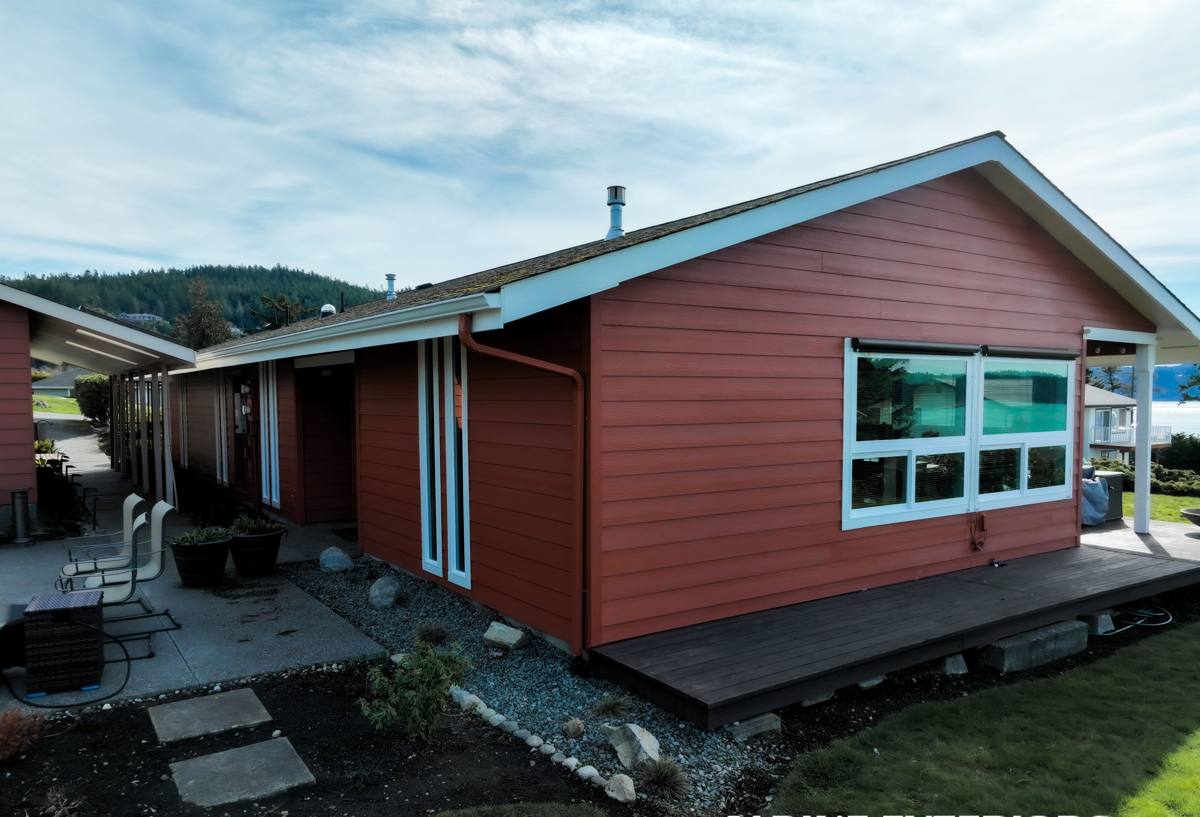
What's Actually in Each Product
Fiber Cement
Fiber cement siding is made from Portland cement, sand, and cellulose fiber, cured under pressure and heat. There's no wood pulp acting as the structural backbone — the cellulose is there for reinforcement, not as the primary material. The result is a board that's dimensionally stable across wet and dry cycles and doesn't have organic wood sugars for moisture or fungus to feed on.
Engineered Wood
Engineered wood siding is built from wood strands or wafers bonded with resin under heat and pressure, similar in concept to OSB sheathing but manufactured to a siding profile and coated with a treated overlay. It's still fundamentally a wood product. That means it expands and contracts with moisture more than fiber cement does, and if the factory coating or field-applied sealant at a cut edge ever fails, the substrate underneath is wood — with everything that implies about what happens when wood gets wet and stays wet.
Bellingham's Climate Is the Real Test
Material data sheets get written in a lab. Siding gets tested on your house, in our climate, for twenty-plus years. Whatcom County isn't a mild, dry environment — it's salt air off Bellingham Bay, driving rain that comes in sideways off the Strait through fall and winter, and a moss season that runs long on north-facing walls and anything shaded by fir and cedar canopy. That combination punishes any siding material that depends on an intact factory coating to keep water out of an absorbent substrate.
Salt air accelerates corrosion on fasteners and hardware and speeds up the breakdown of lesser paint films. Constant damp keeps moss and algae established on siding faces for months at a stretch, which means more scrubbing, more pressure washing, and more chances to damage a coating that was never designed to be pressure washed repeatedly. None of that is unique to one brand of engineered wood — it's a climate reality that any organic-substrate siding has to survive, year after year, in a place that rarely gives a wall enough dry time to fully recover between storms.
Moisture Behavior and Edge Sealing
This is where the two materials diverge most in real-world performance. Fiber cement doesn't swell, rot, or delaminate when it gets wet — it can hold moisture at a cut edge or a poorly flashed joint without the board itself breaking down. It's forgiving of the occasional installation imperfection in a way that matters over a 30-year timeline.
Engineered wood siding relies on factory-applied resin coatings and, critically, on every field-cut edge being properly sealed during installation — every board end at a butt joint, every cut around a window or vent. Manufacturers are explicit about this requirement because it's the single biggest driver of warranty claims: an unsealed or under-sealed cut edge lets moisture into the wood substrate, and once that starts, swelling and softening follow. In a climate with as many wet months as ours, that installation step isn't optional maintenance — it's the difference between a wall system that lasts and one that doesn't.
Fire Resistance
Fiber cement is non-combustible. It won't ignite, and it doesn't contribute fuel to a fire moving across a structure's exterior — a genuine advantage as wildfire smoke and regional fire risk become a bigger part of Pacific Northwest summers, even here on the wetter west side of the Cascades.
Engineered wood, being a wood-based product, carries a combustibility rating typical of treated wood building materials. Manufacturers have improved this over the years with treated cores and coatings, but it doesn't change the basic physics of what the board is made from. For homeowners weighing fire risk alongside everything else, this is a straightforward, non-controversial difference between the two materials.
Finish, Fading, and Long-Term Maintenance
James Hardie's ColorPlus finish is baked on in a factory environment with multiple coats and a UV-cured topcoat, engineered specifically to resist the fading and chalking that field-applied paint suffers under years of sun and salt air. Touch-up paint is formulated to match, and most ColorPlus lines carry a 15-year finish warranty separate from the product warranty itself.
Engineered wood is typically factory-primed rather than factory-finished, which means the homeowner or contractor still applies the topcoat in the field. Field-applied paint is more exposed to application variables — weather during the paint job, coverage consistency, coat thickness — than a factory finish cured under controlled conditions. Repainting cycles tend to come sooner, and every repaint is another chance for a missed spot at a seam or fastener head to go unnoticed until it's already let moisture in.
Installation Sensitivity — Where Failures Actually Start
Almost every siding failure we've been called to evaluate over the years traces back to installation, not the base material choice alone. But the two materials have very different tolerance for installation error, and that's worth being honest about.
Fiber cement installed to manufacturer spec — correct fastener pattern, proper clearance at grade and roof lines, weather-resistant barrier, flashing at every penetration — is a forgiving, long-lived system even if a detail here or there isn't textbook perfect. Engineered wood has a narrower margin for error specifically around edge sealing and moisture management, which raises the stakes on getting every cut, joint, and fastener right the first time, on every wall, in a climate that doesn't offer much of a dry season to catch a missed step before it becomes a problem.
- Ask any siding contractor for their fastening and clearance specs in writing, not just verbally
- Ask who seals cut edges and joints, and how — this is the single biggest factor in long-term performance for wood-based siding
- Ask what moisture barrier and flashing details are used at windows, doors, and roof-to-wall intersections
- Ask what the manufacturer's warranty actually requires for installation compliance — many warranties are voided by common shortcuts
- Ask to see the manufacturer's installation guide the crew is actually following on your project
Warranty and Cost Over the Life of the Siding
Sticker price on the board itself is only part of the cost picture. What matters more is what the siding costs you over 20-30 years in maintenance, repainting, and the likelihood of a warranty claim actually being honored.
| Factor | James Hardie Fiber Cement | Engineered Wood |
|---|---|---|
| Substrate | Cement, sand, cellulose fiber | Resin-bonded wood strands |
| Finish | Factory ColorPlus, UV-cured | Factory primer, field-painted |
| Typical product warranty | 30-year limited, transferable | Commonly 5-year workmanship + longer limited product terms |
| Fire rating | Non-combustible | Combustible, treated core |
| Edge sealing requirement | Recommended, not warranty-critical | Mandatory for warranty validity |
| Repaint cycle | Longer, thanks to factory finish | Shorter, field-applied coating |
Upfront material and labor costs for the two products are often closer than people expect. The real cost gap shows up later, in repainting labor, edge maintenance, and how a warranty claim actually plays out if something goes wrong at year eight or year fifteen.
Why We Install Only James Hardie
We're not going to pretend engineered wood is a bad product across the board — it has legitimate uses and a real place in the market. But as a contractor putting our name behind every job, we made a call: we only install products we're comfortable standing behind for the full life of the siding, in the specific climate we work in. Salt air, driving rain off the Strait, and a moss season that doesn't quit make Whatcom County a demanding environment for any exterior material, and fiber cement's non-organic substrate, factory finish, and non-combustible construction line up with what actually holds up here.
James Hardie also gives us a full climate-engineered product lineup — HardiePlank lap siding, HardiePanel, HardieShingle, and trim — built specifically for regions like ours, backed by a warranty that transfers to a new owner if you sell. That combination of proven material behavior and a warranty structure that doesn't hinge on every field seam being sealed perfectly is why it's the only siding system we put on homes.
If you're weighing a siding replacement and want a straight answer about what's right for your house, we're happy to come take a look. Reach out for a free, no-pressure estimate — we'll walk your home's specific exposure and give you an honest read, no obligation.