 Bellingham Exterior
 Full Siding Replacement for Lynden Homes
Siding replacement is a different job than a patch repair or a partial re-side, and it's worth treating it that way. When a Lynden home's siding has reached the point where patching individual boards no longer makes sense — widespread moisture damage, a material that's failing across the whole house rather than in one spot, or an owner who wants to stop maintaining paint or caulk every couple of years — a full tear-off and replacement is the point where the whole exterior wall system gets rebuilt correctly, not just re-covered. We're based in Bellingham, and Lynden is a regular part of our service area, close enough that we're not treating it as an out-of-town trip with a markup attached.
This page is specifically about full siding replacement for Lynden properties: what the local climate demands of a replacement job, what correct tear-off and installation actually involves, and how the project runs from first look to final walkthrough. We install James Hardie fiber cement exclusively, and on a replacement project — where the whole wall assembly is exposed and being rebuilt — that material decision matters more than it does on almost any other kind of siding work.
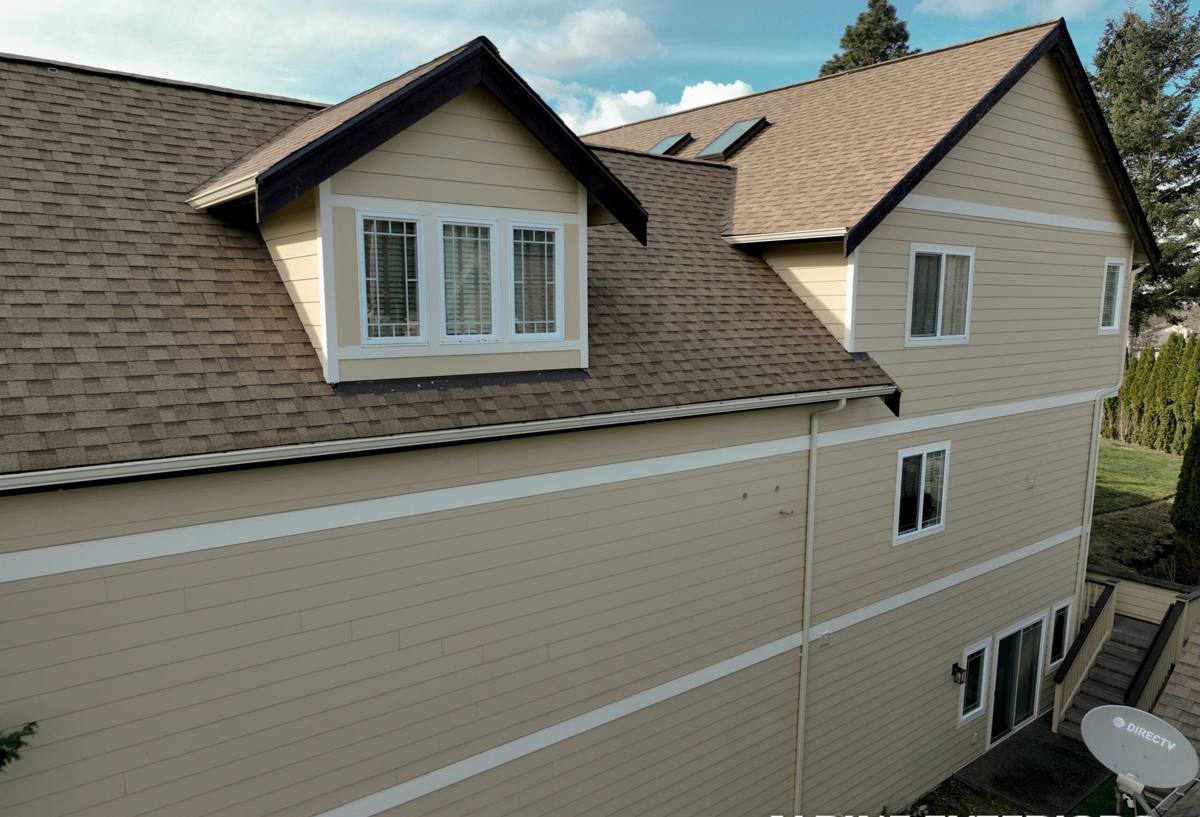
Why Full Replacement Is Sometimes the Right Call in Lynden
Not every siding problem needs a full replacement, and we'll say so plainly during an inspection if a repair is the more honest answer. But replacement is the right call more often in this part of Whatcom County than homeowners moving from a drier climate might expect, for a few specific reasons tied to how Lynden's weather works on a house over time.
Salt Air Works Slowly, Then All at Once
Lynden isn't on the immediate coastline, but it still sits within reach of the marine air that moves across this part of the county. Salt-laden air corrodes fasteners, flashing, and lower-grade trim hardware gradually, and the failure often isn't visible until it's widespread — rust staining showing up at multiple points across a wall, or fastener heads that have lost their grip, tends to appear on a whole elevation around the same time rather than one board at a time. When that's the pattern, patching individual failure points just delays a job that's going to need doing across the whole wall anyway.
Driving Rain Finds the Weak Point, Then Spreads
Rain in this region comes in sideways as often as it comes straight down, and once it finds a gap — a failed caulk joint, a warped panel edge, a poorly lapped seam — it doesn't stay contained to that one spot. Water tracks behind siding and along sheathing, so damage discovered at one point on a wall is frequently a sign of moisture that's already traveled further than it looks from the outside. That's one of the more common reasons a homeowner calls about a small repair and the inspection turns up a case for full replacement instead.
A Long Moss Season Ages Every Material Differently
Mild temperatures and consistent moisture give moss and mildew a long season on shaded, tree-sheltered walls, which are common on Lynden's mix of farmland and residential lots. Different siding materials age very differently under that pressure — some hold moisture against the substrate and become a growth surface, others shed it. On a full replacement, that's the moment to correct a material mismatch permanently instead of fighting the same moss problem on the same material for another decade.
What Correct Siding Replacement Actually Involves
A siding replacement is only as good as the parts nobody sees once the new siding is up. The visible finish is the last five percent of the job; the sequence underneath it is what determines whether that finish lasts twenty-five years or five.
Full Tear-Off, Not Overlay
Replacement means the old siding comes off entirely — we don't install new siding over old. Overlaying hides whatever condition the wall is already in, and on a home old enough to need full replacement, that's exactly the condition worth seeing before covering it back up.
Sheathing Inspection
With the old siding off, the sheathing underneath gets checked for rot, soft spots, and any sign that moisture has already been working on the wall from behind. This is the step that a rushed or overlay-based approach skips entirely, and it's usually the most important thirty minutes of the whole project — problems found here get fixed now, at a known cost, instead of surfacing again in a few years hidden behind brand-new siding.
Weather-Resistive Barrier and Flashing
The house wrap and flashing details around every window, door, and wall penetration get installed or replaced at this stage, since most siding failures in this climate trace back to water getting behind the cladding rather than through the cladding material itself. This layer is invisible once the job is done, which is exactly why it deserves the most attention while it's exposed.
Installation to Manufacturer Specification
James Hardie's warranty is conditioned on installation following their published specs — correct fastener type, spacing, and depth; proper clearances above grade, roofline, and other transitions; and correct field-cutting and caulking practices. We treat that specification as the baseline for every replacement job, not as a premium add-on.
Final Walkthrough
We walk the completed job with the homeowner, confirm it matches what was scoped and estimated, and go over basic care expectations for the new siding before calling the project finished.
Signs a Lynden Home Is Ready for Replacement Rather Than Repair
- Moisture damage, soft spots, or rot showing up in more than one area of the exterior wall
- Siding material that's failing systemically — warping, cracking, or losing paint adhesion across whole elevations, not isolated boards
- Moss or staining that returns within weeks of cleaning, especially on shaded or north-facing walls
- Rust staining at multiple fastener points, suggesting hardware corrosion across the wall rather than a single bad spot
- A home approaching or past 20-25 years on its original siding with no documented replacement
- An owner tired of an ongoing paint, caulk, or moisture-maintenance cycle that a different material wouldn't require
- Visible gaps, buckling, or panel separation after wind events
If an inspection turns up isolated damage rather than a systemic pattern, we'll say so — a full replacement isn't the right recommendation for every siding problem, and we'd rather give an honest assessment than sell a bigger job than the house needs.
Why James Hardie for a Full Replacement
On a repair, the material question is somewhat constrained by what's already on the wall. On a full replacement, it's a clean decision, which is why we treat replacement projects as the clearest case for installing James Hardie fiber cement rather than the alternatives.
- Non-combustible core: Fiber cement doesn't feed a fire the way wood-based siding products can, which is a real factor for both household safety and insurance underwriting.
- Factory-applied ColorPlus finish: The color is baked on in a controlled factory process rather than field-applied, holding adhesion and color far longer under sustained coastal moisture and UV exposure than a site-painted finish.
- Climate-engineered HZ product lines: Hardie's HZ5 formulation is built for regions with substantial moisture exposure and freeze-thaw cycling, which describes Lynden and the rest of Whatcom County well.
- Dimensional stability: Fiber cement doesn't swell, cup, or warp through repeated wetting cycles the way engineered wood siding can over a wet season.
- A strong transferable warranty: Hardie backs the product with one of the more robust warranty structures in the industry, provided installation follows their published spec — which is exactly what a full replacement lets us guarantee from the first fastener.
We don't install LP SmartSide, vinyl siding, Cemplank, Allura, primed spruce, or cedar. Each has a place in the broader market, and plenty of homeowners are satisfied with them elsewhere. Our position is a professional one specific to this climate: on a full replacement, where we're setting the material for the next several decades of the home's life, we'd rather install one system we fully stand behind than offer a lower-cost option that quietly shifts maintenance risk back onto the homeowner.
How the Alternatives Compare on a Replacement Project
| Product | Trade-off worth knowing before a full replacement |
|---|---|
| Vinyl siding | Lower upfront cost, but seams and panel gaps give wind-driven rain an entry point, and panels can warp under sustained UV and temperature swings |
| LP SmartSide / engineered wood | Wood-strand core is more moisture-sensitive at cut edges and fastener points than fiber cement, a real concern on a wall that will see decades of coastal rain |
| Primed spruce or cedar | Needs an ongoing paint and moisture-maintenance cycle to avoid rot — a heavier long-term ownership cost than the upfront material price suggests |
| Other fiber cement brands | May not offer the same climate-specific HZ formulation or factory-finish warranty depth as James Hardie |
What Drives the Cost of a Full Replacement
| Factor | Why It Matters |
|---|---|
| Total square footage and number of stories | More wall area and higher access needs both add labor time |
| Trim and detail complexity | Windows, corners, and roofline transitions each add cutting, fitting, and flashing work |
| Sheathing condition once old siding is off | Rot or moisture damage found underneath needs repair before new siding goes up |
| James Hardie product line and color | Lap siding, panel systems, and trim boards carry different material costs |
| Site access and existing conditions | Multi-story walls, tight lot lines, or extensive landscaping near the house can affect setup and staging |
We walk the property and give a real number based on those specifics rather than a flat per-square-foot estimate that doesn't account for what your particular house actually needs.
Why a Crew Based in Bellingham, Working Lynden Regularly, Matters
Being based in Bellingham means Lynden is a normal part of our territory, not a special trip. We're working across this stretch of Whatcom County through every season, which means we see how salt air, wind-driven rain, and moss actually behave on real walls over a full year rather than how a product performs on a spec sheet. That shapes practical decisions on a replacement project — which wall orientations on a Lynden lot stay wet longest, where extra flashing attention pays off, and which install-day details are worth the extra time so a homeowner isn't dealing with a callback two winters later. It also means if a warranty question or maintenance question comes up years down the line, it's a call to a crew still working in the same county, not one that's moved on.
If your Lynden home's siding is showing the kind of widespread wear that points toward full replacement rather than repair, we're glad to come take a look and walk you through what we find. Reach out using the form below for a free, no-pressure estimate.