 Bellingham Exterior
 Building Decks for Sudden Valley's Particular Conditions
Sudden Valley sits in a different microclimate than a lot closer to downtown Bellingham. Between the tree cover, the proximity to Lake Whatcom, and the moisture that settles into low-lying, shaded yards, a deck out here takes on punishment that a more exposed, sun-drenched property never sees. Add in the driving rain and salt-tinged air that moves through Whatcom County off the Sound, and you've got a combination that ages an improperly built deck fast — cupped boards, black streaks, soft spots around posts, and a slick, moss-covered surface within a couple of wet seasons.
We've built and repaired decks throughout this neighborhood long enough to know that a deck designed for a dry, open lot in another part of the state simply doesn't hold up the same way here. This page covers what actually matters for a Sudden Valley deck: material choices, framing details, drainage, and the maintenance reality homeowners should expect, so you can make an informed decision instead of guessing.
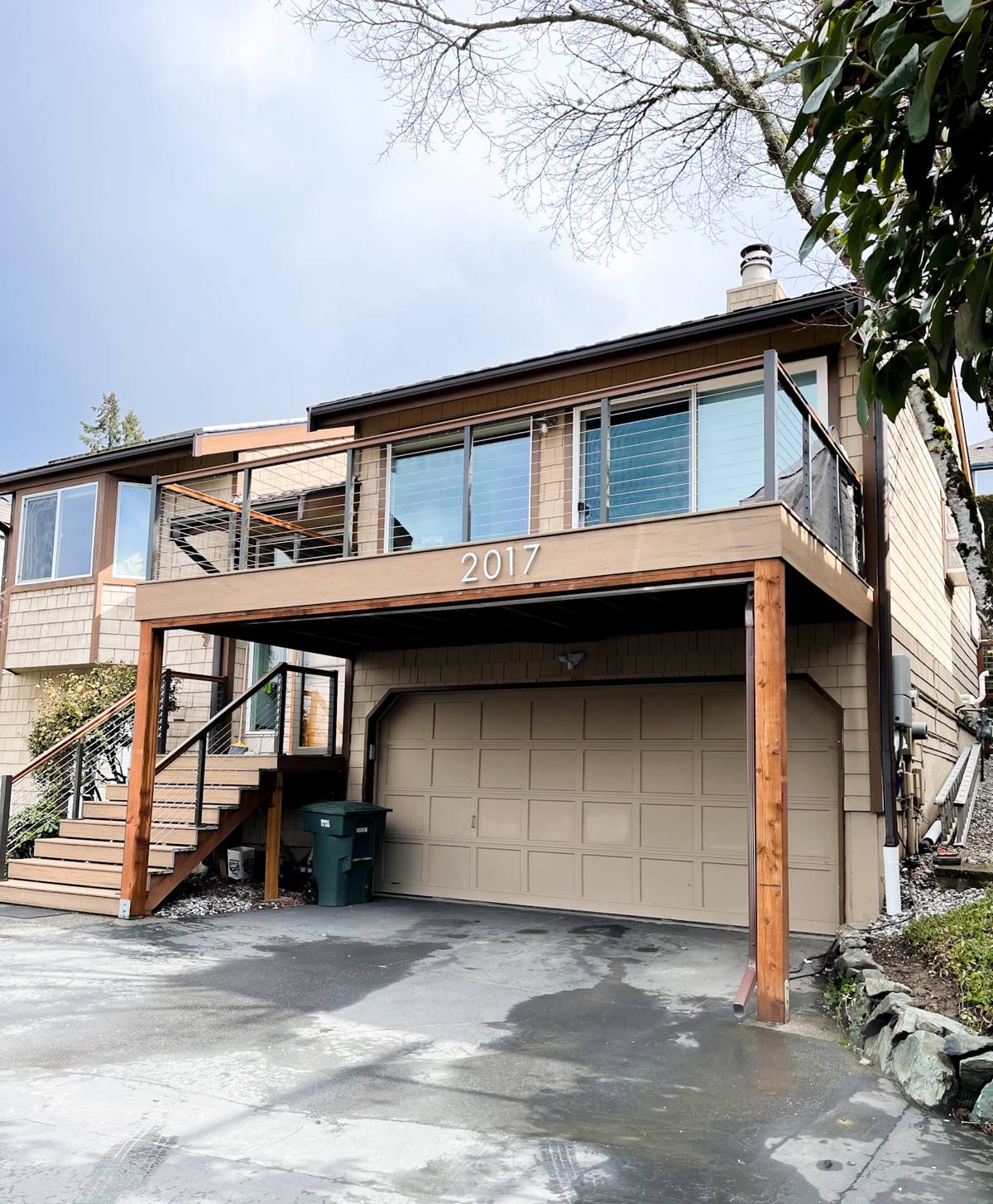
What the Local Climate Actually Does to a Deck
Three things drive nearly every deck problem we see in this area:
- Shade and moisture retention. Mature tree canopy common around Sudden Valley keeps decks damp longer after rain than an open lot would. Wood and even some composites stay wet for days rather than hours, which is exactly the condition moss and algae need to take hold.
- Driving rain and wind-blown moisture. Storms coming through the county don't just fall straight down — wind pushes rain sideways into ledger boards, under railings, and into any gap that wasn't properly flashed or sealed at construction.
- Salt-influenced air. Coastal air moving through the region accelerates corrosion on exposed fasteners, hinges, and hardware that isn't rated for it. Over years, this is what causes rust streaks and loosened connections on decks built with standard hardware.
None of these factors are dealbreakers. They just mean the deck has to be designed and built with them in mind from day one, rather than treated as an afterthought.
The Moss Problem Specifically
Long moss season is one of the most common complaints we hear from homeowners in shaded, tree-lined neighborhoods like this one. Moss isn't just cosmetic — it holds moisture against the decking surface, and on wood it can accelerate rot underneath the growth where you can't see it. On composite decking, moss buildup in the grain pattern can also become a slip hazard on stairs and ramps. Board selection, gap spacing, and airflow underneath the deck all affect how much moss you'll deal with and how easy it is to clean off.
Choosing the Right Decking Material for This Environment
There's no single "best" decking material — the right choice depends on budget, how much upkeep you want to do, and how much shade your specific lot gets. Here's how the common options actually perform under Sudden Valley-type conditions:
| Material | Moisture / Moss Performance | Maintenance | Typical Lifespan |
|---|---|---|---|
| Pressure-treated wood | Absorbs moisture readily; needs sealing to resist moss and rot | Annual cleaning and re-sealing recommended | 10-15 years with upkeep |
| Cedar | Naturally rot-resistant but still needs care in shaded, damp spots | Periodic staining/sealing | 15-20 years with upkeep |
| Capped composite | Resists moisture absorption well; still needs surface cleaning where moss can grow on the film | Occasional washing, no sealing | 25-30 years |
| PVC decking | Doesn't absorb water at all; easiest to keep moss-free | Occasional washing | 25-30+ years |
In consistently shaded, tree-covered yards, we usually steer homeowners away from untreated or minimally treated wood unless they're genuinely committed to yearly maintenance. Composite and PVC cost more upfront but hold up far better where a deck rarely gets direct sun to dry it out.
Structural Details That Matter More Here Than Elsewhere
Framing and Fasteners
Standard hot-dipped galvanized hardware is the minimum we'll use anywhere near this kind of coastal-influenced air; on decks with more direct exposure, we'll spec stainless steel fasteners and connectors instead. Cutting corners on hardware is one of the most common reasons we get called out to repair a deck that's only five or six years old — the wood is often fine, but the connectors have corroded and loosened.
Ledger Board Flashing
Where the deck attaches to the house is the single most important waterproofing detail on the entire structure. A ledger board without proper flashing and a moisture barrier behind it will let water track directly into the house's rim joist — a problem that's slow to show itself and expensive to fix once it does. Given how much driving rain this area gets, we treat ledger flashing as non-negotiable, not an upgrade.
Footings on Sloped and Wooded Lots
Many Sudden Valley properties have grade changes, root systems, and drainage patterns that a flat suburban lot doesn't. Footings need to be sized and placed based on actual soil conditions at your site, not a generic spec sheet. We dig, inspect, and pour footings appropriate to what's actually under the lot — not what's convenient.
Board Spacing and Airflow
Correct gapping between boards, along with adequate clearance and ventilation underneath the deck, lets moisture evaporate instead of sitting. On a shaded lot, this detail is the difference between a deck that dries out in a day and one that stays damp — and mossy — for a week after every storm.
What a Correctly Built Deck Includes
- Engineered footings sized to the actual soil and slope conditions on site
- Properly flashed ledger connection with a moisture barrier behind it
- Corrosion-appropriate fasteners and structural hardware throughout
- Board spacing and substructure ventilation that accounts for shade and slow drying
- Railing and stair connections built to current code, not just "good enough"
- A finish or capped material matched to how much direct sun the specific area of the yard gets
Skipping any one of these items rarely causes an immediate, visible failure — that's exactly why it's so often skipped by crews trying to hit a lower price. The problems show up two, five, or ten years later, usually as a structural or moisture issue instead of a cosmetic one.
How Our Process Works
- On-site assessment. We look at the specific spot on your property — sun exposure, slope, drainage, tree cover — before recommending a material or layout.
- Design and material selection. We walk through the tradeoffs in plain terms: what costs more upfront, what costs more in upkeep, and what actually fits how you'll use the space.
- Permitting. We handle the permit process with the applicable jurisdiction so the structure is inspected and approved, not built off the books.
- Framing and structural work. Footings, ledger flashing, framing, and hardware are installed to the standards outlined above — this is the stage that determines how the deck ages, even though it's the least visible part of the job.
- Decking, railing, and finish work. Surface material goes down last, along with railings, stairs, and any finish or sealant the material requires.
- Final walkthrough. We go over care and maintenance specific to the material you chose and the conditions your yard sees, so there are no surprises the first wet winter.
Maintenance Expectations for This Environment
No deck in a shaded, damp part of Whatcom County is fully "maintenance-free," regardless of what material you choose — but the workload varies a lot:
- Wood decks generally need a yearly inspection, cleaning, and re-sealing to keep moss and rot at bay
- Composite and PVC decks mainly need periodic washing to keep organic growth from building up in shaded corners and under furniture
- Gutters and downspouts near the deck should be checked seasonally so runoff isn't dumping extra water onto the structure
- Fasteners and hardware are worth a visual check every year or two, especially on older decks built before stainless hardware was standard practice
We're upfront about this during the design conversation — if low maintenance matters more to you than upfront cost, that should drive the material decision from the start, not become a regret two winters in.
Why Hiring a Crew That Already Works This Area Matters
A contractor who mostly builds decks in drier, sunnier parts of the state may not default to the flashing details, hardware grade, or ventilation spacing that a shaded, moisture-heavy Sudden Valley lot actually needs. It's not that the techniques are exotic — it's that skipping them doesn't cause a problem on a dry lot the way it does here. We build and repair decks across Bellingham and the surrounding Whatcom County communities regularly enough that these details are standard practice for us, not an upsell.
That local familiarity also shows up in smaller ways: knowing how a particular slope tends to drain after a heavy rain, understanding which tree cover patterns lead to the worst moss buildup, and having a realistic sense of how a given material will actually look and perform five years in — not just on install day.
Typical Cost Factors
| Factor | Why It Affects Price |
|---|---|
| Decking material | Pressure-treated wood costs less upfront; composite and PVC cost more but reduce long-term maintenance |
| Site conditions | Sloped, wooded, or hard-to-access lots require more site work and larger or deeper footings |
| Size and layout | Multi-level decks, built-in seating, and custom railing add labor and material cost |
| Hardware grade | Stainless steel fasteners cost more than standard galvanized but last significantly longer in this climate |
| Permitting requirements | Deck height, attachment to the house, and railing code requirements can affect scope |
We'd rather walk your specific property and give you real numbers than throw out a broad estimate that doesn't reflect your lot, your slope, or the material you actually want.
If you're planning a new deck or need to replace one that's showing its age, we're happy to come take a look and talk through what makes sense for your property. Use the form below to request a free, no-pressure estimate.