 Bellingham Exterior
 Windows Built for Silver Beach's Bay-Side Climate
Silver Beach sits close enough to Bellingham Bay that its homes deal with a slightly different set of pressures than houses further inland in Whatcom County. Salt-laden air off the water accelerates corrosion on hardware and fasteners that would otherwise last decades. Driving rain off the Sound finds its way into any gap in flashing or sealant. And the long, wet moss season that defines a Pacific Northwest fall through spring keeps humidity pressed up against every window frame for months at a time. None of this is dramatic on its own, but stacked together year after year, it's exactly the kind of slow, cumulative exposure that ages out older windows faster than homeowners expect.
When we talk about "energy-efficient windows" in Silver Beach, we're not just talking about a U-factor rating on a spec sheet. We're talking about a window and installation package that can shrug off wind-driven moisture, resist the salt-air corrosion that eats cheap hardware, and still keep heating bills down through a Bellingham winter. That's a narrower target than a generic efficiency upgrade, and it's why we approach this job differently in a neighborhood like Silver Beach than we would somewhere more sheltered.
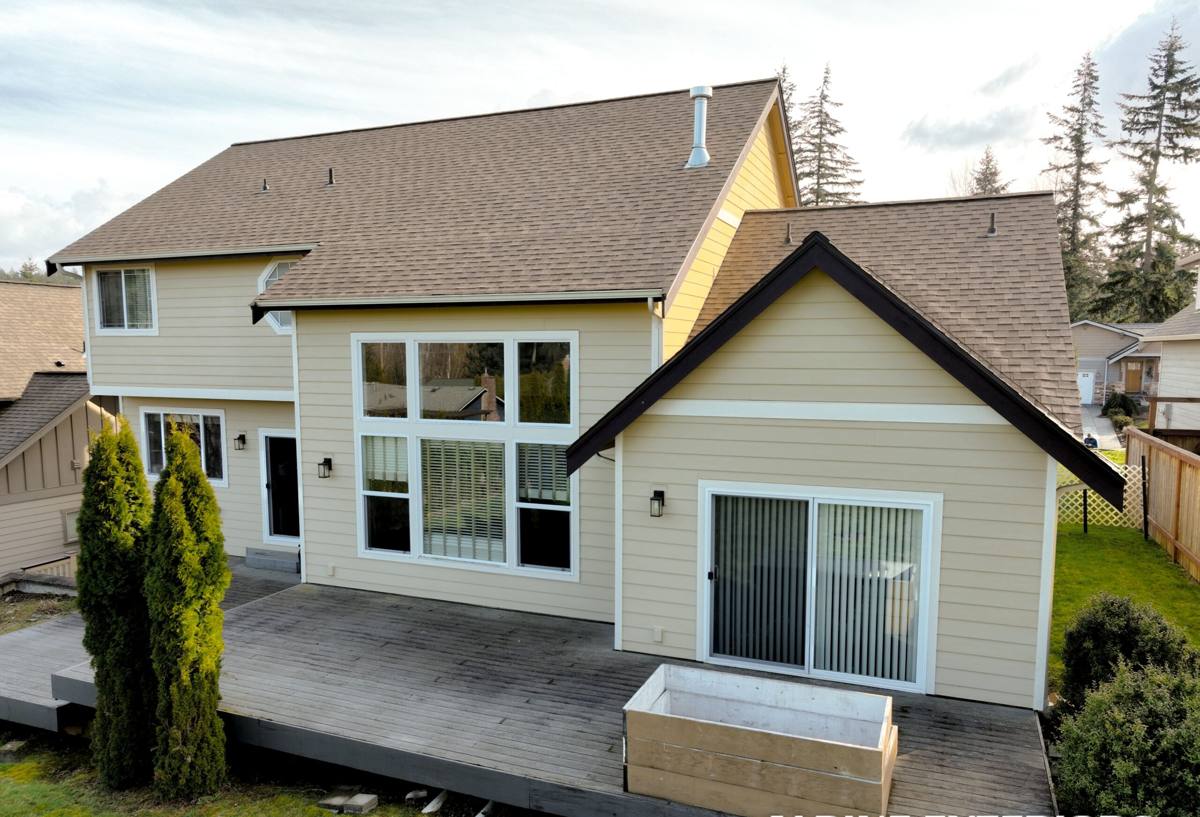
Why Older Windows Struggle Here Specifically
Most of the window failures we see in this part of Bellingham trace back to the same handful of causes, and they show up earlier here than they would in a drier climate:
- Corroded or seized hardware — locks, cranks, and balance mechanisms exposed to salt-tinged coastal air pit and stick well before their rated lifespan.
- Failed seals and fogged glass — constant humidity swings stress the seal around insulated glass units, letting moisture creep between the panes.
- Wood rot at the sill and jamb — driving rain that gets past aging caulk or worn weatherstripping has nowhere to go but into the wood, and moss-season dampness means it rarely gets a chance to dry out.
- Warped or swollen sashes — repeated wet-dry cycling through the year works wood and lower-grade vinyl frames until they no longer sit flush.
- Drafts around the frame — original construction-grade flashing and sealant weren't built for decades of coastal weather, and gaps open up slowly enough that homeowners often adjust to the draft rather than notice it.
Any one of these problems is a comfort issue. Together, they're an energy bill issue — a home losing conditioned air through five or six aging windows is working its furnace or heat pump harder every single day of the heating season, which in Whatcom County runs long.
What "Efficient" Actually Means in This Climate
Efficiency ratings are usually built around national or regional averages, but a bay-adjacent, rain-heavy climate rewards a slightly different set of priorities than a hot, dry one would. For Silver Beach homes, we weigh these factors in roughly this order: air and water infiltration resistance first, whole-window U-factor second, and solar heat gain coefficient third. A window that's thermally excellent but lets wind-driven rain past its weatherstripping isn't actually efficient here — it just fails in a different, wetter way.
What a Correct Installation Involves
Energy-efficient windows only perform as advertised if they're installed correctly. A high-spec window set into a sloppy rough opening will underperform a mid-grade window installed properly — this is one of the most common gaps between what a homeowner pays for and what they actually get.
The Steps We Don't Skip
- Opening inspection — checking the existing rough opening, sill, and surrounding framing for hidden rot or moisture damage before anything new goes in.
- Removal without collateral damage — pulling the old unit carefully to avoid tearing siding or trim that would otherwise need full replacement.
- Sill and flashing correction — installing or repairing sloped sill pans and proper flashing so water is directed out, not trapped against the frame.
- Air sealing at the rough opening — closing gaps between the window unit and framing with appropriate sealant and backer material, not just spray foam alone.
- Level, plumb, and square set — a window that's slightly out of square will bind, won't seal evenly, and will wear its weatherstripping unevenly over time.
- Weatherproofing the exterior — sealant and trim work sized for actual driving-rain exposure, not a minimum-code approach.
- Interior finish and operation check — confirming smooth operation, proper locking engagement, and a clean, finished look inside.
Skipping or rushing any one of these steps is how a brand-new window ends up with a draft or a leak within a few winters — and it's the single biggest reason we see homeowners replacing "recently installed" windows sooner than they should have to.
Choosing Materials That Hold Up Near the Water
Frame material matters more in Silver Beach than it would a few miles inland, simply because of the added salt-air exposure. We steer homeowners toward frame and hardware choices based on how they actually perform in this specific environment, not just on sticker price.
| Frame Material | How It Handles This Climate | Maintenance Reality |
|---|---|---|
| Vinyl (quality-grade) | Doesn't rot or corrode; handles moisture well | Low — occasional cleaning, no painting |
| Fiberglass | Very stable in wet/dry cycling, strong seal retention | Low — durable finish, minimal upkeep |
| Wood (clad exterior) | Good insulation, but exterior cladding is doing the weather-fighting | Moderate — interior wood still needs periodic attention |
| Bare wood | Most vulnerable to driving rain and moss-season dampness | High — repainting, sealing, and rot-watching are ongoing |
| Aluminum | Prone to corrosion and poor thermal performance in this climate | Moderate, but efficiency losses often outweigh upkeep savings |
We're not against wood-framed windows as a category — they have real advantages indoors — but for a home taking direct exposure near the bay, we're honest with homeowners about the added maintenance commitment before they commit to one. A window that looks better on day one but demands yearly upkeep to keep performing isn't necessarily the better long-term investment, and that's a trade-off worth deciding on deliberately rather than by default.
Glass Packages Worth Considering
Double-pane, low-E, argon-filled units are the practical baseline for this climate — they cut heat loss and reduce condensation risk on interior glass during cold, damp mornings, which is a common complaint in older single-pane homes here. Triple-pane makes sense in specific situations, like a north-facing wall with heavy wind exposure, but it's not automatically the right call for every opening, and we'll tell you when the added cost doesn't match the benefit for a particular window's orientation and exposure.
Repair Versus Full Replacement
Not every window in Silver Beach needs to come out. Some of the most cost-effective work we do is targeted repair: replacing failed weatherstripping, re-bedding a leaking sill, restoring hardware function, or resealing glass units that have started to fog but haven't fully failed. The decision point usually comes down to a few honest questions:
- Is the frame itself sound, or is there rot in the jamb or sill that repair can't fix?
- Has the seal failed on the glass unit itself (permanent fogging), or is the issue isolated to weatherstripping and hardware?
- Is the draft coming from the window unit, or from the surrounding wall assembly and flashing?
- Would repair cost approach 40-50% or more of a full replacement, once labor and materials are counted?
We'll always tell you if repair is the more sensible option — there's no advantage to us in replacing a window that has a few more good years left in it.
Our Process for Silver Beach Homeowners
Because we already work regularly in this part of Bellingham, we're familiar with the typical window ages, construction styles, and common trouble spots found in Silver Beach homes. That local familiarity shortens the assessment phase and helps us spot issues — like early sill rot or hardware corrosion — that a crew unfamiliar with this specific coastal exposure might miss on a first look.
What to Expect
- On-site assessment — we look at each window individually, not just the house as a whole, since exposure and condition often vary window to window based on orientation.
- Honest repair-vs-replace recommendation — window by window, with reasoning you can follow.
- Straightforward estimate — clear about materials, labor, and timeline, with no pressure to upgrade beyond what makes sense for your home.
- Scheduled installation — timed with weather in mind, since a rushed install during a wet stretch is how corners get cut.
- Final walkthrough — checking operation, seals, and exterior finish work before we consider the job done.
Why Local Experience Matters for This Job
Window installation looks similar everywhere on paper, but the details that make it last differ by climate and by neighborhood. A crew that mostly works drier inland areas of Whatcom County may not automatically account for the added flashing and sealant attention a bay-exposed home in Silver Beach actually needs. We've built our approach around the conditions we see repeatedly in this area — salt air, sustained rain, and a moss season that keeps everything damp for months — so the recommendations we make are grounded in what actually holds up here, not a one-size-fits-all standard.
Maintaining Your Investment After Installation
Energy-efficient windows are a long-term investment, and a little seasonal attention protects that investment considerably. A short list worth keeping on the fridge:
- Rinse frames and hardware periodically to reduce salt buildup, especially on the side of the house facing the water.
- Check exterior caulking each fall before the wet season sets in, and touch up anywhere it's cracked or pulled away.
- Clear moss and debris from sills and tracks so water has a clean path to drain rather than pooling.
- Operate locks and cranks periodically through the year, even on windows you don't open often, so hardware doesn't seize.
- Watch for condensation between panes — it's the clearest early sign a seal has failed and the unit needs attention.
If your Silver Beach home has drafty, fogged, or aging windows, we're happy to take a look and give you a straightforward, no-pressure estimate — just fill out the form below to get started.