 Bellingham Exterior
 Why Puget's Siding Wears Differently Than Other Bellingham Neighborhoods
Every house in Whatcom County deals with rain, but homes in and around Puget catch a specific combination of conditions that's harder on exterior cladding than most inland Bellingham lots. Proximity to the water means more salt-laden air moving across the siding surface, which accelerates corrosion on fasteners, trim, and any material that isn't built to shrug off airborne minerals. Add driving, wind-pushed rain off the Sound and a moss season that can run most of the year in shaded, north-facing exposures, and you have an environment that punishes shortcuts. Siding that would hold up fine in a drier part of the state can start showing swelling, staining, or soft spots within a few years out here if it's the wrong material or it went up without the right details.
This isn't a reason to panic about your home's exterior — it's a reason to be specific about what you install and how. A correctly installed, climate-appropriate siding system handles Puget's weather for decades. A generic install of the wrong product often doesn't make it a decade without problems.
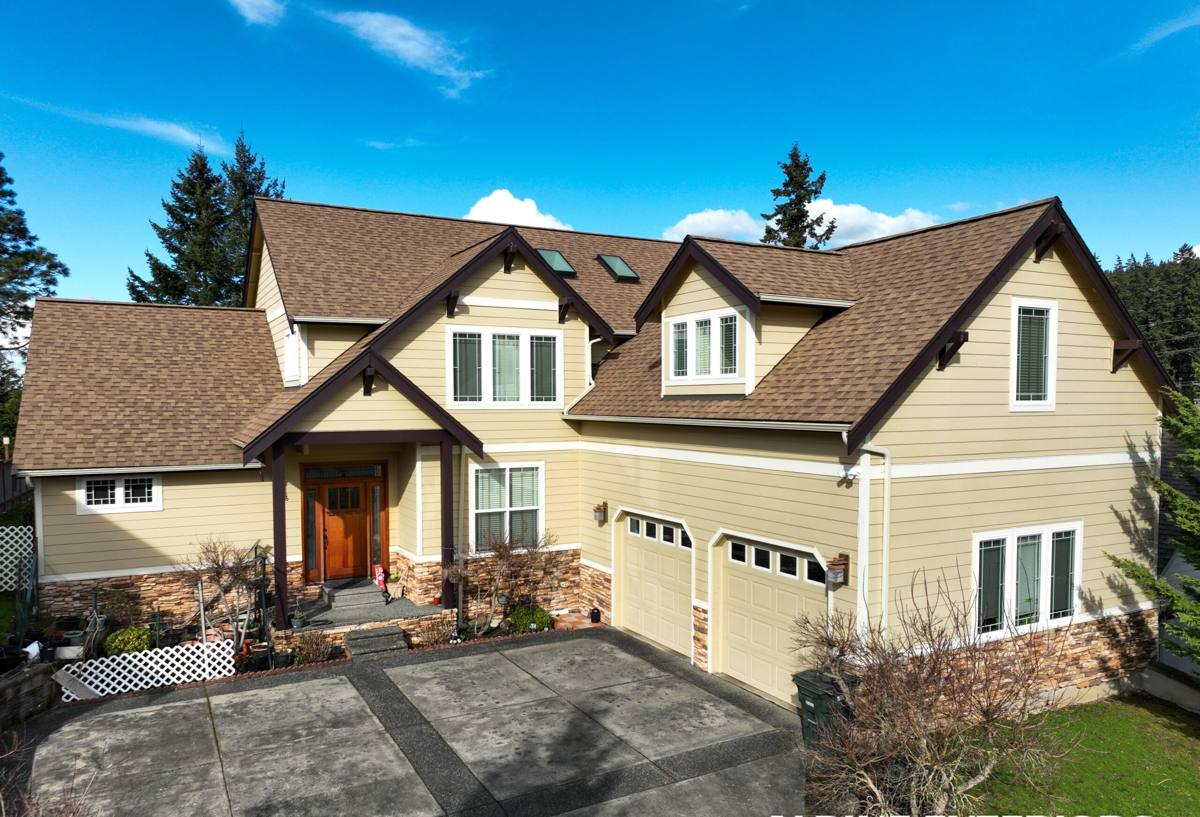
What Puget Homes Actually Need From Their Siding
Moisture Management, Not Just Moisture Resistance
The biggest misconception about siding is that the material alone keeps water out. In practice, water always finds a way behind cladding eventually — through a nail hole, a hairline gap at a window, wind-driven rain forced sideways under a lap. What actually protects a house near the Sound is the drainage plane behind the siding: the house wrap, flashing, and rain screen gap that let any water that gets in run back out instead of sitting against the sheathing. Salt air speeds up corrosion on anything metal that's exposed to it repeatedly, so flashing details and fastener choice matter more here than in a drier inland neighborhood.
A Material That Doesn't Feed Moss and Mildew
Bellingham's moss season is long, and Puget's tree cover and shaded exposures make it worse in spots. Organic siding materials — cedar, primed wood, and some engineered wood products — give moss, algae, and mildew something to grip and feed on, especially where sun exposure is limited. Fiber cement doesn't offer that same foothold. It's an inorganic material, so while spores can still land on the surface, they don't have organic material to root into the way they do with wood-based siding.
Dimensional Stability in a Wet-Dry Cycle
Even in a mild coastal climate, siding goes through repeated wet and dry cycles across the year. Materials that swell when wet and shrink when dry eventually loosen fasteners, open joints, and crack paint film. Over enough cycles, that movement is what causes the visible problems homeowners associate with old siding — not one storm, but years of expansion and contraction.
Why We Install James Hardie and Nothing Else
We standardized on James Hardie fiber cement for every home we side, including in Puget, for reasons that come directly from the conditions above:
- Non-combustible core — fiber cement doesn't contribute fuel to a fire, which matters for insurance conversations as much as safety.
- Engineered for Pacific Northwest moisture — Hardie's HZ5 product line is formulated for climates like ours, with performance testing built around wet, moderate-temperature regions rather than a one-size-fits-all formula.
- ColorPlus factory finish — the color is baked on at the factory under controlled conditions, which holds up better against fading and moisture intrusion at the paint film than field-applied paint on site-finished materials.
- Dimensionally stable — fiber cement moves far less with humidity and temperature swings than wood-based or vinyl products, so joints, caulk lines, and fastener holes stay tighter over time.
- Backed by a real transferable warranty — Hardie's warranty structure is written around the product performing for decades, and it transfers to a new owner if you sell, which matters to buyers evaluating an older home.
We don't install LP SmartSide, vinyl, Cemplank, Allura, primed spruce, or cedar. Each of those has legitimate uses in the right project, but we've made a professional call that Hardie is the product we're willing to warranty our workmanship against, given what we see on siding tear-offs across Whatcom County.
What a Correct James Hardie Installation Involves
Before the Siding Goes Up
The sheathing gets inspected for rot or soft spots, especially around old flashing and penetrations, before anything new goes on. A proper weather-resistive barrier goes over the sheathing, lapped correctly at every seam so water sheds downward and outward. Windows and doors get flashed with attention to the head, jambs, and sill — the sill pan detail is one of the most common places we find water damage on tear-offs, and it's invisible once the siding is up.
The Rain Screen Gap
For a climate with this much sustained moisture, we install with a rain screen gap — a small air space between the back of the siding and the water-resistive barrier. That gap lets any incidental moisture drain and lets air circulate to dry the assembly out, instead of trapping water against the sheathing. It's a detail that costs a bit more labor and material up front and makes a real difference in how the wall assembly performs over 20-plus years near the water.
Fastening and Fastener Material
Hardie specifies fastener types, spacing, and embedment depth for a reason — under- or over-driven nails are one of the most common installation defects and one of the main causes of early cracking or panel movement. In a salt-air environment, fastener corrosion resistance matters more than inland, so we pay attention to fastener material, not just placement.
Joints, Caulking, and Trim
Butt joints get flashed or backed properly rather than just caulked and hoped for. Caulk is a backup, not the primary defense — any detail that relies on a bead of sealant as its only barrier against wind-driven rain is a detail that will eventually fail. Trim gets back-primed and installed with the same moisture-management mindset as the field siding.
Our Process for a Puget Siding Project
- On-site assessment — we walk the exterior, check for existing moisture damage, and look at exposure direction (which walls take the most wind-driven rain and moss growth) before quoting anything.
- Scope and product selection — plank profile, exposure width, and color come from what fits the home and the HOA or neighborhood character where relevant, always within the Hardie product lines.
- Tear-off and sheathing repair — old siding comes off, and any damaged sheathing gets addressed before house wrap goes back on. This is often where we find the real story behind why old siding failed.
- Weather barrier, flashing, and rain screen installation — the parts nobody sees but that determine whether the job lasts.
- Hardie installation to manufacturer spec — correct fastening, joint treatment, and clearances at grade, trim, and roof lines.
- Final inspection and walkthrough — we go over the finished exterior with you before calling the job done.
Comparing the Options Puget Homeowners Actually Consider
| Factor | James Hardie Fiber Cement | Vinyl | Cedar / Primed Wood |
|---|---|---|---|
| Moisture behavior in coastal climate | Stable; engineered for wet regions | Doesn't rot, but can trap moisture behind panels | Absorbs moisture; prone to rot without upkeep |
| Moss/algae susceptibility | Low — inorganic surface | Low, but can look dated with algae film | High in shaded, damp exposures |
| Salt air / fastener corrosion | Managed with correct fastener spec | Fasteners often hidden but panels can warp | Wood movement stresses fasteners over time |
| Finish longevity | Factory ColorPlus finish resists fade | Color molded in but can chalk/fade | Requires repainting/staining on a cycle |
| Fire resistance | Non-combustible | Melts/deforms under heat | Combustible |
| Typical maintenance | Occasional wash, caulk checks | Occasional wash | Regular repainting/staining, rot repair |
Maintenance Puget Homeowners Should Actually Expect
Hardie siding isn't zero-maintenance, but the maintenance is manageable and predictable rather than a recurring repaint cycle. A yearly rinse to knock off surface grime and any early moss or algae film keeps the finish looking right, especially on north-facing or shaded walls where moss takes hold fastest. Caulk lines at trim and penetrations are worth a visual check once a year — sealant is a maintenance item on any siding system, and catching a failed bead early is cheap; ignoring it for years is not. Beyond that, a properly installed Hardie exterior doesn't ask for much, which is part of why we consider the extra installation care worth it up front.
Why It Matters That We Already Work in Puget
A crew that installs siding across varied inland conditions but rarely works this close to the water can miss details that matter here — how much wind-driven rain a particular wall exposure actually takes, where moss pressure is worst on a given lot, or how salt air affects fastener and flashing choices over time. Working repeatedly in Bellingham neighborhoods near the Sound, including Puget, means those judgment calls are informed by what we've actually seen on tear-offs and callbacks in this specific environment, not a generic install checklist written for a different climate.
What to Ask Any Contractor Bidding Your Siding Job
- Do they install a rain screen gap, or just house wrap directly behind the siding?
- Are they a factory-certified Hardie installer, and can they explain why?
- How do they handle window and door flashing — specifically the sill detail?
- What fastener type and spacing do they use, and why for this climate?
- Will the manufacturer's warranty stay valid based on how they install, and is it transferable if you sell?
- Do they have experience with homes in this specific area, near the water?
If you're planning a siding project in Puget or elsewhere in Bellingham, we're happy to walk your home, look at your specific exposure and moisture conditions, and put together a straightforward, no-pressure estimate — no obligation, just a clear look at what your home actually needs.