 Bellingham Exterior
 Composite Decking Built for Puget's Weather, Not Against It
Puget is close enough to the water that salt air is part of daily life, and that changes what a deck needs to survive here. Between the salt, the driving rain that comes off Bellingham Bay through the fall and winter, and the long stretch of gray, damp months that let moss get a foothold on anything horizontal, a deck in this part of Whatcom County works harder than one built inland. Composite decking can handle that load well, but only when it's specified and installed with this specific climate in mind. A board rated for "all weather" on a manufacturer's website and a board that's actually detailed correctly for a Puget backyard are two different projects.
This page is about that one job, done right, in this one area: what local conditions demand from a composite deck, what a correct installation actually involves, how we approach the work, and why it matters to hire a crew that already knows what Puget's weather does to a deck over time.
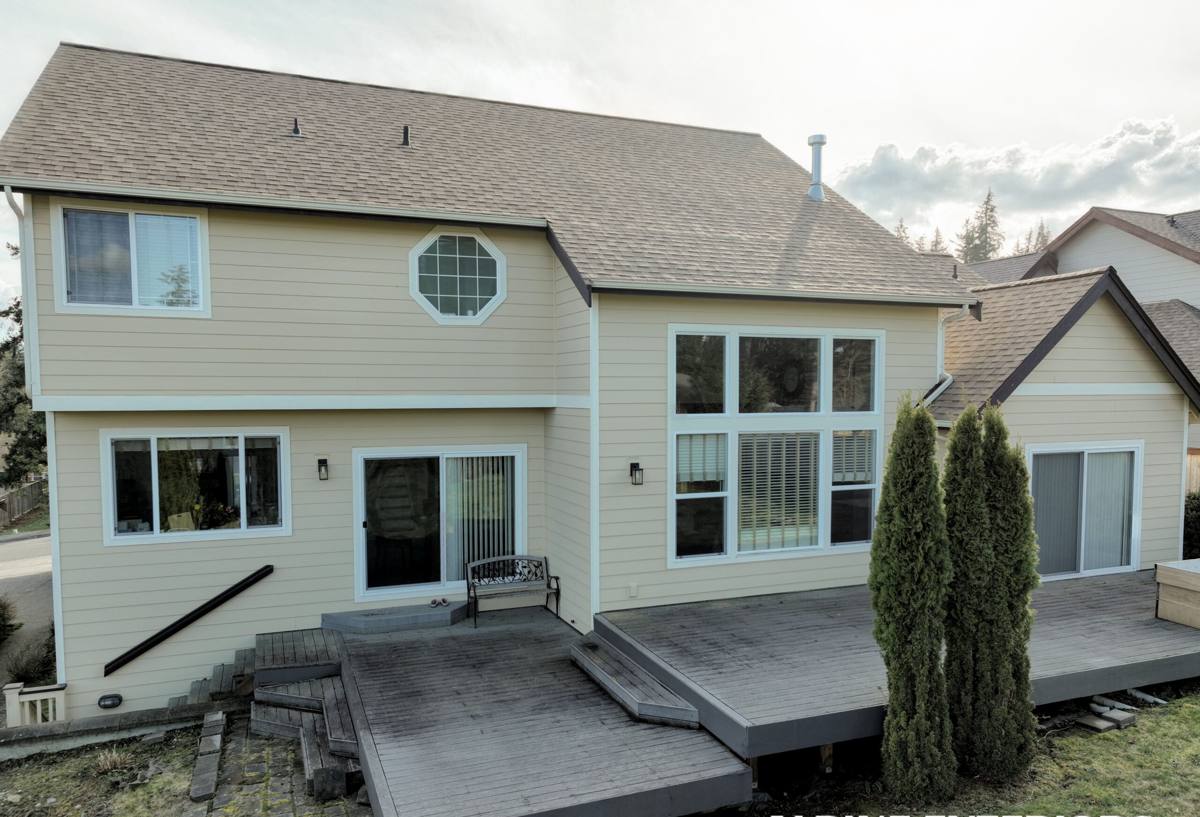
What Salt Air, Rain, and Moss Actually Do to a Deck
Salt Air
Salt-laden air doesn't just sit on the surface of a deck — it works into fastener heads, hinges, hardware, and any exposed metal in the substructure. Over years, that accelerates corrosion on anything that isn't rated for coastal exposure. Composite boards themselves don't rust, but the screws, joist hangers, post bases, and railing hardware holding the deck together absolutely can if the wrong grade is used.
Driving Rain
Rain that comes in at an angle, rather than falling straight down, gets pushed under rail caps, into end grain, and behind fascia boards in a way that vertical rain doesn't. That means water intrusion points that would be a non-issue in a drier climate become real weak spots here if they're not flashed and sealed correctly the first time.
Moss Season
Bellingham's extended damp season — roughly fall through spring — gives moss and algae months of uninterrupted moisture and shade to establish themselves. On a deck, that shows up first in board grooves, fastener recesses, and anywhere airflow is restricted underneath. Left alone, it turns a deck surface slick and green well before the material itself is anywhere near worn out.
What a Correct Composite Deck Install Involves Here
None of these are optional extras — they're the difference between a deck that looks good for a season and one that performs for its full warranty life in this climate.
- Ventilated substructure: Adequate clearance and airflow underneath the deck so moisture doesn't sit trapped against joists and the underside of boards.
- Corrosion-resistant fasteners and hardware: Stainless or coated hardware rated for coastal/marine exposure, not the standard-grade fasteners that work fine further inland.
- Correct board spacing: Gapping set to the manufacturer's spec so boards can shed water and dry rather than wicking moisture between them.
- Flashing at the ledger board: Proper ledger flashing where the deck ties into the house, since this is one of the most common points of hidden water damage on any deck, composite or wood.
- Joist tape or joist protection: A moisture barrier on top of framing lumber to slow rot at the fastener points, which matters more here given how many wet months the frame sits through each year.
- Grooved-board drainage systems installed correctly: If hidden-fastener grooved boards are used, the drainage/clip system has to be installed square and consistent or water pockets can form.
Composite vs. Wood vs. PVC: What Actually Makes Sense in Puget
Every decking material has trade-offs. Here's how the three most common options hold up against Puget's specific conditions — salt air, driving rain, and a long moss season.
| Material | Moss & Algae Resistance | Maintenance | Coastal Durability |
|---|---|---|---|
| Pressure-treated wood | Low — porous surface holds moisture and organic growth | Annual cleaning, staining, or sealing | Fasteners and framing need upgraded hardware; wood itself degrades faster near salt air |
| Composite decking | Moderate to high, depending on the capstock — smoother, capped boards resist growth better than uncapped | Periodic washing; no staining or sealing | Performs well when hardware and substructure are specified for coastal conditions |
| PVC decking | High — fully synthetic surface, least hospitable to moss and algae | Lowest — occasional washing | Very good, though it comes at a higher material cost and a different look/feel underfoot |
For most Puget homeowners, capped composite hits the practical middle ground: meaningfully lower maintenance than wood, real resistance to moss and algae compared to uncapped or older-generation composite, and a cost that's more accessible than full PVC systems. We'll walk through where your budget and priorities land on that spectrum during an estimate rather than pushing one product line by default.
A Note on Product Choice
We don't install every composite product on the market, and that's a deliberate call. Some lower-tier boards have capstocks that are thin enough to scuff through with normal foot traffic, or warranty structures with enough exclusions around moisture and staining that they don't hold up to scrutiny in a climate like ours. We'd rather stand behind a shorter list of products we trust in wet, salt-exposed conditions than install something that looks fine on day one and causes callbacks in year three.
How Our Process Works
1. On-Site Evaluation
We look at sun and shade exposure, drainage around the footprint, how close the deck sits to salt air exposure, and the condition of any existing structure or ledger connection.
2. Substructure Check or Build
If you're replacing an old deck, we assess the framing before anything new goes down — reusing a frame that's already compromised by rot or corrosion just buries a problem under new boards. If we're building new, framing is sized and fastened for this climate from the start.
3. Material Selection
We go over board options, colors, and grooved vs. solid-edge profiles based on your budget and how the space will actually be used, plus what's realistic to maintain.
4. Installation
Ledger flashing, joist protection, correct fastener spacing, and proper board gapping are handled as standard practice, not upsells.
5. Walkthrough and Care Guidance
Before we leave, we go over basic seasonal care — mainly how to keep moss from establishing itself — so the deck stays looking the way it did on day one.
Living With a Composite Deck Through a Puget Winter
Composite decking is genuinely lower-maintenance than wood, but "low-maintenance" doesn't mean "no maintenance" in a climate that stays wet for months at a stretch. A periodic rinse or wash, especially heading into and coming out of the wettest stretch of the year, keeps organic buildup from getting a grip in the first place. Boards installed with correct spacing and airflow underneath are far easier to keep clean than boards crowded together or built over a substructure with poor drainage — which is exactly why getting the install right matters more here than in a drier region.
Simple Seasonal Habits That Help
- Sweep debris off the deck regularly in fall, when falling leaves and organic matter give moss something to feed on.
- Rinse the surface periodically through the wet months rather than waiting until spring to deal with buildup.
- Keep gutters and downspouts near the deck clear so runoff isn't dumping extra water onto the deck surface or framing.
- Trim back overhanging vegetation where practical to let more light and airflow reach the deck.
Why a Crew That Already Works in Puget Makes a Difference
A deck built to a generic spec sheet and a deck built for this specific stretch of Whatcom County aren't the same project, even if the materials look identical on a supplier's shelf. A crew that already works in and around Puget knows which hardware grade actually holds up to the salt exposure here, how far to run ledger flashing given how the rain comes in, and where moss tends to establish first on a deck in this microclimate. That's the kind of judgment that doesn't show up on a materials invoice but shows up in how the deck looks and performs five and ten years down the road.
Getting an Honest Estimate
Every property is a little different — sun exposure, existing structure condition, and how sheltered or exposed the lot is from the water all affect what the right build looks like. If you're weighing a new composite deck or a replacement in Puget, we're happy to come take a look, walk you through what we're seeing, and put together a straightforward, no-pressure estimate using the form below.