 Bellingham Exterior
 Ferndale sits close enough to Bellingham Bay and the surrounding lowlands that outdoor living spaces here take a real beating over the year. A composite deck built for this part of Whatcom County has to shrug off salt-tinged air rolling in off the water, weeks of driving rain through fall and winter, and a moss season that seems to start earlier and end later every year. This page covers what composite decking actually needs to hold up in Ferndale, what a correct installation looks like, and why the details matter more here than they would in a drier climate.
What Ferndale's Climate Actually Does to a Deck
Whatcom County doesn't deal with hurricanes or wildfire smoke damage, but it wears decks down in quieter, steadier ways. Salt air off the bay speeds up corrosion on fasteners, joist hangers, and any exposed metal hardware — a problem that affects composite and wood decks equally, since the boards themselves aren't what fails first in a coastal climate. Driving rain, especially the sideways rain that shows up with fall storms, finds its way into board gaps, ledger connections, and any spot where flashing was skipped or done poorly. And because this area rarely gets a long dry stretch — especially under tree cover or on a north-facing deck — moss and algae get a foothold fast and don't let go on their own. A deck built without accounting for all three of these — corrosion, water intrusion, and organic growth — will show problems within a few seasons, regardless of what decking material sits on top.
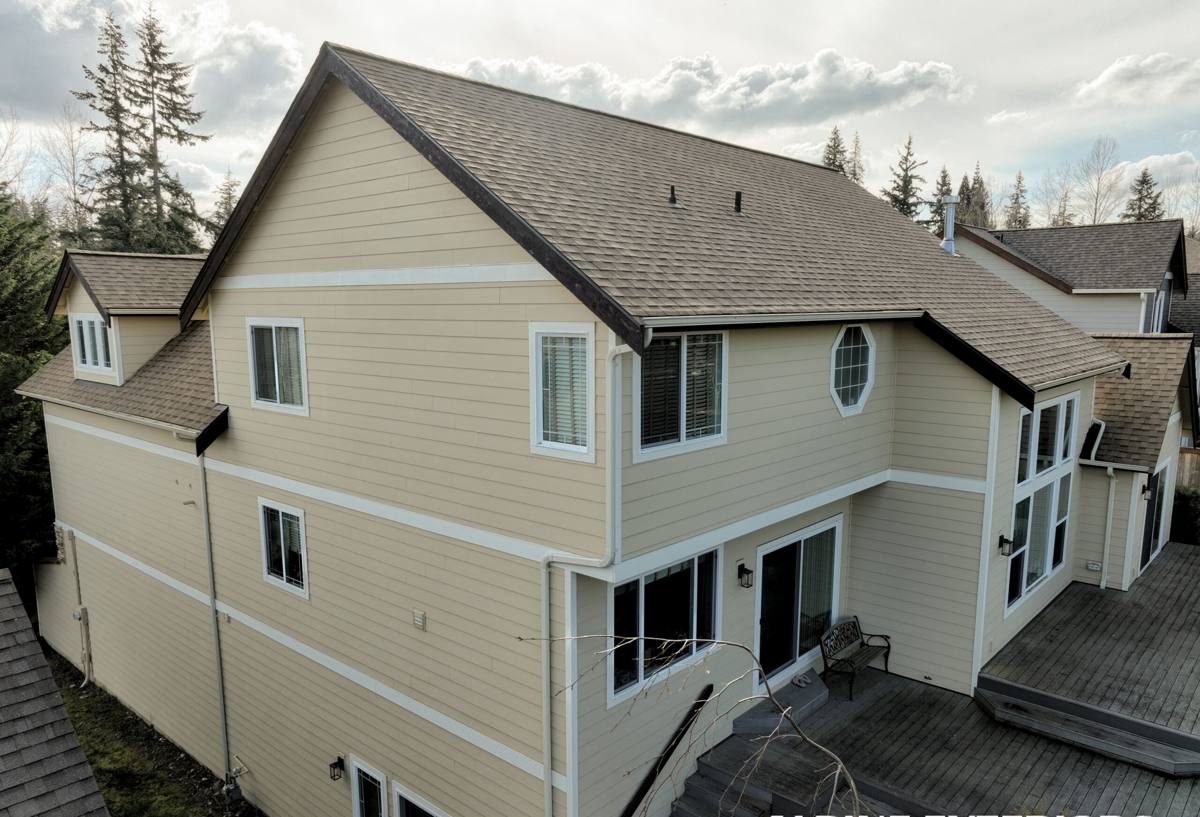
Composite vs. Wood for a Ferndale Deck
Composite decking isn't automatically the right call for every project, but in a climate like this one it solves some real, recurring problems that wood decking runs into year after year.
| Factor | Composite Decking | Wood Decking |
|---|---|---|
| Moisture behavior | Doesn't swell, cup, or split from repeated wetting and drying | Absorbs and releases moisture with every wet/dry cycle, which drives cupping and splintering over time |
| Moss and algae | Still needs periodic cleaning, but there's no organic wood fiber for growth to feed on and rot | Moss holds moisture against the wood, which speeds up decay underneath it |
| Annual upkeep | Occasional wash-down; no refinishing schedule | Sanding, staining, or sealing on a recurring cycle to keep water out |
| Upfront cost | Higher material cost | Lower material cost, but higher lifetime labor and refinishing cost |
| Fastener and hardware risk | Same coastal corrosion risk as wood — hardware still has to be matched to the exposure | Same coastal corrosion risk as composite |
The honest trade-off: composite costs more up front and it's not maintenance-free — it still needs to be washed off periodically, especially in shaded, moss-prone spots. What it avoids is the yearly refinishing cycle that wood requires to keep water from getting into the fibers, which matters a lot in a climate that doesn't give wood much time to fully dry out between rain events.
What a Correct Composite Deck Installation Involves
Framing and Drainage Come First
The decking boards get most of the attention, but the framing underneath is what actually determines whether the deck holds up. In a high-rainfall climate, the substructure needs enough airflow and slope to let water move off and away rather than pooling against joists or ledger boards. Composite boards don't rot, but the framing under them usually still is wood, and wet framing that can't dry out is exactly how a deck develops soft spots and hardware failures years before the surface shows any sign of trouble.
Fastening, Spacing, and Board Direction
Composite boards expand and contract with temperature more than most homeowners expect, and correct gapping between boards has to account for that movement — too tight and boards can buckle, too loose and the deck looks and feels sloppy. Hidden fastener systems need to be rated for the specific board profile being installed, and every screw, clip, and bracket exposed to salt air needs to be coastal-rated stainless or coated hardware, not standard interior-grade fasteners that will rust and stain the decking within a couple of seasons.
Flashing Where the Deck Meets the House
The single most common point of failure on any deck — composite or wood — is where it attaches to the house. A ledger board without proper flashing lets water track behind the siding and into the rim joist, and in a climate with as much driving rain as Whatcom County sees, that's not a hypothetical. Correct flashing at this connection is not optional trim work; it's the difference between a deck that lasts and one that causes hidden water damage to the house behind it.
Composite Board Types and What Drives Cost
Composite decking isn't one product — it spans a range of construction types and price points, and the right choice depends on budget, sun exposure, and how much of the deck is shaded and prone to holding moisture or moss.
| Cost Factor | What It Affects |
|---|---|
| Capped vs. uncapped boards | Capped composite has a protective outer shell that resists staining and moisture absorption better in shaded, moss-prone areas; uncapped boards cost less but are more exposed to surface wear |
| Substructure material | Pressure-treated wood framing costs less than aluminum or composite substructure, but wood framing has a shorter service life in a wet climate |
| Railing and code requirements | Deck height above grade determines whether guardrails are required, which adds material and labor cost |
| Deck size and layout complexity | Picture-frame borders, multiple levels, and angled cuts increase both material waste and labor time |
| Fastener and hardware grade | Coastal-rated hardware costs more than standard-grade but avoids early corrosion and staining |
Broadly, homeowners should expect composite decking to run higher per square foot than pressure-treated wood, with the total project cost shaped more by substructure condition, railing requirements, and layout complexity than by the composite boards themselves. We'll walk through the actual cost drivers for your specific deck during an estimate rather than quoting a number that doesn't account for your framing, footprint, or grade.
Moss and Mildew: The Maintenance Reality
No decking material in this part of Washington is truly maintenance-free, and it's worth being upfront about that. Composite boards resist rot, but surface mildew and moss can still develop on shaded sections of a deck, especially under overhangs or near tree cover where the surface stays damp longer between rain events. Regular light cleaning — a simple wash-down a couple of times a year, more often in shaded spots — keeps that from building into a slippery or discolored surface. The advantage over wood isn't that composite never needs attention; it's that neglecting it doesn't lead to structural decay the way trapped moisture under moss does on an unsealed wood deck.
Our Process for a Ferndale Composite Deck
- On-site assessment of the existing deck or build site, including sun exposure, drainage path, and proximity to trees or shaded areas prone to moss
- Structural check of the ledger connection, posts, and footings if we're working with an existing structure
- Drainage and flashing plan built around the site's actual water flow, not a generic template
- Framing with attention to airflow underneath the deck so wet substructure can dry between storms
- Composite board installation with correct spacing for thermal movement and coastal-rated fasteners throughout
- Railing, fascia, and stair details finished to match the board system installed
- Final walkthrough covering care and cleaning so the deck holds up as intended over time
Signs Your Current Deck Is Due for Replacement
- Soft, spongy, or bouncy spots when walking across the deck surface
- Boards that have cupped, split, or pulled away from fasteners
- Persistent moss or dark staining that comes back within weeks of cleaning
- Rust streaking around fasteners or visible corrosion on brackets and hangers
- Gaps or staining at the ledger board where the deck meets the house
- Railings that feel loose or move when leaned on
Why a Crew That Already Works Ferndale Matters
A lot of what separates a deck that lasts from one that doesn't isn't the brand of board — it's whether the framing, flashing, and fastener choices were made for the actual conditions the deck will sit in. A crew that regularly works in Ferndale and the rest of Whatcom County already knows where moss builds up fastest, which sides of a house take the worst driving rain, and how much drainage slope a substructure needs in a climate that doesn't dry out quickly. That local familiarity also extends to permitting — deck projects in and around Ferndale typically need a permit depending on height and size, and knowing that process ahead of time keeps a project from stalling partway through.
If you're weighing a new composite deck or replacing one that's showing its age, we're happy to take a look and give you an honest read on what your project actually needs. Use the form below to request a free, no-pressure estimate.