 Bellingham Exterior
 Metal Roofing for Birchwood Homes: Built for What This Climate Actually Does
Birchwood sits like a lot of Bellingham neighborhoods: tree cover overhead, moisture in the air most months of the year, and a roof that rarely gets a real break from either. Homeowners here aren't dealing with hypothetical weather stress — it's the daily combination of salt-tinged air off the Sound, driving rain that comes in sideways during winter storms, and a moss season that seems to start earlier every year. A metal roof handles all three better than most alternatives, but only if it's specified and installed correctly for this specific environment. A metal roof panel and fastener system that works fine in a dry inland climate can underperform here if the details aren't adjusted for what Whatcom County actually throws at a house.
This page covers what a correct metal roofing job looks like specifically for Birchwood conditions — not a generic rundown of metal roofing in general, but the material choices, installation details, and maintenance realities that matter for a roof going on a home in this part of Bellingham.
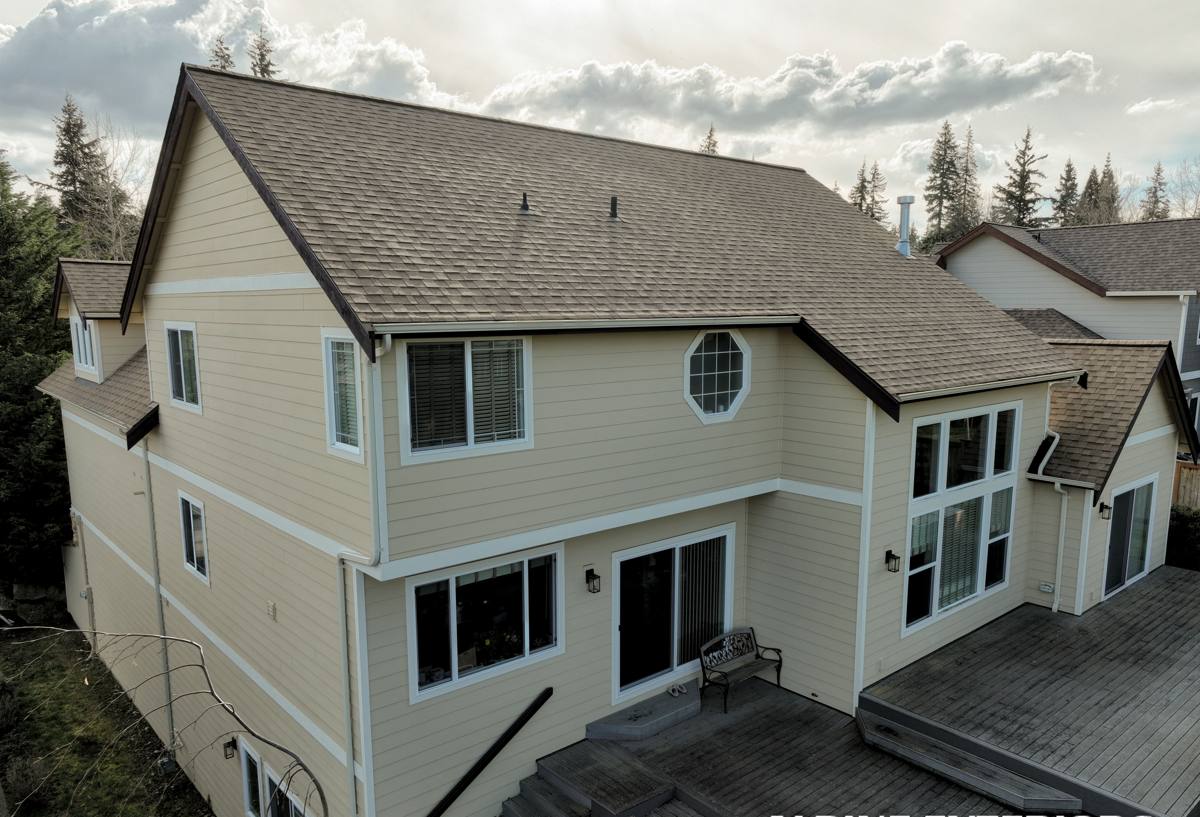
What Bellingham's Climate Does to a Roof Over Time
Salt Air and Corrosion
Being close to Bellingham Bay and the greater Puget Sound means airborne salt is a real factor, even for homes that aren't right on the water. Salt accelerates corrosion on any exposed metal — fasteners, flashing, panel edges — and it's the reason we don't treat every metal roofing product as interchangeable. Coating quality and fastener grade matter more here than they would fifty miles inland.
Driving Rain and Wind-Driven Moisture
Bellingham doesn't just get rain, it gets rain pushed sideways by wind coming off the water. That matters for a roof because wind-driven rain can work its way under panels or through fastener penetrations that would stay dry in a calmer climate. Underlayment choice and panel overlap have to account for that lateral pressure, not just water running downhill.
Moss, Shade, and a Long Wet Season
Tree cover and a long stretch of damp months mean moss and algae growth is a near-constant issue on roofs with the wrong surface or poor airflow. Moss holds moisture against roofing material, and on the wrong substrate that trapped moisture leads to premature wear. Metal roofing resists moss far better than composite shingles because there's no porous surface for spores to grab onto, but panel spacing, ventilation, and eave design still influence how much debris and moisture collect at transitions and valleys.
What a Correct Metal Roofing Job Involves
A metal roof is only as good as the assembly underneath it. The panels get the attention, but the components most homeowners never see are what determine whether the roof performs for decades or develops problems in five years.
- A synthetic underlayment rated for high moisture exposure, not a basic felt product that degrades faster in a wet climate
- Corrosion-resistant fasteners matched to the panel material — mismatched metals cause galvanic corrosion over time
- Proper panel overlap and fastening pattern sized for wind-driven rain, not just standard spacing
- Ice-and-water shield at eaves, valleys, and any low-slope transitions where water tends to back up
- Flashing detail at every penetration — chimneys, vents, skylights — sealed and mechanically fastened, not just caulked
- Ventilation that lets the roof deck breathe so moisture doesn't get trapped underneath the panels
Skip any one of these and the panels themselves stop mattering much. We've seen roofs with premium metal panels fail early because the underlayment or flashing detail wasn't right for the climate — the panel was never the weak point.
Panel Types: What We Recommend and Why
Not every metal roofing profile makes sense for a home in this part of Bellingham. Some hold up better against moss and moisture than others, and some require more precise installation to avoid problems down the road. Here's how the common options compare for a Birchwood-area home.
| Panel Type | Moisture & Moss Resistance | Installation Sensitivity | Typical Fit |
|---|---|---|---|
| Standing seam (concealed fastener) | Excellent — no exposed fastener penetrations | Higher — requires experienced crew for clean seams | Most Birchwood homes, especially under tree cover |
| Exposed-fastener corrugated/ribbed | Good, but fastener seals need regular checks | Lower — faster install, more forgiving | Outbuildings, garages, budget-conscious projects |
| Stone-coated steel | Good — coating adds some grip for moss to start on if debris isn't cleared | Moderate | Homes wanting a shingle-like look with metal durability |
| Copper or specialty metals | Excellent long-term, develops natural patina | High — specialized skill and cost | Accent roofing, architectural features |
For most full roof replacements in this neighborhood, we lean toward standing seam because the concealed fastener system removes the most common failure point — exposed screws that loosen or corrode over years of salt air and freeze-thaw cycling. It also sheds moss and debris more effectively since there are no raised fastener heads for material to catch on.
What We Steer Away From — and Why
We're selective about certain low-end exposed-fastener systems and thin-gauge panels marketed as budget metal roofing. It's not that these products can't work anywhere — it's that in a climate with this much sustained moisture and salt exposure, thinner gauges and cheaper fastener washers degrade faster than the labor cost to install them justifies. Our standard is to spec a system that will still be performing well in twenty-plus years under Birchwood conditions, not just one that passes inspection on day one.
How Our Process Works
We approach every Birchwood metal roofing project the same structured way, adjusted for the specific house and its exposure to wind, shade, and moisture.
- On-site assessment. We inspect the existing roof deck, ventilation, flashing points, and any signs of moisture intrusion or moss buildup before quoting anything.
- Deck evaluation and repair. Any soft, rotted, or moisture-damaged decking gets addressed before a single panel goes on — installing metal over a compromised deck just hides a bigger problem.
- Underlayment and ice-and-water shield installation. We install high-moisture-rated underlayment across the full deck, with reinforced protection at eaves, valleys, and low-slope areas.
- Flashing fabrication and installation. Flashing is custom-fit at every penetration and transition rather than relying on generic pre-formed pieces that leave gaps.
- Panel installation. Panels are installed with the fastening pattern and overlap appropriate for the roof's pitch and wind exposure.
- Ventilation check and adjustment. We confirm intake and exhaust ventilation is balanced so moisture isn't trapped under the new roof system.
- Final walkthrough. We walk the completed roof with the homeowner, point out maintenance items, and answer questions before considering the job done.
Ventilation, Flashing, and the Details That Actually Prevent Problems
Most metal roof complaints we get called out to inspect on other contractors' work trace back to two things: poor ventilation and rushed flashing work. In a climate like Bellingham's, a roof deck that can't breathe traps condensation underneath the panels, which over time causes rot that has nothing to do with the metal itself. We check attic and roof ventilation as part of every assessment, not as an afterthought.
Flashing is the other piece that separates a roof that lasts from one that leaks within a few winters. Chimneys, skylights, vent stacks, and valley transitions are where water finds its way in — not through the flat panel field. We fabricate and fit flashing to the specific geometry of each roof rather than relying on one-size-fits-all pieces, because a generic flashing kit rarely accounts for the wind-driven rain angles common in this area.
What Metal Roofing Costs Depend On
We don't publish a flat price because roof cost depends on real, house-specific factors — but homeowners deserve to know what actually drives the number before they get a quote.
| Cost Factor | Why It Matters |
|---|---|
| Panel type and gauge | Standing seam and heavier gauges cost more upfront but last longer under moisture and salt exposure |
| Roof complexity | More valleys, dormers, and penetrations mean more flashing labor and material |
| Deck condition | Rotted or damaged decking found during tear-off adds repair cost before installation can proceed |
| Tear-off vs. overlay | Full tear-off costs more short-term but avoids trapping moisture under old roofing material |
| Ventilation upgrades | Adding or correcting intake/exhaust venting protects the new roof investment |
| Roof pitch and access | Steeper or harder-to-access roofs require more labor and safety setup |
Generally, metal roofing costs more upfront than asphalt shingles but the gap narrows significantly when you factor in how much longer a properly installed metal roof lasts in this climate before needing replacement.
Maintaining a Metal Roof in a Birchwood Climate
Metal roofing is low-maintenance compared to shingles, but "low-maintenance" isn't "no-maintenance" — especially under tree cover with a long wet season. A little attention once or twice a year keeps small issues from becoming expensive ones.
- Clear gutters and downspouts of needles and debris each fall, before the heavy rain season starts
- Check valleys and low-slope transitions for accumulated debris that can trap moisture against panels
- Look at exposed fasteners (if applicable) for early signs of loosening or corrosion, particularly after storm seasons
- Trim back overhanging branches that keep sections of the roof shaded and damp longer than the rest
- Watch for any moss starting at panel edges or fastener heads and address it before it spreads
- Have flashing points inspected every few years, since that's where most leaks actually start
Why a Crew That Already Works Birchwood Matters
Metal roofing done right isn't a generic skill — it's knowing how the wind hits a roof on this side of Bellingham, how much shade a particular house gets and for how long, and which flashing details tend to fail first when the rain comes in sideways off the water. A crew that's already worked on homes in this neighborhood has seen how these roofs age here specifically, not in a textbook or a manufacturer's install guide written for a different climate zone.
That local experience shows up in small decisions that add up: where we add extra ice-and-water protection even though it's not strictly required by code, how we detail a valley that collects more debris than most, or when we recommend a ventilation upgrade because we've seen what happens to roofs in similar spots without one. It's the difference between a roof that technically meets spec and one that's actually built for where it sits.
Get a Straight Answer About Your Roof
If you're weighing metal roofing for a home in the Birchwood area, we're happy to come take a look, walk you through what your specific roof needs, and give you a straightforward, no-pressure estimate — no exaggerated claims, no pushing a product that isn't right for your house. Fill out the form below and we'll get back to you to schedule a time.