 Bellingham Exterior
 Why Birchwood Homes Need Siding Built for This Climate
Birchwood is a well-established part of Bellingham, and like most of Whatcom County, it sits in a climate that is quietly hard on exterior siding. The combination of salt-tinged marine air, long stretches of driving rain off the Sound, and a moss season that can run most of the year puts real, ongoing stress on whatever material is covering a home's exterior walls. Siding here doesn't fail because of one dramatic storm — it fails slowly, from months of moisture exposure that never fully lets up.
That's the backdrop for every siding decision a Birchwood homeowner makes. A product that performs fine in a dry inland climate can behave very differently after a few Bellingham winters. This page covers what local conditions actually do to siding, what a correct James Hardie installation looks like for a Birchwood home, and why we install James Hardie fiber cement exclusively — no vinyl, no LP SmartSide, no cedar, no other fiber cement brands.
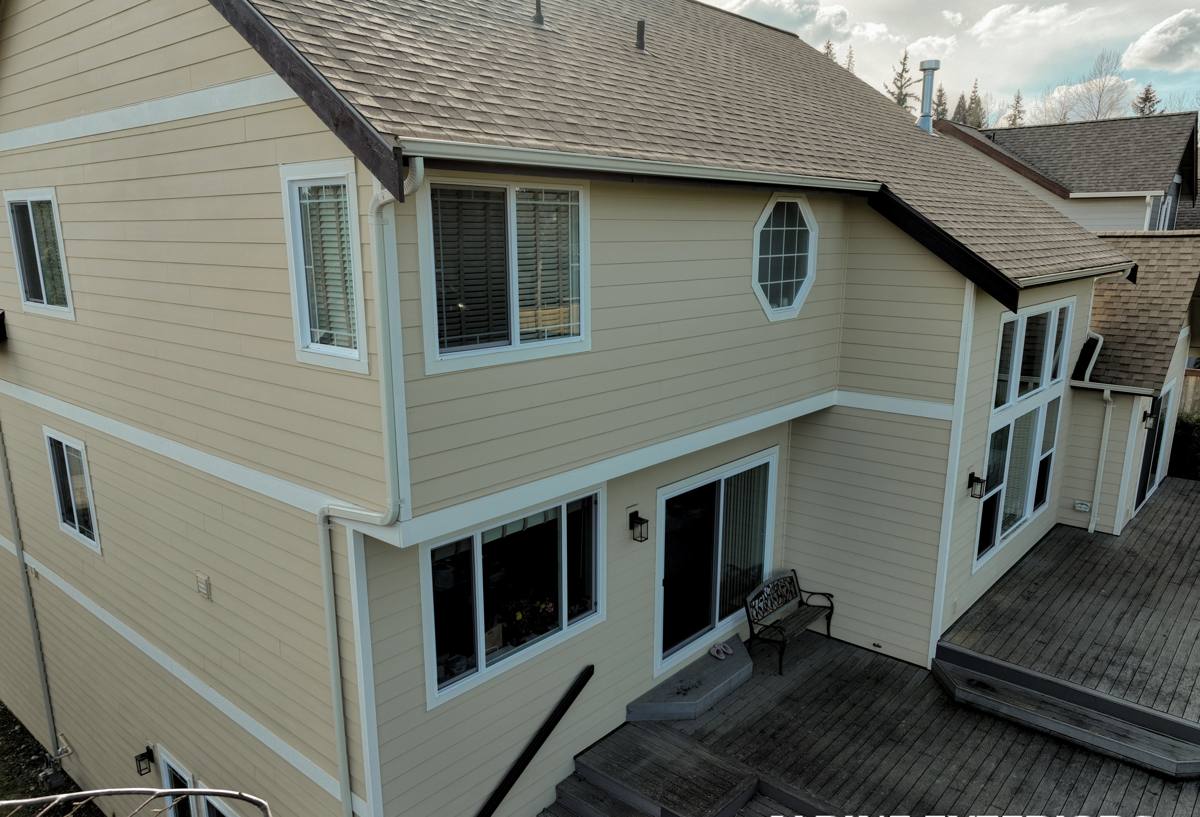
What Bellingham's Climate Actually Does to Siding
Salt Air and Coastal Exposure
Bellingham's proximity to the water means airborne salt is a real factor, even for homes that aren't directly waterfront. Salt-laden moisture accelerates corrosion on fasteners and metal trim, and it interacts with wood-based siding products in ways that speed up swelling, cupping, and paint failure. Over years, this is a slow erosion of whatever protective finish a product started with.
Driving Rain and Wind-Driven Moisture
Whatcom County doesn't just get a lot of rain — it gets a lot of rain pushed sideways by wind off the water. That matters more than total rainfall totals suggest, because wind-driven rain finds its way into laps, seams, and fastener penetrations that a calmer climate would never test. Siding systems and installation details that work fine in a still, dry region can leak in a Bellingham windstorm if they weren't built and installed with that specific stress in mind.
The Long Moss Season
Moss and algae growth on siding is a near-constant issue in this part of the state. Shaded, north-facing, and tree-sheltered walls — common throughout Birchwood — stay damp longer after every rain, which gives moss and mildew more time to take hold. On absorbent siding materials, that constant dampness doesn't stay on the surface; it works into the material itself over time, which is where real damage starts.
Why We Install Only James Hardie Fiber Cement
We made a deliberate decision to install James Hardie exclusively, rather than offering vinyl, LP SmartSide, cedar, or other fiber cement brands as options. That's not a marketing position — it's a response to what we've seen hold up in this exact climate versus what struggles.
James Hardie fiber cement is non-combustible, dimensionally stable, and engineered specifically for regional moisture conditions through its HZ5 product line, which is formulated for the Pacific Northwest's wet, moderate climate. It resists moisture absorption far better than wood-based products, doesn't provide the organic material that moss and mildew feed on the way untreated wood fiber can, and holds its shape and finish through repeated wet-dry cycles instead of warping or delaminating.
ColorPlus Technology
Most Hardie products we install use ColorPlus Technology, a factory-applied finish baked onto the board under controlled conditions rather than sprayed or brushed on-site. That finish is substantially more resistant to fading and moisture intrusion than field-applied paint, and it comes with its own finish warranty separate from the product warranty. For a climate that never really gives paint a long dry stretch to cure and bond properly, a factory finish is a meaningful advantage, not a convenience feature.
A Transferable, Backed Warranty
James Hardie backs its siding with a strong, transferable limited warranty — a real factor for resale in a market like Bellingham's, where buyers increasingly ask about siding age, material, and warranty status. That warranty only means something when the installation itself was done to spec, which is why correct installation matters as much as product selection.
What a Correct Installation Involves
Fiber cement siding is only as good as the details behind it. Most of the siding failures we get called out to inspect in this region trace back to installation shortcuts, not the product itself.
Flashing and Water Management
Every window, door, and penetration needs proper flashing and a drainage plane behind the siding so that any moisture that does get past the surface has somewhere to go besides into the wall assembly. This is the single most important — and most commonly skipped — part of a correct installation, and it's exactly the detail that matters most in a wind-driven-rain climate like Bellingham's.
Fastening and Clearances
James Hardie specifies exact fastener types, spacing, and penetration depth, along with minimum clearances from grade, roof lines, and decks. Getting these wrong doesn't just void the manufacturer warranty — it creates the gaps and stress points where moisture, and eventually rot, gets started.
Caulking and Joint Treatment
Butt joints, corners, and trim intersections need to be treated correctly, whether that means a factory joiner, sealant, or trim detail appropriate to the product line. Done wrong, these are the first spots to show staining or moss growth, often within the first year or two.
- Weather-resistant barrier and flashing installed and inspected before any siding goes up
- Fasteners matched to Hardie specifications for type, length, and spacing
- Proper clearance maintained from grade, roofing, decks, and patios
- Joints and corners sealed or detailed per manufacturer instructions, not left to guesswork
- Field-cut edges primed or sealed so raw material isn't exposed to moisture
- Final inspection against James Hardie's published installation checklist before the job is called done
How Siding Materials Compare in Birchwood's Climate
| Factor | James Hardie Fiber Cement | Vinyl | Wood / Engineered Wood |
|---|---|---|---|
| Moisture resistance in driving rain | Strong when installed to spec | Sheds water but seams can leak | Absorbs moisture over time |
| Moss and algae resistance | Better resistance; not an organic food source | Resists growth but shows dirt/staining | More susceptible, especially shaded walls |
| Salt air / coastal durability | Engineered for coastal, marine climates (HZ5) | Can become brittle over time | Fasteners and finish degrade faster |
| Fire resistance | Non-combustible | Combustible | Combustible |
| Finish longevity | Factory ColorPlus finish, long warranty | Color molded in, can fade/chalk | Field-applied paint needs recoating |
Our Process for a Birchwood Siding Job
Every job starts with an on-site assessment of the existing siding, sheathing, and any moisture or moss damage already present — this is especially important on tree-shaded or north-facing walls, which we see a fair amount of throughout Birchwood. From there:
- We inspect the wall assembly after tear-off, checking sheathing condition and existing flashing before anything new goes up.
- We install or repair the weather-resistant barrier and flashing system so water has a proper drainage path.
- We install James Hardie panels or planks per manufacturer specification for fastening, spacing, and clearance.
- We detail all joints, corners, and trim to manufacturer standard rather than relying on caulk alone to cover gaps.
- We walk the finished job against Hardie's installation checklist before we consider it complete.
We don't treat any of these steps as optional add-ons — they're what a warrantied Hardie installation actually requires, and skipping them is how siding that should last decades ends up failing in five or ten years.
Why Hiring a Crew That Already Works in Birchwood Matters
A crew that regularly works this specific area already understands the wall assemblies common to Birchwood's mix of home ages, the shade and moisture patterns particular to its tree-covered lots, and how the local building department handles siding and moisture-barrier inspections. That local familiarity shows up in fewer surprises once tear-off starts and fewer callbacks after the job wraps.
It also matters for warranty support. If a manufacturer warranty question comes up years down the road, you want a contractor who's still local, still doing this work in Whatcom County, and still able to stand behind the installation — not a crew that moved on to another region.
Maintenance That Actually Extends the Life of Your Siding
James Hardie siding is low-maintenance, not no-maintenance. In this climate, a few habits go a long way:
- Rinse siding periodically to clear pollen, dust, and early moss growth before it takes hold, especially on shaded walls
- Keep gutters clear so overflow doesn't run down and saturate siding near rooflines
- Trim back vegetation and tree limbs that keep walls shaded and damp longer than necessary
- Have caulking and joint sealant checked periodically, since this is the first place wear shows up
- Address any impact damage or cracked boards promptly rather than letting moisture get behind them
None of this is heavy upkeep — it's the difference between siding that reaches its full expected lifespan and siding that starts showing problems a decade early because small issues went unaddressed.
Get a Straight Answer for Your Birchwood Home
If your siding is aging, showing moss, or you're just planning ahead for a replacement, we're happy to take a look and give you a straightforward assessment — what condition your current siding is in, what a correct James Hardie installation would involve for your home, and a clear estimate. No pressure, no upsell on products we don't stand behind. Reach out below for a free estimate.