 Bellingham Exterior
 Why Siding Fails Faster in the York Neighborhood
Homes in York and the surrounding Bellingham neighborhoods sit close enough to the water and under enough tree cover that siding takes a beating most inland homeowners never think about. Salt-laden air off Bellingham Bay works into seams and fastener heads. Driving rain off Puget Sound storms doesn't just fall straight down — it gets pushed sideways into wall assemblies that weren't detailed to handle it. And Whatcom County's long, wet moss season means anything shaded by mature trees or facing north stays damp for weeks at a stretch instead of drying out between rains.
None of that is unusual for Bellingham. But it does mean siding decisions that work fine in a drier climate — cheaper products, shortcuts on flashing, thinner factory finishes — show their weaknesses here years before they would somewhere else. Older York homes with original wood siding or aging vinyl are often past the point where another coat of paint or a patch job makes sense.
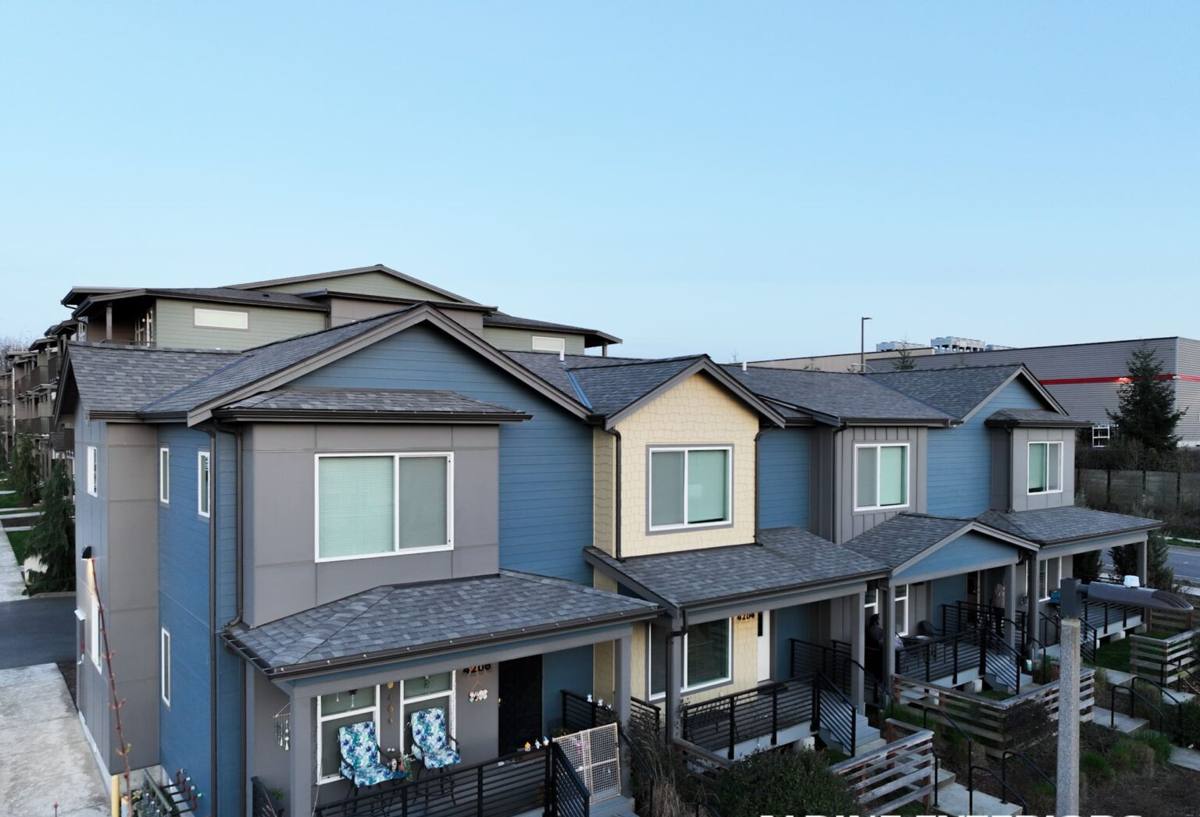
Signs a York Home Needs Siding Replacement, Not Repair
Not every problem means a full tear-off. But in a climate like this, a few warning signs almost always mean the siding underneath the surface is compromised, not just the paint or caulk on top.
- Soft or spongy spots when you press on the siding, especially near the bottom courses or below window sills
- Persistent green or black staining that comes back within weeks of cleaning, particularly on shaded or north-facing walls
- Paint that's bubbling, peeling, or won't hold no matter how often it's redone
- Visible cupping, warping, or buckling in wood or engineered wood panels
- Gaps opening up at seams, corners, or around trim that weren't there a few years ago
- A musty smell in an adjoining room, which often means moisture has already reached the sheathing
If you're seeing two or more of these, it's worth having someone look at the wall assembly itself, not just the visible surface.
What a Correct Siding Replacement Actually Involves
A siding replacement is only as good as what happens after the old material comes off and before the new material goes on. That middle step is where most long-term failures start, and it's the part homeowners can't see once the job is finished.
Tear-off and inspection
Removing the old siding down to the sheathing lets us actually see what the wall has been dealing with — rot, soft sheathing, failed flashing, or moisture trapped behind the old cladding. Any damaged sheathing gets replaced before anything new goes back on. Covering over a damp or compromised wall with new siding just hides the problem for a few more years.
Water-resistive barrier and flashing
A correctly lapped weather-resistive barrier, paired with properly integrated flashing at windows, doors, and every horizontal trim break, is what actually keeps wind-driven rain out of the wall. This is the detail that separates a job that lasts thirty years from one that leaks in five, and it's invisible once the siding is up — which is exactly why it has to be done right the first time.
Fastening and installation to manufacturer spec
Fiber cement siding has specific fastening patterns, nailing zones, and clearance requirements from grade and roof lines. Installing it off-spec doesn't just risk cosmetic issues — it can void the manufacturer's warranty entirely. We install to the manufacturer's published instructions, every time, because a warranty that gets voided by a bad install isn't a warranty at all.
Why We Install Only James Hardie Fiber Cement
We get asked fairly often why we don't offer vinyl, LP SmartSide, or cedar as options. The honest answer is that after years of doing this work in a climate like ours, we standardized on one product system because it's the one we trust to perform here without caveats.
Non-combustible and dimensionally stable
Fiber cement doesn't expand and contract with moisture the way wood-based products do, and it won't support a flame the way vinyl or engineered wood can. In a wet, humid climate where siding spends much of the year damp, that dimensional stability matters — it's a big part of why fiber cement holds paint lines and caulk joints better over time.
Climate-engineered product lines
James Hardie makes region-specific HZ product lines engineered for different climate zones, including formulations built for wetter, humid environments like ours. That's a meaningfully different approach than a one-size-fits-all siding product, and it's part of why we can stand behind the material in a coastal Whatcom County climate specifically, not just in general.
Factory-applied ColorPlus finish
Instead of a job-site paint job that starts failing at seams and cut edges, ColorPlus finish is baked on at the factory under controlled conditions, with touch-up product formulated to match. It holds color and resists fading and moisture intrusion at the finish level far better than field-applied paint, which matters when a home is getting hit with salt air and near-constant moisture for months of the year.
A warranty that's actually transferable
James Hardie backs its siding with a strong, transferable limited warranty — a real factor if the home is ever sold. That's not something we can offer on every product on the market, and it's a big part of why fiber cement is the only thing we put on a home.
How James Hardie Compares to Other Siding Options
| Factor | James Hardie Fiber Cement | Vinyl | LP SmartSide / Engineered Wood | Cedar / Primed Spruce |
|---|---|---|---|---|
| Moisture behavior | Dimensionally stable, engineered for wet climates | Can warp/buckle with heat and moisture cycling | Vulnerable at cut edges and fastener points if moisture gets in | Absorbs moisture, prone to swelling and rot |
| Finish durability | Factory ColorPlus finish, long fade/moisture resistance | Color molded in but can fade and chalk | Factory-primed or painted, needs field maintenance | Requires ongoing painting/staining |
| Fire resistance | Non-combustible | Combustible, can melt/deform | Combustible | Combustible |
| Typical maintenance | Occasional wash, periodic caulk check | Low, but limited repair options if cracked | Moderate — edge sealing, repainting cycles | High — regular refinishing needed |
| Warranty structure | Strong, transferable limited warranty | Varies widely by manufacturer/grade | Varies, installation-sensitive | Typically none from a "manufacturer" |
Every product on this list has homeowners who are happy with it. Our position isn't that the alternatives are junk — it's that after weighing moisture behavior, finish durability, and long-term maintenance in this specific climate, fiber cement is the one we're willing to install and warranty our workmanship behind.
Our Siding Replacement Process, Start to Finish
1. On-site assessment
We look at the existing siding, check for moisture and sheathing damage where we can access it, and talk through what we're seeing with you directly — no pressure, no upsell script.
2. Written estimate and product selection
You get a clear, itemized estimate and a walk-through of James Hardie board options, textures, and ColorPlus colors that fit the home.
3. Tear-off and wall inspection
Old siding comes off, sheathing gets inspected, and any necessary repairs are addressed and documented before we move forward.
4. Weather barrier and flashing installation
This is the step that actually keeps water out. We take the time here because it's the part of the job nobody sees again once it's covered.
5. Hardie installation to manufacturer spec
Fastening patterns, clearances, and joint treatment follow James Hardie's published requirements, keeping the manufacturer warranty fully intact.
6. Final walkthrough
We go around the home with you before we consider the job done, not after.
What Siding Replacement Typically Costs
Every home is different, and the honest answer to "what will this cost" depends on square footage, the condition of the sheathing underneath, trim complexity, and story height. In general terms, homeowners should expect the total project cost to be shaped by these factors:
| Cost Factor | Why It Matters |
|---|---|
| Sheathing condition | Hidden rot or moisture damage found during tear-off adds repair scope before new siding can go on |
| Home size and story height | More square footage and taller walls mean more material, labor, and staging/access equipment |
| Trim and architectural detail | Homes with more corners, gables, and window trim take longer to flash and finish correctly |
| Board profile and color selection | Certain textures and ColorPlus colors carry different material costs |
| Access and site conditions | Tight lot lines, landscaping, or difficult staging can add labor time |
We won't quote a number without seeing the home, but we will always explain what's driving the price on your specific estimate.
Why a Crew That Already Works in York Is Worth Choosing
Siding installation isn't just about the product — it's about how that product gets detailed against the specific way weather hits a specific home. A crew that regularly works in York and the rest of Bellingham has already seen how wind-driven rain behaves against walls facing the water, how long moss and moisture linger on shaded north walls under mature trees, and where local siding jobs tend to fail if flashing and drainage aren't handled correctly. That familiarity isn't something you get from a national franchise crew rotating through unfamiliar neighborhoods — it comes from doing this work, on homes like yours, in this exact climate, repeatedly.
It also means a straightforward, local point of contact if a question comes up after the job is done, rather than a call center in another state.
Caring for Your New Siding
James Hardie fiber cement is low-maintenance, not no-maintenance. A few habits keep it performing the way it's designed to in a wet coastal climate:
- Rinse the exterior periodically to keep salt residue and organic buildup from settling into the finish
- Keep gutters clear so water isn't sheeting down the siding face during heavy rain
- Trim back tree limbs and shrubs that keep sections of wall shaded and damp longer than the rest of the home
- Check caulk joints at trim and penetrations annually and have any gaps resealed promptly
- Address any impact damage quickly rather than waiting, since exposed edges are where moisture can find a way in
If you're weighing a siding replacement for a home in York or elsewhere in Bellingham, we're glad to walk the property with you and put together a straightforward, no-pressure estimate — just fill out the form below.