 Bellingham Exterior
 Why Sunnyland Decks Wear Out the Way They Do
Sunnyland sits close enough to Bellingham Bay that salt-laden air is a constant factor in how exterior materials age here, and it works alongside the region's long wet season rather than against it. Salt air accelerates corrosion in fasteners, hardware, and any metal connectors that weren't rated for coastal exposure. Combine that with Whatcom County's driving rain — often blown sideways by wind off the water rather than falling straight down — and you get moisture finding its way into joints, ledger connections, and end grain that a drier climate would never test.
Then there's moss season, which in this part of Washington isn't really a season so much as most of the year. Moss and algae hold moisture against wood and composite surfaces long after a storm passes, and on a deck that's shaded by mature trees or the north side of a house, that dampness can sit for days. Over years, this combination — salt exposure, driving rain, and prolonged moss growth — breaks down decking and framing faster than homeowners expect, even on decks that looked fine from a distance.
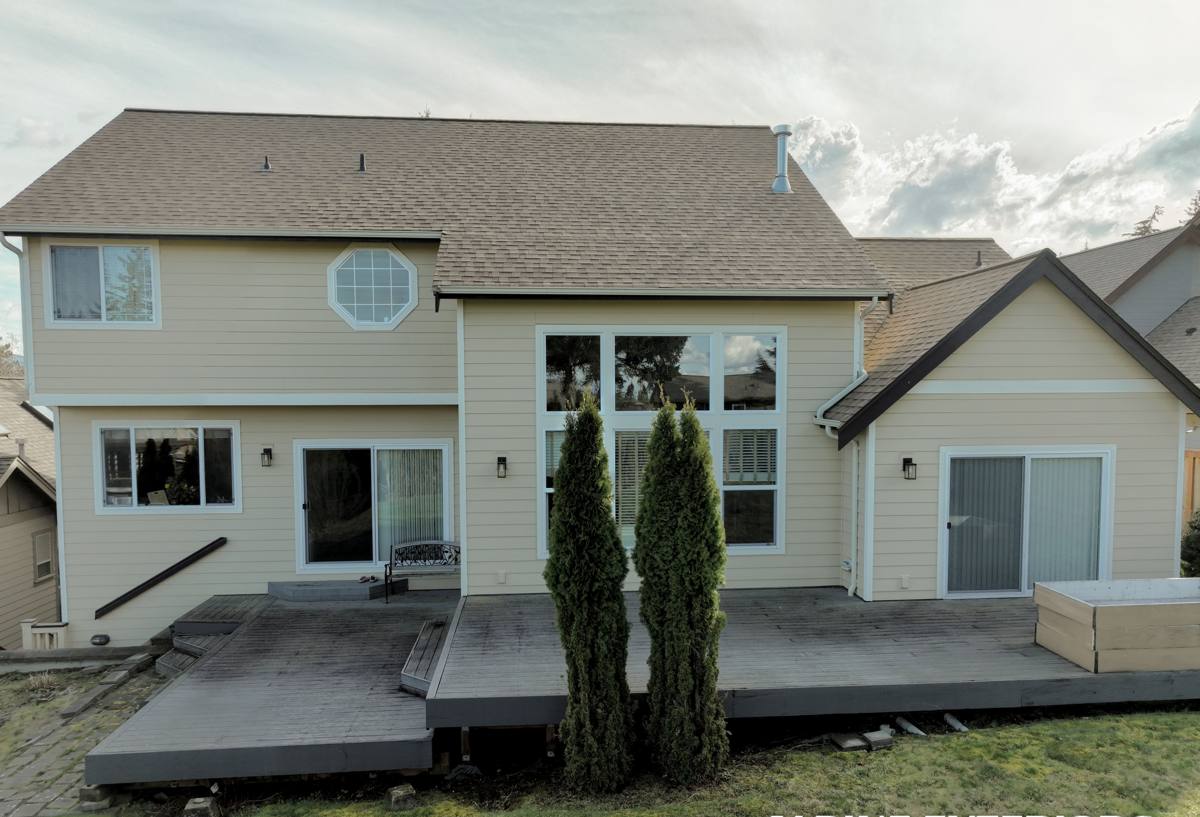
Signs a Deck Needs Replacement, Not Another Repair
Not every tired-looking deck needs to be torn out. But there's a point where patching boards or re-staining stops being a real fix and starts being a way to delay the inevitable. We look at a few things when we assess a Sunnyland deck:
- Soft or spongy spots in the decking or framing when you walk across it, especially near the house or in shaded corners
- Rust streaks or corroded fasteners, which are common here given the salt air and often signal hardware failure below the surface
- A ledger board (where the deck attaches to the house) that shows staining, gaps, or soft wood — this is the single most safety-critical connection on any deck
- Persistent moss or algae growth that keeps returning within weeks of cleaning, which usually means the wood underneath is already holding moisture
- Structural posts or footings that have shifted, settled, or show visible rot at the base
- A deck that's simply reached the end of its designed lifespan for the material it's built from
If the framing and ledger are sound and it's just surface boards showing wear, repair or resurfacing can make sense. If the structure itself is compromised, replacement is the honest recommendation — and it's usually more cost-effective than repeated repairs that don't address the underlying moisture problem.
Why the Ledger Board Matters So Much
The ledger is the board that bolts the deck to the house framing, and it's the connection responsible for carrying most of the deck's live load — people, furniture, grills. In wet coastal climates like ours, this is also the spot most prone to hidden rot, because water tends to collect where the deck meets the siding if the original flashing wasn't installed correctly or has failed over time. A deck can look structurally fine from the surface while the ledger connection underneath is quietly failing. This is one of the first things we check, and it's non-negotiable on any replacement.
What a Correct Deck Replacement Actually Involves
A deck replacement done right is not just pulling old boards and screwing down new ones. For homes in a wet, salt-exposed area like Sunnyland, the work that happens below the decking surface matters more than what's visible on top.
Ledger and Flashing
Proper flashing at the ledger board is what keeps water from wicking into the house framing and the deck structure at the same time. We install ledger flashing designed to shed water away from both the siding and the deck connection — this is one of the most common failure points we find on older decks in this area, and it's cheap to do right and expensive to fix later if it's skipped.
Framing and Fasteners
Given the salt air here, we use fasteners and structural connectors rated for coastal or high-corrosion environments rather than standard-grade hardware. Joist hangers, post bases, and structural screws all see accelerated wear near the bay, and using the correct rated hardware up front is far cheaper than dealing with hardware failure five or ten years down the road.
Footings and Structural Support
We check footing depth and condition against current code requirements — older decks in Sunnyland were sometimes built to standards that have since been updated, particularly around footing size and post connections. If footings are undersized or frost-heaved, replacement is the right time to correct that rather than build a new deck on a compromised foundation.
Decking Material
The visible surface is what most homeowners think about first, but it's the last decision in a properly sequenced replacement, not the first. We'll walk through material options based on how the deck is used, how much sun and shade it gets, and your maintenance preferences.
Comparing Decking Materials for Sunnyland's Climate
There's no single "best" decking material — each comes with real trade-offs, especially in a climate with this much moisture and moss pressure. Here's how the common options compare for this specific setting.
| Material | Moisture Behavior | Moss/Algae Resistance | Maintenance |
|---|---|---|---|
| Pressure-treated wood | Absorbs moisture readily; needs sealing to perform well long-term | Low — prone to moss and mildew without regular cleaning | High — annual cleaning and periodic sealing |
| Cedar | Naturally moisture-resistant but still absorbs water over time | Moderate — natural oils slow growth but don't stop it | Moderate to high — regular cleaning and finish maintenance |
| Composite decking | Does not absorb water into the core, but surface can stay damp longer | Moderate — smoother, capped boards resist buildup better than wood | Low — periodic washing, no sealing or staining |
| PVC decking | Fully non-absorbent | Moderate to high, depending on surface texture | Low — washing only |
In practice, we see a lot of Sunnyland homeowners lean toward composite or PVC decking specifically because of the moss and moisture maintenance burden of wood in this climate — not because wood is a bad material, but because the upkeep schedule that keeps wood performing well is a harder commitment to stick to when moss season runs most of the year. That's a maintenance and lifestyle trade-off, not a knock on wood decking itself.
Our Deck Replacement Process
- On-site assessment — we inspect the existing deck's framing, ledger, footings, and hardware to determine what's actually driving the failure, not just what's visible on the surface
- Scope and material discussion — we walk through material options and structural corrections needed, with honest trade-offs for each
- Permitting — deck replacements of most sizes in Bellingham require a permit; we handle this so the work is inspected and legal for resale or insurance purposes
- Demolition — careful removal of the old deck, checking the ledger and house connection point as it's exposed
- Structural correction — footings, framing, and ledger flashing brought up to current code and rated for this climate
- Decking installation — surface material installed per manufacturer spec, including proper fastener spacing and gapping for drainage
- Final walkthrough — we go over the finished deck with you, including what maintenance (if any) the material requires
Permits and Code in Bellingham and Whatcom County
Most deck replacements that involve structural changes — new footings, a rebuilt ledger connection, or a deck attached above a certain height — require a permit from the City of Bellingham or Whatcom County, depending on where the property sits. Skipping this step is a common shortcut some contractors take to move faster, but it creates real problems later: unpermitted structural work can complicate a home sale, cause issues with insurance claims, and in the worst case, means the deck was never inspected for the structural corrections that matter most, like the ledger connection. We pull the appropriate permits and coordinate inspections as part of the job, not as an add-on.
Moss, Algae, and Long-Term Deck Maintenance
Whatever material you choose, moss and algae control is an ongoing part of deck ownership in this part of Washington. A few practical habits go a long way:
- Keep gutters and downspouts clear so water isn't dumping directly onto or near the deck surface
- Trim back overhanging branches to let more light and air reach the deck, which slows moss growth significantly
- Sweep debris off the deck regularly — trapped leaves and needles hold moisture against the surface
- Wash the deck at least once a year with a cleaner appropriate to the material; pressure washing wood too aggressively can damage the surface, so settings matter
- Check and re-seal wood decking on the schedule the product calls for, typically every one to three years depending on sun exposure
Cost Factors to Expect
Every deck is different, but the price of a replacement is driven by a consistent set of factors. We give firm quotes after an on-site assessment, but this is generally what moves the number:
| Factor | Why It Matters |
|---|---|
| Deck size and shape | More square footage and complex angles increase material and labor |
| Decking material chosen | Composite and PVC cost more upfront than wood, less over time in maintenance |
| Structural condition found underneath | Rotted framing, undersized footings, or a failed ledger connection add scope once uncovered |
| Height and railing requirements | Taller decks and code-required railings add labor and material |
| Site access | Decks that are hard to reach with equipment or materials take longer to build |
Why Hiring a Crew That Already Works in Sunnyland Matters
A deck built to a generic national standard isn't necessarily built for this specific climate. Contractors who work regularly in Sunnyland and the surrounding Bellingham neighborhoods already know which fastener grades hold up against salt air, where moss tends to collect on local rooflines and decks, and how Whatcom County's permitting process actually works in practice — not just on paper. That local familiarity shows up in details a homeowner might not think to ask about: flashing details at the ledger, hardware corrosion ratings, and drainage gapping that accounts for how much rain this area actually gets. It's the difference between a deck that looks good for a season and one that's still structurally sound a decade from now.
A Homeowner's Deck Replacement Checklist
- Walk the deck and note any soft, spongy, or bouncy spots
- Look for rust staining around fasteners or connectors
- Check where the deck meets the house for staining or gaps in the siding
- Note how much moss or algae returns after cleaning, and how quickly
- Ask any contractor you're considering whether they pull permits for structural deck work
- Ask what fastener and hardware grade they use, given the salt air exposure in this area
If your Sunnyland deck is showing any of these signs, we're happy to take a look and give you a straight assessment — no pressure, no upsell, just an honest read on whether repair or replacement makes sense. Fill out the form below for a free estimate.