 Bellingham Exterior
 Why Sudden Valley Siding Wears Differently Than Siding Closer to Downtown
Sudden Valley sits back in the trees along Lake Whatcom, and that setting changes how siding ages compared to a house on an open lot closer to Bellingham Bay. Heavy tree canopy means less direct sun on north- and east-facing walls, which means siding stays damp longer after every rain. Add the lake's own humidity and the driving rain that rolls through Whatcom County most of the fall and winter, and you get siding that's almost never fully dry for months at a time. That's the exact condition moss, algae, and rot need to get established.
We've worked on enough homes around Lake Whatcom to know the pattern: damage doesn't show up evenly. It concentrates in the shaded, tree-shielded corners, behind shrubs planted too close to the wall, and along any spot where a gutter overflow or downspout dumps water against the siding instead of away from it. A repair plan for a Sudden Valley home has to account for that uneven exposure, not just patch the obvious spot and move on.
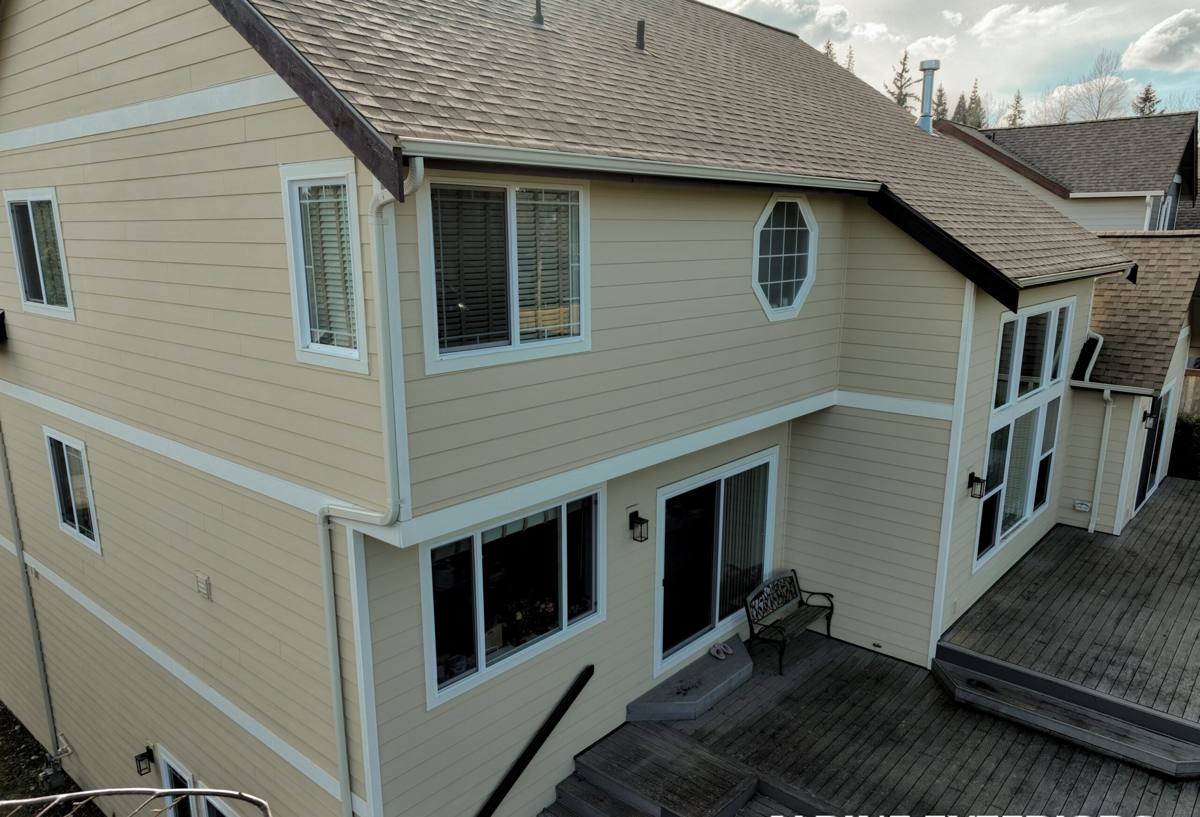
Signs Your Siding Needs Repair, Not Just Cleaning
A lot of homeowners in this area assume moss and staining are cosmetic. Sometimes they are. Sometimes they're a sign that moisture has been sitting against the siding long enough to start breaking it down underneath. Knowing the difference matters, because pressure-washing over a soft or delaminating panel can push water further into the wall instead of removing the problem.
- Soft, spongy, or crumbling spots when you press on the siding, especially near the bottom courses or trim
- Persistent moss or dark streaking that comes back within a season of cleaning
- Visible gaps, cracks, or separation at seams, corners, and butt joints
- Paint that's bubbling, peeling, or failing in a specific area rather than uniformly across the house
- Warping, bowing, or panels that no longer sit flat against the wall
- Staining or discoloration on interior walls near an exterior wall, which often means water has already gotten past the siding
- Visible wood rot at trim boards, window and door casings, or corner boards
Any one of these is worth a look before it's ignored through another wet season. In a climate like ours, small problems don't stay small.
Where Damage Hides on a Sudden Valley Lot
Because so many lots here back up to trees or slope toward the lake, we pay close attention to a few specific areas that get overlooked on a quick visual check: siding directly under roof valleys where runoff concentrates, wall sections shaded most of the day, and anywhere landscaping has grown up against the house and is trapping moisture against the wall.
What a Correct Siding Repair Actually Involves
A proper repair is more than swapping out a damaged board for a new one. Done right, it addresses why that section failed in the first place, or the same spot fails again in a year or two.
Diagnosing the Cause, Not Just the Symptom
Before we replace anything, we check what's behind it. That means looking at the house wrap or weather barrier, the flashing above windows and doors, and how water is actually moving across that section of wall. If a repair goes in over an existing moisture problem, it fails again fast — and that's a callback nobody wants, us included.
Matching and Sealing
Replacement pieces need to match the existing siding's profile, exposure, and finish as closely as possible so the repair doesn't stand out and so the wall keeps performing as a system. Seams, joints, and fastener penetrations get properly sealed and flashed — this is where a lot of budget repairs cut corners, and where problems come back.
Checking the Substrate
If sheathing or framing underneath has started to rot, replacing the siding without addressing what's behind it just hides the problem for a while. We open up affected areas enough to confirm the substrate is sound, or repair it, before closing the wall back up.
Repair vs. Replacement: How We Make the Call
Not every problem area needs a full re-side, and we're not going to tell a homeowner they need a whole new exterior when a targeted repair will hold up. The honest answer depends on how much of the house is affected and what's driving the damage.
| Situation | Usually Repair | Usually Replace |
|---|---|---|
| Damage isolated to one wall or a few boards | Yes | No |
| Rot traced to one recurring moisture source (gutter, flashing, grading) | Yes, once source is fixed | No |
| Moss and staining widespread across most elevations | Sometimes, if boards are structurally sound | Often, if underlying material is failing |
| Siding material is at or past its expected service life | No | Yes |
| Multiple past repairs in the same areas | No | Yes — recurring failure points to a bigger issue |
We'll walk the exterior with you, explain what we're seeing, and give a straight answer about which side of that table your house is on. If repair is the right call, that's what we'll recommend.
Our Repair Process for Sudden Valley Homes
- On-site assessment. We inspect the affected areas plus the surrounding wall sections, gutters, flashing, and grading that could be feeding the problem.
- Root-cause identification. We tell you what caused the damage, not just where it is, so you're not paying to fix the same spot again next winter.
- Scope and estimate. A clear written scope covering what's being replaced, what's being repaired in place, and what it addresses.
- Removal and substrate check. Damaged siding comes off carefully, and we confirm the sheathing and framing behind it are sound before closing it back up.
- Repair or replacement of the affected material. Matched profile and finish, correctly flashed and sealed at every seam and penetration.
- Final walkthrough. We show you the completed work and explain any maintenance steps that will help it hold up, given your lot's sun and moisture exposure.
Why James Hardie Is the Only Material We Use to Repair or Patch
We install and repair exclusively with James Hardie fiber cement siding — we don't patch a damaged wall with vinyl, LP SmartSide, cedar, or primed spruce, even as a stopgap. In a climate that keeps siding wet for long stretches of the year, that decision matters more than it might in a drier region.
Fiber cement doesn't absorb and swell with moisture the way engineered wood products can, and it doesn't support rot the way untreated wood siding does. James Hardie's ColorPlus factory finish is baked on and warranted against fading and peeling, which matters on a shaded wall where paint failure shows up fast. And Hardie's HZ product lines are engineered by climate zone — the HZ5 formulation used in the Pacific Northwest is built for exactly the freeze-thaw and moisture cycling this region sees.
When we repair a Hardie wall, we're matching into a system we know inside and out, backed by a manufacturer warranty that stays intact when the work is done to spec. When we're asked to repair or replace a section of vinyl, cedar, or engineered wood siding, we'll do an honest assessment and, if it's time to address that section long-term, explain why we'd recommend transitioning that area to Hardie rather than replacing failing material with more of the same.
Why a Crew That Already Works Sudden Valley Matters
Siding repair isn't a one-size-fits-all trade, and a lot Sudden Valley job isn't the same as a job on an open, sunny lot elsewhere in Whatcom County. A crew unfamiliar with heavily wooded, lake-adjacent properties can miss the actual cause of damage — treating a moss problem as cosmetic when it's really a sign of chronic moisture, or replacing a board without checking whether tree cover and grading are going to cause the same failure again.
Access matters too. Homes tucked into wooded lots or set back on sloped ground sometimes need a different approach to staging, ladders, and material handling than a straightforward street-front house. A crew that's done this specific kind of property before plans for that upfront instead of running into it mid-job.
And because Sudden Valley is a private community, having a contractor who's already familiar with how the neighborhood operates — gate access, HOA expectations, quiet hours around a residential lake community — makes the process smoother for everyone, including your neighbors.
What Drives the Cost of a Siding Repair
| Factor | Why It Matters |
|---|---|
| Extent of damage | A few isolated boards costs far less than damage spread across a full elevation |
| Cause of the damage | If flashing, gutters, or grading need correction too, that's added scope but prevents a repeat repair |
| Substrate condition | Rotted sheathing behind the siding adds material and labor beyond the visible repair |
| Access and site conditions | Wooded lots, slopes, and limited staging area can affect labor time |
| Color and finish matching | Matching existing ColorPlus finish or repainting the repaired section for a seamless look |
We give a written estimate that spells out what's driving the cost on your specific house, so there are no surprises once work starts.
Simple Maintenance That Protects Sudden Valley Siding Between Repairs
- Keep gutters clear so overflow isn't running down the wall instead of through the downspout
- Trim back branches and shrubs so siding gets airflow and at least some sun exposure
- Check caulking at trim, windows, and doors annually — the first thing to fail in a wet climate
- Address moss early with a gentle wash rather than letting it establish and hold moisture against the wall
- Watch shaded, tree-covered elevations more closely than sunny ones — that's where problems start first
If you're seeing moss that won't stay gone, soft spots, or damage tucked into a shaded corner of your Sudden Valley home, we're happy to take a look. We'll give you a straight read on what's causing it and what it actually takes to fix — with a free, no-pressure estimate using the form below.