 Bellingham Exterior
 Why Sudden Valley's Setting Is Hard on Exterior Walls
Sudden Valley sits along Lake Whatcom southeast of Bellingham, and the neighborhood's defining feature — heavy tree canopy over most lots — cuts both ways. It's a big part of why people live there, but it also means a lot of exterior walls stay shaded for much of the day, sometimes for months at a stretch in the darker part of the year. Shaded siding dries slower after rain, and slower drying means more time for moisture to sit against the wall assembly instead of evaporating off.
Layer that on top of the region's normal weather pattern — driving rain off the water, a long stretch of overcast, damp months, and marine air that moves inland through Whatcom County — and you get a climate that's genuinely tougher on siding than a drier, more open part of the same county. Moss and algae get a long runway to establish themselves on north-facing and tree-shaded walls, gutters and roof valleys fill with needles and leaf litter that hold water against trim and end grain, and any siding product that isn't built to handle sustained moisture exposure will show it — usually in the form of paint failure, swelling, staining, or soft spots at the joints long before it should.
None of this means Sudden Valley is a bad place to own a home. It means the siding choice and the installation details matter more here than they would on a wide-open, full-sun lot, and that's the lens we bring to every fiber cement job in the neighborhood.
What Siding Actually Needs to Do in This Kind of Setting
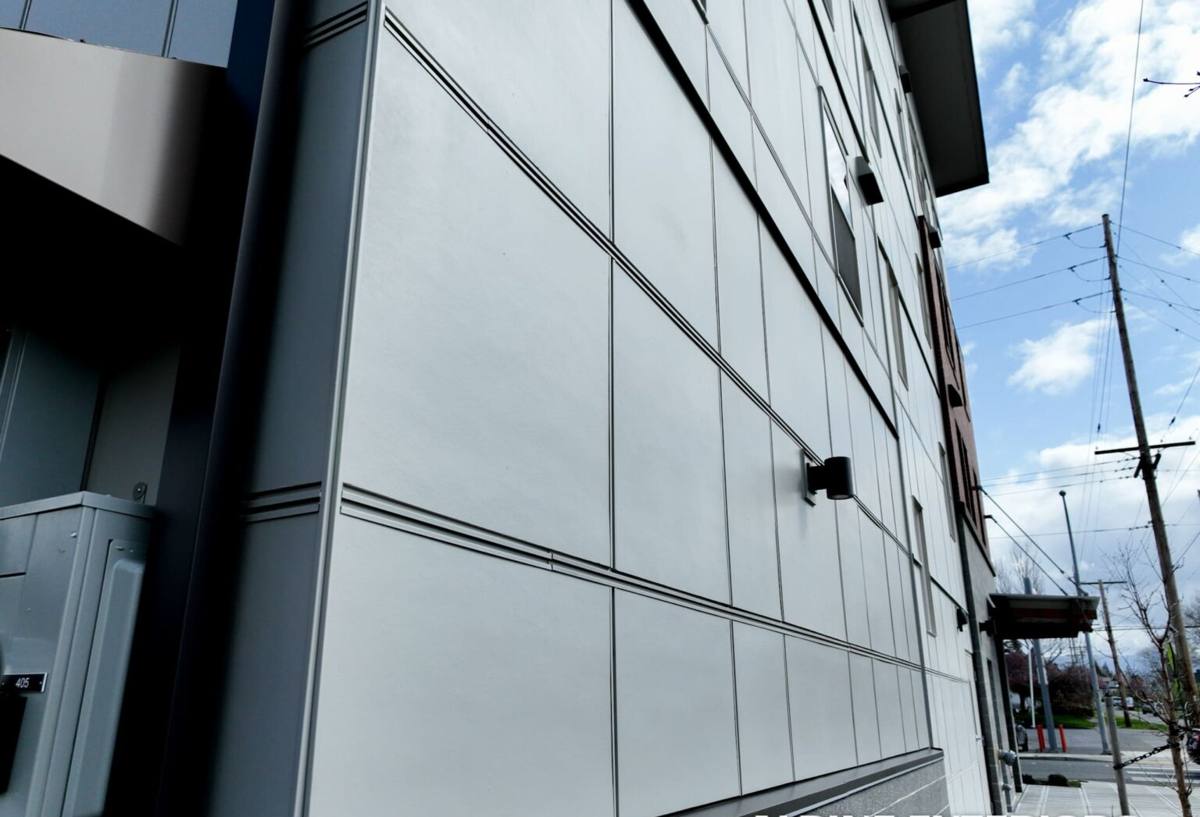
A wall product in Sudden Valley needs to do three things well: resist moisture without swelling or rotting, hold its finish under shade and moss pressure without chalking or peeling, and stay dimensionally stable through repeated wet-dry cycles. That's the whole reason we standardized on James Hardie fiber cement and don't install anything else. It's not brand loyalty — it's that Hardie's cement-based composition doesn't absorb and swell the way wood-based siding products do, and its factory-applied ColorPlus finish is baked on under controlled conditions rather than rolled or sprayed on site, which gives it meaningfully better resistance to the moss and algae staining that shaded, damp walls invite.
Hardie also engineers specific product lines for different climate zones (their HZ designations), which matters in a marine climate like ours. We spec the products and profiles built for wet, moderate-temperature exposure rather than a generic national product, because the difference shows up years down the road, not on installation day.
Why We Don't Install the Alternatives Here
We get asked about vinyl, LP SmartSide, primed wood, and cedar fairly often, and each has real strengths — vinyl is inexpensive, LP is lighter to handle, cedar looks great fresh off the truck. But in a shaded, moisture-heavy setting like Sudden Valley, the trade-offs stack up fast: wood-based products are more sensitive to sustained moisture and need diligent, ongoing maintenance to avoid swelling or rot at cut edges and joints; vinyl can warp and doesn't hold up well to the kind of debris and impact that comes with tree-heavy lots; cedar needs recoating on a schedule most homeowners don't actually keep up with once the newness wears off. We'd rather put one product on a home and stand behind it than sell something that needs a maintenance routine most people won't follow.
What a Correct Fiber Cement Installation Involves
Fiber cement siding is only as good as the installation underneath it. A rushed or by-the-eye install is where most siding failures — Hardie or otherwise — actually start.
Clearances and Drainage
Hardie publishes specific clearance requirements above grade, roofing, decks, and other hard surfaces, along with minimum gaps at trim and roof intersections. Those numbers aren't arbitrary — they exist so water has somewhere to go instead of wicking up into the bottom edge of a board. On wooded, sloped Sudden Valley lots, we pay close attention to grading and downspout discharge near the foundation, since a wall that's technically installed to spec can still take on moisture if the ground around it is holding water against the siding.
Flashing and Water Management
Every window, door, and roof-to-wall intersection needs flashing that sheds water down and out, layered correctly behind the water-resistive barrier — never just caulked over gaps and called finished. This is the part of the job nobody sees once the siding goes up, which is exactly why it's the part that separates a correct install from a problem waiting to surface in five years.
Fastening and Joints
Fiber cement needs to be fastened per manufacturer spec — correct nail type, depth, and placement — and butt joints need to be treated so they don't become the entry point for moss and moisture that they will become if left as a bare, unsealed seam. We follow Hardie's published fastening and joint-treatment requirements rather than a generic "close enough" approach, because that's what keeps the warranty valid and the wall dry.
Our Process for a Sudden Valley Fiber Cement Project
- Site walk and assessment — we look at tree cover, shade patterns, drainage, and access before we ever talk product or price.
- Moisture and substrate check — before new siding goes on, we check the existing wall assembly for hidden rot or moisture damage, especially at trim, corners, and any area that's been shaded and wet for years.
- Removal and repair — old siding comes off, any damaged sheathing or framing gets repaired, not covered up.
- Water-resistive barrier and flashing — installed and lapped correctly at every penetration, seam, and intersection.
- Hardie installation to spec — correct clearances, fastening, and joint treatment throughout.
- Trim, caulking, and final detailing — the finish work that determines how the job actually looks and performs.
- Walk-through — we go over the finished work with the homeowner before calling it done.
Why Local Experience in Sudden Valley Actually Matters
A lot of siding contractors can install a straight, flat wall on an open lot. Sudden Valley isn't always that. Many properties have narrow or shared access, tree root systems that limit where equipment and material staging can go, and slopes that change how scaffolding and safe access get planned. A crew that's already worked the neighborhood knows to plan for that before the trucks show up, not after.
It's also worth knowing that many Sudden Valley homes fall under a community association with its own expectations around exterior work, so we build that into scheduling and communication rather than treating it as a surprise partway through the job. And because shaded, tree-heavy lots behave differently than open ones, a crew with real reps in this specific setting is better at spotting the early signs of moisture trouble — soft trim, moss creeping into a joint, staining at a north wall — before they turn into a bigger repair.
James Hardie vs. Other Siding Options
| Factor | James Hardie Fiber Cement | Vinyl | LP SmartSide / Wood-Based | Cedar / Primed Wood |
|---|---|---|---|---|
| Moisture resistance | High — cement-based, doesn't swell | Moderate — can warp with heat/impact | Moderate — engineered wood, sensitive to sustained wet exposure | Low to moderate — needs consistent maintenance |
| Moss/algae resistance on shaded walls | Strong with factory ColorPlus finish | Moderate — finish can dull and stain | Moderate — surface coating wears | Low — organic surface invites growth |
| Fire performance | Non-combustible | Combustible | Combustible | Combustible |
| Maintenance routine | Low — occasional rinse and caulk check | Low but limited repair options | Moderate — coating upkeep | High — recoating on a schedule |
| Typical warranty structure | Long-term, transferable | Varies, often prorated | Varies by manufacturer | Product-dependent, often limited |
Cost Factors for a Sudden Valley Fiber Cement Project
| Factor | Why It Affects Cost |
|---|---|
| Existing siding removal and disposal | Tear-off scope depends on what's currently on the house and how it's fastened |
| Hidden repair needs | Rot or moisture damage found during removal adds repair time before new siding goes on |
| Home size and wall complexity | More linear footage, corners, and cuts means more labor |
| Trim and detail work | Windows, dormers, and architectural trim take more time than plain flat runs |
| Site access | Tree cover, slope, and staging space on wooded lots can affect equipment and labor time |
| Profile and finish choice | Lap size, texture, and ColorPlus color selection affect material cost |
Maintenance Checklist for Homes in a Shaded, Lake-Adjacent Setting
- Rinse siding at least once a year, paying extra attention to shaded, north-facing, and tree-covered walls
- Keep gutters clear of needles and leaf litter so water doesn't back up against trim and end joints
- Trim back vegetation that's touching or crowding the siding to improve airflow and drying time
- Check caulking at trim, corners, and penetrations annually, and re-seal anything that's cracked or pulled away
- Watch for moss forming at butt joints or lower courses — it's easier to address early than after it's established
- Address any drainage or grading issues near the foundation promptly, since standing water near the wall base undermines even a correctly installed siding job
If you're weighing a siding replacement on a Sudden Valley property, we're glad to walk the house with you, look at what the shade and moisture exposure have actually done to the current siding, and give you a straight read on what correct fiber cement installation would look like for your home. There's no pressure and no obligation — just fill out the form below to get a free estimate.