 Bellingham Exterior
 Why South Hill Windows Take a Different Kind of Beating
South Hill sits up above downtown Bellingham with open exposure toward Bellingham Bay, and that position cuts both ways. The views are part of why people love living there, but that same elevation and openness means homes take a steadier dose of wind-driven rain and salt-laden air off the water than houses tucked into more sheltered parts of Whatcom County. Add in our long, damp moss season and you have three separate forces working on every window opening in the house: corrosion from salt air, water intrusion from driving rain that hits window walls at an angle instead of straight down, and moisture that never fully dries out because the marine layer keeps humidity high for months at a time.
None of that means South Hill homes need exotic products. It means the installation details that get skipped on a quick, cheap job — the ones nobody sees once the trim is back on — are exactly the details that determine whether a window lasts 25 years or starts leaking in five. We've installed enough windows on this hill to know which corners get water and which walls take the brunt of a southwesterly storm, and we build the installation around that reality rather than treating every opening the same.
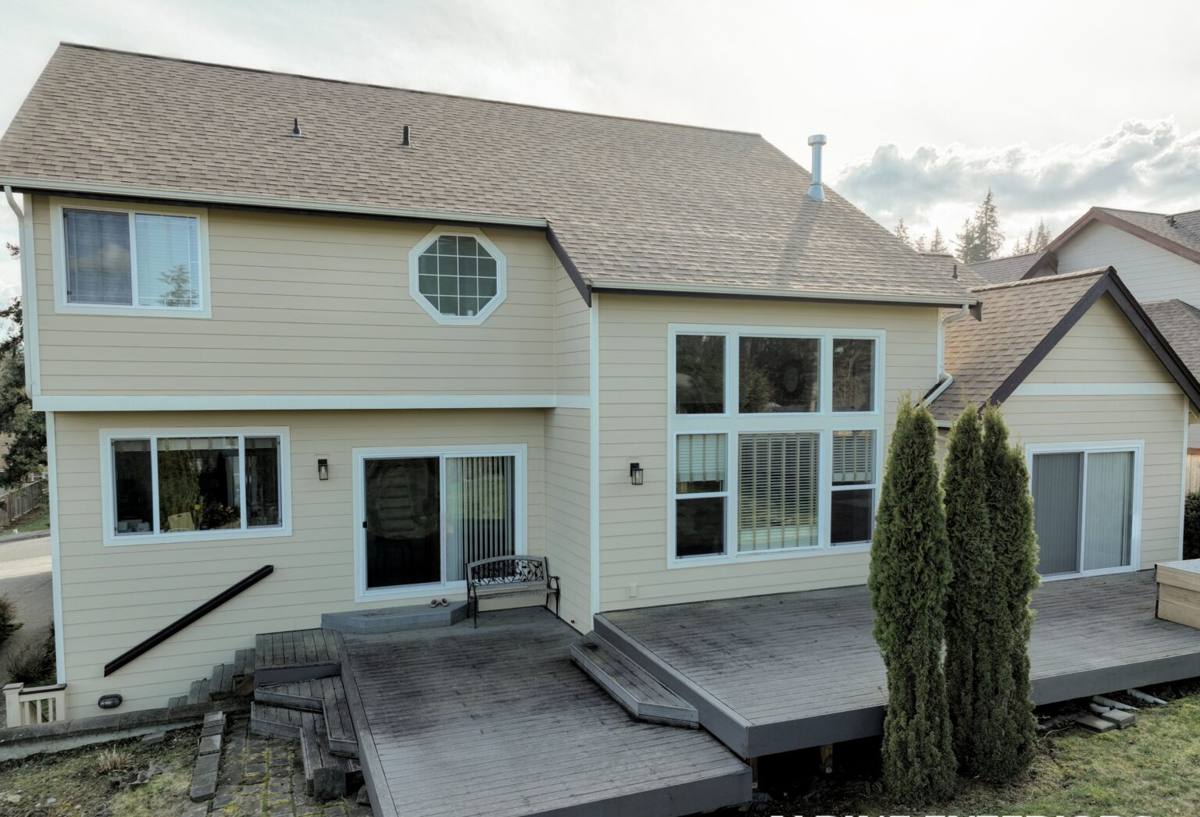
What a Correct Window Installation Actually Involves
Swapping a window sounds simple: pull the old one, drop in the new one, caulk the edges. That approach is also the single most common reason a "new" window leaks within a year or two. A correct installation is really about everything around the window unit, not the unit itself.
The Parts Nobody Sees
- Sill pan flashing — a sloped, sealed pan under the window that gives any water that does get past the frame a way out, instead of a place to pool
- Head flashing integrated with the house wrap or building paper so water sheds over the top of the window, not behind it
- Proper shimming and squaring so the window operates smoothly and the seals compress evenly — a racked frame stresses the seal on one side and leaves a gap on the other
- Backer rod and the right sealant at the interior and exterior, sized to the gap rather than just smeared over a joint
- Insulation in the rough opening without over-packing, which can bow the frame and cause the sash to bind
On a home exposed to the kind of driving rain South Hill gets in a winter storm, the flashing details matter more than almost anything else on the job. Water will find any gap given enough wind pressure behind it; the job of the flashing is to manage where that water goes once it's inside the wall assembly, not to pretend it will never get in.
Signs Your Current Windows Are Already Losing the Battle
Whatcom County's damp climate means window problems often show up as general "dampness" complaints long before anyone traces them back to the windows themselves. Here's what we look for during an assessment:
- Fogging or a milky haze between the panes of a double-pane unit — the seal has failed and the gas fill is gone
- Soft or discolored wood, drywall, or trim at the corners of the window, especially the bottom corners
- Visible moss or black streaking on the exterior sill or siding directly below a window
- Drafts you can feel with a hand near the frame on a windy day, even with the window latched
- Windows that are difficult to open, close, or lock — a sign the frame has shifted or swollen
- A musty smell in a room that doesn't go away with normal cleaning
Any one of these can be minor. Two or three together, especially on a wall that faces the prevailing weather, usually means water has been getting into the wall assembly for a while.
Choosing a Window Built for Bellingham's Coastal Weather
There is no single "best" window material — every option is a trade-off between upfront cost, maintenance, and how it holds up to sustained moisture and salt exposure. Here's how the common choices actually compare for a home in this climate:
| Frame Material | Moisture & Salt Air Behavior | Maintenance | Typical Lifespan |
|---|---|---|---|
| Vinyl | Won't rot or corrode; seams and welds are the weak point if not fabricated well | Low — occasional cleaning | 20–30 years |
| Fiberglass | Excellent — dimensionally stable, resists both moisture and salt corrosion | Low | 30–40+ years |
| Wood (unclad) | Handsome but vulnerable; needs a sound paint or finish barrier to resist our rain season | High — repainting/refinishing on a cycle | Varies widely with upkeep |
| Wood-clad (aluminum or vinyl exterior) | Good — exterior shell handles weather, wood interior stays protected | Moderate | 25–35 years |
| Aluminum | Conducts cold and can condense heavily in our humidity; thermally broken versions perform better | Low | 20–30 years |
We steer most South Hill homeowners toward vinyl or fiberglass for straightforward replacements, and wood-clad when matching an older home's architectural character matters. Unclad wood isn't wrong, but it's an honest maintenance commitment in a climate that rarely gives paint a long dry stretch to cure — we'll say that plainly rather than sell a product that doesn't fit how a homeowner actually wants to spend their weekends.
How Our Installation Process Works
- On-site assessment — we check existing flashing, sill condition, and any signs of prior water intrusion before quoting anything
- Measure and order — exact opening measurements, accounting for any out-of-square conditions common in older South Hill framing
- Remove the old unit carefully — including inspecting the rough opening once it's exposed, since this is the only point in the project where hidden rot or old flashing failures are visible
- Repair the opening — replace any soft framing, install new sill pan flashing, and integrate new flashing with the existing weather barrier
- Set, shim, and square the new window — checking operation before final fastening
- Insulate and seal — interior and exterior sealant, backer rod where called for, low-expansion foam at the perimeter
- Trim and finish — interior and exterior trim reinstalled or replaced to match
- Final operation and water-test check — confirming the window latches, seals, and sheds water correctly before we call the job done
Every step past the first two is where a rushed installer cuts time. We don't skip the rough-opening inspection even when the old window looks fine from the outside, because that's the one chance to catch a slow leak before it becomes a rot repair down the road.
Retrofit vs. Full-Frame Replacement on Older South Hill Homes
South Hill has a good number of older homes, and older framing changes the calculus on how a window should be replaced. A retrofit (or "pocket") replacement reuses the existing exterior frame and trim, which is faster and less disruptive — but it only makes sense if that existing frame is solid and properly flashed. A full-frame replacement removes the old frame down to the rough opening, which costs more and takes longer, but it's the only option when there's any sign of water damage, rot, or flashing that was never installed correctly in the first place.
We won't recommend a retrofit just because it's the cheaper, quicker sell. If we open things up and find damage, we'll tell you honestly what a full-frame replacement involves and why it's the right call for that specific opening — even if it means a bigger project than you walked in expecting.
Why a Crew That Already Works South Hill Matters
Window installation quality depends heavily on understanding the specific conditions of a site, and South Hill has a few recurring ones: homes positioned to catch weather straight off the bay, a mature tree canopy in places that keeps roofs and sills shaded and slow to dry, and a housing stock that spans decades of different construction practices. A crew that has worked the neighborhood before isn't guessing at how a particular wall assembly was built or which exposures need extra attention to flashing — they've already seen it up the street.
That local familiarity also shows up in smaller ways: knowing which permitting requirements apply in the City of Bellingham versus unincorporated Whatcom County parcels nearby, and being available for a follow-up visit without a long drive if a question comes up after the job.
What Affects the Cost of a South Hill Window Project
| Factor | Why It Matters |
|---|---|
| Retrofit vs. full-frame | Full-frame requires more labor, trim work, and sometimes siding repair around the opening |
| Frame material | Vinyl is typically the most budget-friendly; fiberglass and wood-clad cost more upfront but can cost less over the window's life |
| Number of openings | Per-window cost usually drops as the total project size grows |
| Existing damage | Rot or failed flashing discovered during removal adds repair scope before the new window can go in |
| Access and elevation | Upper-story or hard-to-reach windows on a sloped South Hill lot can require additional equipment or time |
We give straightforward, itemized estimates so you can see what's driving the number — not a flat per-window price that hides what happens if we find a problem once the old window comes out.
Protecting Your Investment After Installation
A correctly installed window still needs a little seasonal attention in this climate. Keep gutters clear so overflow doesn't run down the wall and pool at window heads. Clean moss off sills and adjacent siding before it holds moisture against the frame — moss doesn't damage a properly flashed window directly, but it keeps the surrounding area wetter for longer, which stresses everything nearby over time. Check exterior caulk lines once a year, since even good sealant has a service life and UV plus constant damp cycles will eventually break it down. None of this is heavy maintenance, but skipping it is how a well-installed window ends up with an avoidable problem a decade in.
If you're noticing drafts, fogged glass, or water staining around windows on your South Hill property, we're happy to take a look and give you an honest read on what's actually going on — no pressure, no hard sell. Use the form below to request a free estimate.