 Bellingham Exterior
 Siding Repair in Fairhaven Has Its Own Set of Problems
Fairhaven sits close to Bellingham Bay, which means homes here deal with a combination of conditions that inland Whatcom County properties don't see nearly as much: salt-laden air off the water, wind-driven rain that hits walls at an angle instead of falling straight down, and long stretches of shade and dampness that keep moisture sitting against exterior walls far longer than it should. Add in the tree cover common to many Fairhaven lots, and you get a near-constant moss and algae season that most siding products were never designed to handle gracefully.
That combination shows up in the repair calls we get from this part of Bellingham. It's rarely one dramatic failure. It's usually a slow accumulation of small problems — a soft spot near a downspout, a stretch of paint that won't hold, a corner where moss has been sitting for two winters — that eventually adds up to a wall that needs real attention. Repairing siding correctly in Fairhaven means understanding that pattern, not just patching the spot that's visible today.
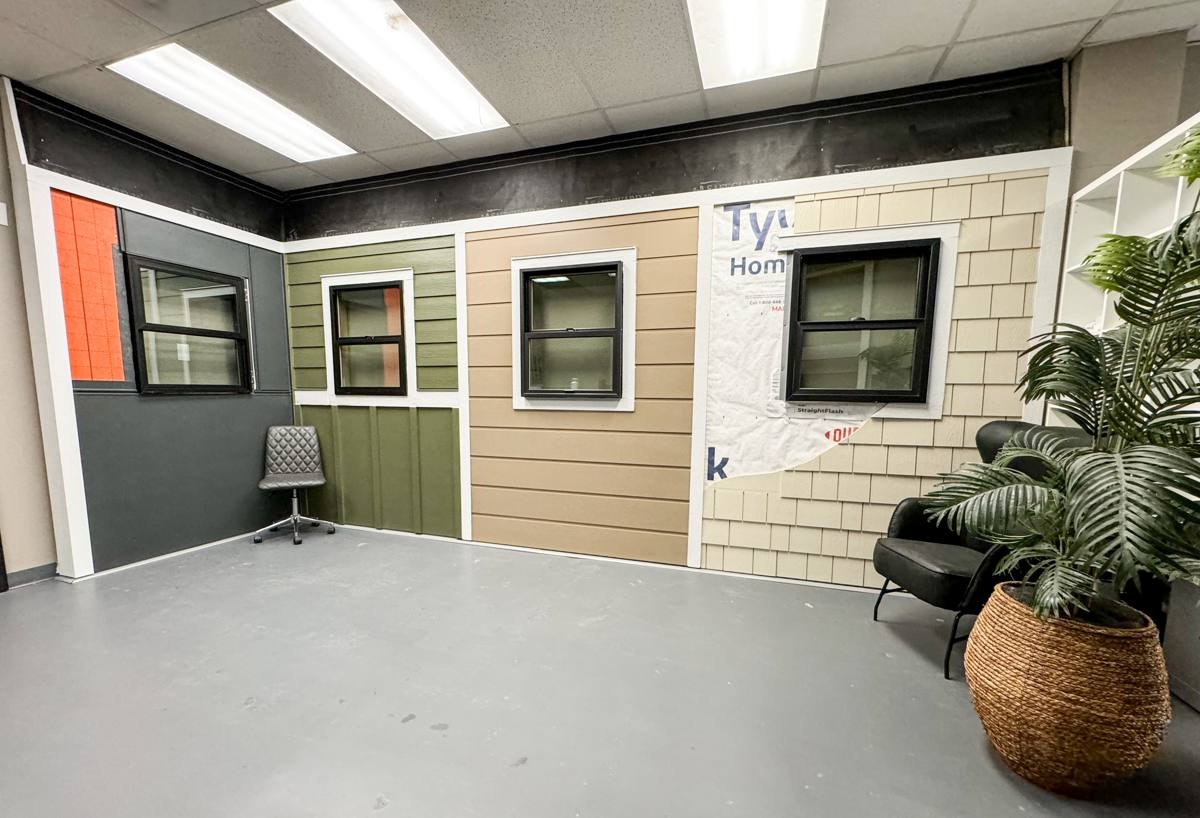
What Bellingham's Climate Actually Does to Exterior Walls
Salt Air and Moisture Cycling
Proximity to the bay means airborne salt settles on siding, trim, and fasteners. On its own, salt exposure is a slow, steady stressor — it accelerates corrosion on metal fasteners and flashing, and it interacts with paint films in ways that shorten repaint cycles. Combined with our region's near-constant humidity, it also means siding rarely gets a long, dry stretch to fully release moisture it's absorbed.
Driving Rain and Wind-Loaded Walls
Storms coming off the water frequently push rain sideways into walls rather than letting it run straight down and off. That matters because most siding failures aren't caused by rain landing on a wall — they're caused by rain finding a gap, seam, or fastener hole and getting behind the cladding. Wind-driven rain finds those gaps far more aggressively than a calm, vertical rainfall ever would.
Moss, Algae, and Shade
Many Fairhaven properties have mature trees and close-set homes that limit direct sun on at least one or two exterior walls. Those shaded, damp faces are where moss and algae take hold first, and where paint failure and substrate softening tend to start. A north-facing wall under tree cover can need attention years before the rest of the house shows any wear at all.
How Whatcom County's Climate Stacks Up
| Condition | Effect on Siding | Most Affected Areas of a Fairhaven Home |
|---|---|---|
| Salt air off the bay | Accelerates fastener corrosion, shortens paint life | Bay-facing walls, exposed trim, fastener heads |
| Wind-driven rain | Forces water into seams and fastener penetrations | Corners, butt joints, window and door trim |
| Shade and tree cover | Keeps walls damp longer, promotes moss/algae growth | North-facing walls, areas under overhangs and trees |
| Mild, wet winters | Extended freeze-thaw-adjacent moisture cycling | Lower wall sections, areas near grade and downspouts |
Signs Your Fairhaven Home Needs Siding Repair
Most siding problems give warning signs well before they become structural. Homeowners who catch these early save real money on the repair.
- Soft or spongy spots when you press on siding, especially near the bottom courses or below windows
- Paint that's bubbling, peeling, or won't hold even after a fresh coat
- Visible moss, algae, or dark streaking that keeps returning after cleaning
- Gaps or separation at seams, corners, or where siding meets trim and flashing
- Warping, cupping, or bowing in individual boards or panels
- Rust staining running down from fastener heads or metal flashing
- Interior signs — a musty smell, a stained wall, or peeling interior paint on an exterior wall
What a Correct Repair Actually Involves
A quick patch — caulk over a gap, a fresh coat of paint over a soft spot — almost never solves the underlying problem, and on a home exposed to Fairhaven's rain and salt air it tends to fail again within a season or two. A repair worth doing right involves a few non-negotiable steps:
1. Find the Actual Water Path
Visible damage is rarely where water is entering. We trace the path back — often to a fastener hole, a failed seam, a piece of missing or damaged flashing, or a gap where trim meets siding — before deciding what needs to come off.
2. Check What's Underneath
Siding is the visible layer, not the only layer. Once damaged material is removed, we look at the water-resistive barrier, sheathing, and framing underneath. If moisture has been getting in for a while, the repair scope may need to expand to include what's behind the siding, not just the siding itself.
3. Match Material and Method, Not Just Color
A patch that doesn't match the surrounding material's expansion behavior, fastening pattern, or moisture response will telegraph as a visible seam and can create a new weak point. This is one of the reasons material choice matters as much in a repair as it does in a full replacement.
4. Rebuild the Water Management, Not Just the Surface
Flashing, seams, and fastener placement get corrected as part of the repair — not just covered back over. A repair that re-creates the same water path that caused the original damage isn't a repair, it's a delay.
Repair or Replace? How We Help You Decide
Not every damaged section needs a full re-side, and not every damaged section should be patched. The right call depends on how far the damage has spread and what's driving it.
| Factor | Favors Targeted Repair | Favors Full Replacement |
|---|---|---|
| Extent of damage | Isolated to one or two areas | Recurring across multiple walls or elevations |
| Underlying material condition | Substrate and framing are sound | Sheathing or framing shows rot or long-term moisture damage |
| Age of existing siding | Siding is mid-life and otherwise performing well | Siding is near or past its expected service life |
| Original material and installation | Was installed correctly and is a durable material | Original install had systemic flashing or fastening issues |
We'll always tell you honestly which category your home falls into. A well-installed wall with one damaged section doesn't need to come down. A wall with a pattern of recurring failures usually does — and patching it repeatedly just delays a bigger bill.
Why We Repair Into, and Replace With, James Hardie Fiber Cement Only
We install exclusively James Hardie fiber cement siding — we don't work with vinyl, LP SmartSide, cedar, primed spruce, or other fiber cement brands like Cemplank or Allura. That's a deliberate standard, not a sales preference, and it matters most in a climate like Bellingham's.
Wood-based and engineered-wood products can perform well for a time, but they depend heavily on paint film integrity and moisture management to avoid swelling, delamination, or rot — exactly the failure modes we see accelerated by Fairhaven's damp, shaded, salt-exposed conditions. Vinyl handles moisture differently but can become brittle over time, distort under heat, and offers limited repair options when damaged since color-matched replacement pieces aren't always practical. Other fiber cement brands may share Hardie's basic material category but don't carry the same climate-specific engineering, factory-applied ColorPlus finish, or the transferable warranty backing we require before we'll stand behind a repair.
James Hardie's HZ5 product line is engineered specifically for wetter, harsher climates like ours, with moisture and freeze-thaw performance built into the material itself rather than relying entirely on field-applied paint. When we repair a section of Hardie siding, we're working with a material that's non-combustible, dimensionally stable, and backed by a strong warranty — and when a repair reveals that a full section or wall needs replacing, we rebuild it in the same system rather than mixing materials.
Why This Matters Specifically for Repairs
Patch repairs are only as good as the material they're tying into. Matching new material into old is easier and more durable when the original installation was done to spec with a product designed for the climate it's in. That's a major reason homes already sided in James Hardie tend to have simpler, more durable repairs than homes sided in materials more sensitive to moisture and UV exposure.
Our Process for Fairhaven Siding Repair Calls
- On-site inspection — we look at the damaged area and check the rest of the home for related issues, since Fairhaven's exposure conditions rarely affect just one spot.
- Honest scope assessment — we tell you plainly whether this is a contained repair or something that's grown into a replacement, and why.
- Removal and inspection behind the siding — we don't guess at what's underneath; we check it.
- Repair or rebuild using James Hardie materials — matched profile, proper fastening, and corrected flashing and water management.
- Final check — seams, trim, and paint match are reviewed before we consider the job finished.
Why Local Experience in Fairhaven Matters
A contractor who only occasionally works in this part of Bellingham can miss the specific pattern of damage that Fairhaven's location produces — the bay-facing exposure, the shaded north walls under mature trees, the way wind-driven rain behaves against a home a few blocks from the water. A crew that regularly works this neighborhood knows where to look first, what typically drives the damage, and how to build a repair that actually holds up through the next wet season instead of needing attention again in a year or two.
If you're seeing soft spots, recurring moss, failing paint, or any of the warning signs above on a Fairhaven home, it's worth having it looked at before the damage spreads further behind the wall. We offer free, no-pressure estimates — use the form below to schedule a look at your home and get a straight answer on what it needs.