 Bellingham Exterior
 Deck Repair in Barkley: What Bellingham's Climate Does to a Deck
Barkley sits close enough to Bellingham Bay that salt-tinged air is part of daily life, and that air is harder on exterior wood and fasteners than most homeowners realize. Add Whatcom County's driving winter rain, long shoulder seasons of damp overcast, and a moss season that can run from October through May, and you have a climate that quietly works against every deck in the neighborhood. None of this means a deck is doomed — it means a deck built or repaired without that climate in mind will fail years before it should.
Most deck problems we find in Barkley aren't dramatic. They're slow: a ledger board that's been trapping moisture behind the siding for two winters, fasteners that started rusting the day they were installed with the wrong coating, or a shaded corner where moss has been holding water against the boards since last fall. Repair work here is really about finding and correcting those slow failures before they turn into a safety issue or a full rebuild.
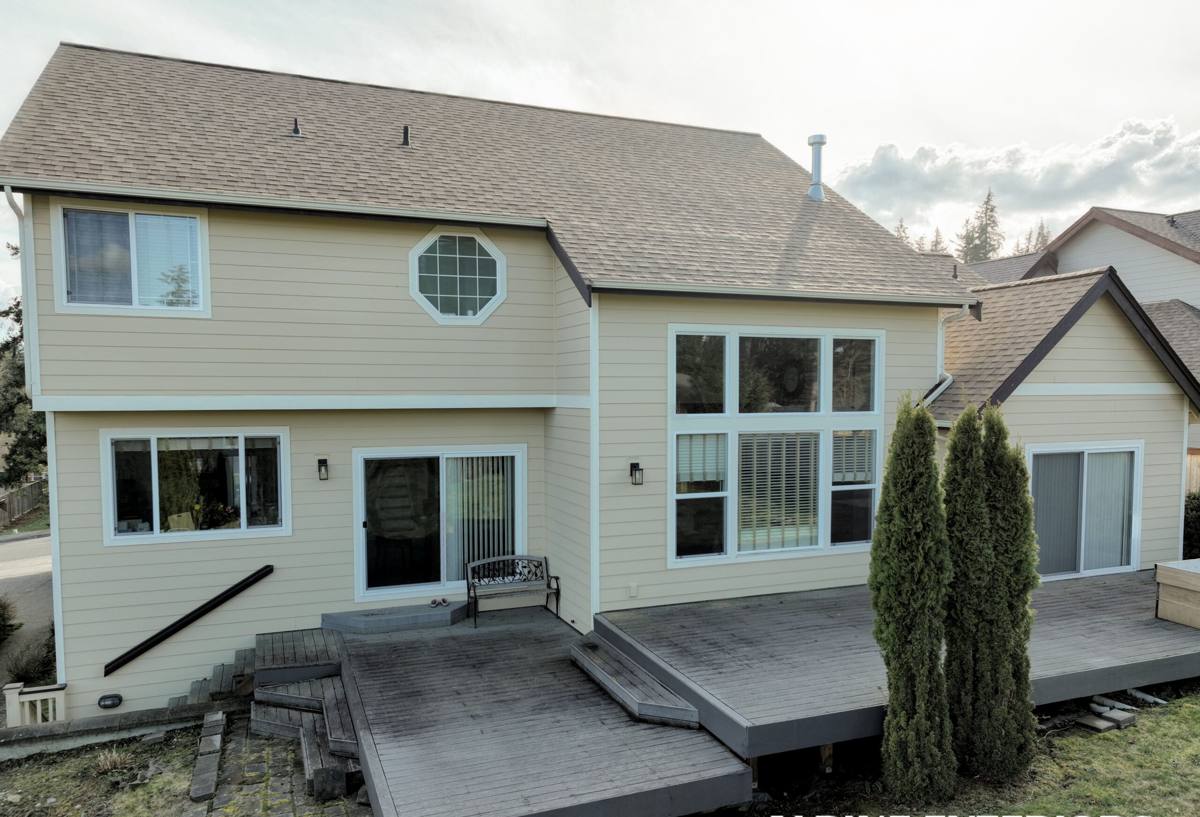
Signs Your Barkley Deck Needs Repair, Not Just a Wash
A pressure wash and a coat of sealer can make a tired deck look better for a season, but it won't fix what's underneath. Before you book a cleaning, look for these signs that the deck needs actual repair work:
- Boards that feel spongy, soft, or flex noticeably when you step on them
- A gap, dark staining, or soft wood where the deck meets the house (the ledger board area)
- Rust streaks bleeding out from screw or nail heads
- Railings or stair posts that wobble or shift under hand pressure
- Persistent moss or algae in the same spots no matter how often you clean
- Water that pools and takes hours to drain after rain instead of shedding off
- Cracking, splitting, or checking that runs along the length of a board rather than just the surface
- Stair stringers pulling away from the deck frame or the ground
Any one of these on its own might be a small fix. Several at once usually means water has been getting into the structure for a while, and it's worth having someone look at the framing, not just the surface.
Why "It Still Looks Fine" Isn't the Right Test
Decking boards weather to a gray or silvery color no matter what they're made of, and that color change alone doesn't mean anything is wrong. The problems that actually matter — framing rot, fastener corrosion, a failing ledger connection — happen underneath and behind the visible surface. That's why a real inspection involves probing joists and the ledger area, not just looking at the top of the boards from a few feet away.
The Problems We See Most Often on Barkley Decks
Moss and Algae Buildup
Shaded decks, north-facing decks, and anything under overhanging trees hold moisture longer in this climate, and moss takes hold fast. Left alone, moss doesn't just look bad — it holds water against the wood surface continuously, which accelerates rot in a way that a deck getting normal sun and airflow doesn't experience.
Ledger Board and Flashing Failures
The ledger board — where the deck attaches to the house — is the single most common failure point we find on repair calls. If the flashing behind it was installed wrong, is missing, or has failed over time, water gets channeled directly into the rim joist and wall framing behind the siding. This is a structural issue, not a cosmetic one, and it's often invisible until you know where to look.
Fastener Corrosion
Older decks, or decks repaired with mismatched hardware, often have fasteners that were never rated for the type of treated lumber used or for constant coastal moisture exposure. Corroding fasteners lose holding strength gradually, which shows up as loose boards, squeaking, or railings that feel less solid than they used to.
Post and Footing Movement
Freeze-thaw cycles and saturated soil during the wettest months can shift undersized or shallow footings over time. A deck that's developed a slight lean, or stairs that no longer sit flush with the ground, are usually telling you something moved below grade.
Repair or Replace? How We Make the Call
Not every deck problem calls for a full rebuild, and we don't default to recommending one. The decision usually comes down to how much of the structural framing is still sound versus how much of the damage is limited to the visible decking surface.
| Factor | Repair Usually Makes Sense | Replacement Usually Makes Sense |
|---|---|---|
| Framing condition | Joists and beams are solid when probed | Widespread soft or rotted framing |
| Ledger connection | Flashing is intact or easily corrected | Ledger and rim joist are compromised |
| Extent of damage | Isolated boards, posts, or stair sections | Damage spread across most of the deck |
| Age of structure | Newer build with a localized issue | Original structure past its practical service life |
| Code compliance | Railings, spacing, and footings already meet current code | Structure predates current guardrail or footing requirements |
In a lot of Barkley homes, we find the framing is in better shape than the surface suggests, which means a targeted repair — new decking boards, corrected flashing, upgraded fasteners — restores the deck without the cost of a full teardown. We'll always tell you honestly which category your deck falls into.
What a Proper Deck Repair Involves
A repair that actually holds up through another Bellingham winter goes well beyond swapping out a few obviously bad boards. Here's what we check and correct on a typical repair:
- Full inspection of the frame, ledger, posts, and footings, not just the decking surface
- Moisture and soft-spot checks on framing members, especially near the house connection
- Correction of any flashing or ledger issues found — this gets fixed before any new decking goes down
- Replacement of damaged joists, posts, or stair stringers as needed
- Installation of new decking boards matched to the existing material where possible
- Fastener upgrades using hardware rated for treated lumber and coastal moisture exposure
- Railing and guard post tightening or rebuilding to current safety standards
- Final cleanup and, where appropriate, sealing or finishing recommendations
Skipping the flashing or framing check to save time is the single most common shortcut that leads to a deck needing the same repair again within a couple of years. We don't do that step separately — it's part of every repair job, not an upsell.
Decking Material Options When Repairing
When we're replacing sections of decking, homeowners usually have a choice between matching the existing material or switching to something with different maintenance needs. Here's how the common options compare for repair work in this climate:
| Material | Moisture Behavior | Maintenance | Typical Use in Repairs |
|---|---|---|---|
| Pressure-treated lumber | Resists rot when properly sealed; needs reapplication over time | Periodic cleaning and re-sealing | Matches most existing framing and older decks |
| Cedar | Naturally rot-resistant but softer, shows wear faster in wet shade | Regular sealing to hold color and resist moss | Common on older, higher-end decks needing board matching |
| Composite | Doesn't absorb water into the board itself | Occasional washing, no sealing | Good option when replacing large sections and moving away from wood upkeep |
There's no single right answer — it depends on what's already there, your budget, and how much upkeep you want going forward. We'll walk through the trade-offs honestly rather than pushing whichever product happens to be easiest for us to install.
Our Process From Estimate to Finished Repair
Repair calls in Barkley generally follow the same straightforward process:
- On-site inspection — we look at the whole structure, not just the area you called about, since problems often extend past what's visible from the surface
- Written scope and estimate — you get a clear breakdown of what needs fixing and why, with an honest range before any work starts
- Repair work — framing, flashing, decking, fasteners, and railings addressed in the right order so nothing gets covered up before it's fixed
- Walkthrough and cleanup — we go over the completed work with you before we consider the job done
There's no pressure to upgrade to a full rebuild if a repair is the right call, and no shortcuts taken just to keep the estimate low.
Why a Local Bellingham Crew Matters for Barkley Homes
Deck problems here are shaped by conditions that are specific to this part of Whatcom County — the salt air off the bay, the amount of shade and moisture certain lots hold onto, and how long moss season actually runs compared to drier parts of the state. A crew that works this area regularly has already seen how these conditions play out on decks similar to yours, which means less guesswork during the inspection and fewer surprises once repairs are underway.
Being local also means we're not far away if a repair needs a follow-up visit, and we're familiar with the permitting and inspection expectations that apply to structural deck work in Bellingham. That matters most on anything involving footings, framing, or guardrail changes, where doing it right the first time avoids problems at resale or during a future inspection.
Keeping Your Deck in Good Shape After the Repair
A repaired deck still needs ongoing attention in this climate — the same conditions that caused the original problem don't go away. A few habits go a long way toward getting years of extra life out of the work:
- Sweep leaves and debris off regularly, especially in fall, so moisture doesn't sit trapped against the boards
- Treat moss and algae as soon as you see it return, rather than waiting for a full seasonal cleaning
- Check railings and stair posts for looseness once or twice a year, particularly after a hard winter
- Keep gutters and downspouts near the deck clear so runoff isn't draining directly onto or under it
- Reseal wood decking on the schedule appropriate to the product used, not just when it looks faded
- Have the ledger and flashing area glanced at periodically, since it's the spot most likely to hide a slow leak
If you're noticing soft boards, loose railings, persistent moss, or anything else on the list above, it's worth getting an honest look before it turns into a bigger job. We offer free, no-pressure estimates for deck repair work in Barkley and the surrounding Bellingham area — the form below is the easiest way to get one scheduled.