 Bellingham Exterior
 Siding Installation in Cordata: What This Part of Bellingham Needs
Cordata sits in north Bellingham, a part of the city that grew up mostly through subdivision and infill development from the 1990s onward, which gives the neighborhood a different housing profile than Bellingham's older, waterfront-adjacent areas. A lot of Cordata homes are newer construction relative to the rest of the city, built with the vinyl, engineered wood, or budget fiber cement that was standard on production homes at the time. That matters for one simple reason: a growing share of those original installations are now old enough that homeowners are starting to see real wear, and they're asking whether it's time for a full siding replacement rather than another round of patching and caulking.
Cordata isn't sitting directly on Bellingham Bay the way some neighborhoods are, but it's still inside the same marine air mass and the same wet weather pattern that defines exterior work across Whatcom County. Salt-tinged air, sideways rain, and a moss season that runs most of the year don't stop at the water's edge — they follow the wind inland, and homes here deal with the same slow-motion weathering as anywhere else in Bellingham, just with a housing stock that's often younger and, in a lot of cases, sided with materials that weren't built with this specific climate in mind.
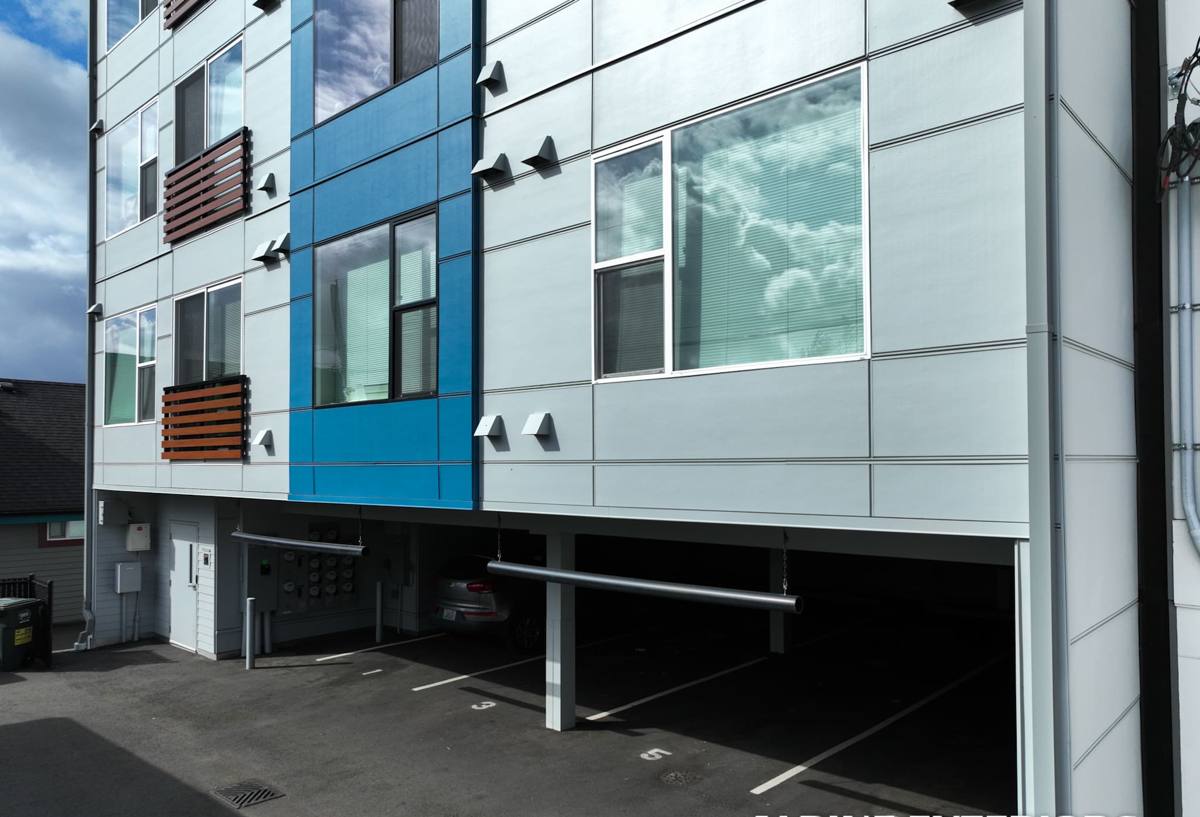
What Bellingham's Climate Asks of a Cordata Siding Installation
Salt Air Reaches Beyond the Waterfront
Marine air off Bellingham Bay and the Salish Sea doesn't just sit at the shoreline — it moves with the prevailing weather patterns across the city, including inland neighborhoods like Cordata. It's a background condition more than a dramatic one: a slow, steady exposure that works on fasteners, caulking, and lower-grade finishes over years rather than seasons. On a lot of production-built homes from the 1990s and 2000s, the original siding wasn't specified with this kind of sustained coastal exposure in mind, which is part of why so many of those installations are showing their age now.
Wind-Driven Rain Still Finds the Gaps
Bellingham's rain is rarely a straight-down event. Wind carries it sideways, and it finds lap joints, trim seams, and wall penetrations from angles a siding system built for a calmer climate was never tested against. Newer construction doesn't get a pass here — a house built in 2001 deals with the same wind-driven rain as a house built in 1951, and the installation quality underneath the siding matters just as much as the material on top of it.
A Moss Season That Doesn't Skip Newer Neighborhoods
Mild, damp conditions for most of the year mean moss and mildew growth is a fact of life anywhere in Bellingham with shade and limited airflow, including the mature landscaping that's grown in around Cordata's older subdivisions over the past two or three decades. Porous or moisture-retentive siding materials become a growth surface over time, and it typically starts on north-facing walls or spots shielded by fencing, trees, or neighboring structures — the same areas that get checked least often.
Why We Only Install James Hardie Fiber Cement
We don't offer a menu of siding brands and let price make the decision. We install James Hardie fiber cement, and only James Hardie, based on what we've consistently seen on tear-offs and repair calls across this climate.
- Non-combustible core: Fiber cement doesn't feed a fire the way wood-based siding can, which matters for household safety and can matter for insurance considerations.
- Factory-applied ColorPlus finish: The color coat is baked on under controlled factory conditions rather than field-applied, which gives it real resistance to fading, chalking, and moisture intrusion over time.
- Climate-engineered HZ product lines: Hardie's HZ5 formulation is built for regions with sustained moisture and freeze-thaw cycling, a closer match to Whatcom County than a generic national spec.
- Dimensional stability: Fiber cement doesn't swell, cup, or warp the way engineered wood can after repeated wet-season moisture cycles.
- Strong transferable warranty: Hardie backs its products with one of the more substantial warranty structures in the industry, provided the installation follows spec.
We don't install LP SmartSide, vinyl siding, Cemplank, Allura, primed spruce, or cedar. Those are legitimate products, and plenty of contractors install them competently. We made a professional call that in a climate this consistently wet and salt-exposed, standing behind one system we understand completely serves homeowners better than offering something cheaper that quietly shifts maintenance risk onto them down the road.
What the Alternatives Trade Off
A lot of Cordata's original siding is vinyl or engineered wood, since those were the standard production-home choices when much of the neighborhood was built. Vinyl is affordable and low-maintenance in the right conditions, but it can warp under direct sun, crack in a cold snap, and trap moisture behind the panel if the house wrap and flashing weren't installed with real care — a detail that's easy to get wrong and hard to catch just by looking at the finished wall. LP SmartSide and similar engineered wood products use a resin-treated strand core that can perform reasonably in drier regions, but in a marine climate with this much sustained humidity, that core is more sensitive to moisture intrusion at cut edges and fastener penetrations than fiber cement is. Cedar and primed spruce look great, but they need ongoing painting or sealing to keep moisture out, and in a climate this wet, that maintenance schedule tends to slip, which shortens the material's real-world lifespan well below what it's technically rated for.
What a Correct Siding Installation Actually Involves
Choosing the right material is only half the job. A siding installation that actually performs the way it's engineered to requires house wrap and flashing that function as one integrated water-management system, fastening at the manufacturer's specified pattern and spacing, correct clearance from grade, roofline, and decks, and joints that are lapped and sealed the way the spec calls for rather than caulked and hoped for. A rushed or corner-cut install is one of the most common reasons a good material ends up with problems that show up years later, which is exactly why we treat the installation detail with the same seriousness as the material choice.
New Construction and Additions
Cordata still sees new home construction and additions as the neighborhood continues to fill in, and getting siding right the first time on new framing is more straightforward than replacement work — there's no hidden damage to uncover, and house wrap and flashing can be sequenced correctly from the start. That doesn't mean it's a lesser job; it means the margin for error is smaller in a different way, because there's no excuse for a detail to be wrong on a wall that was never covered by anything else.
Full Replacement Over Aging Builder-Grade Siding
Full replacement is a different project. Tear-off exposes whatever's been happening behind the original siding for the past two or three decades, and on a lot of Cordata's older production homes, that means finding out how well the original house wrap and flashing actually held up. Sometimes it's fine and the new installation goes on a clean, dry substrate. Sometimes years of minor moisture intrusion have already done some damage to the sheathing underneath, and that needs to be addressed before a single new board goes up, not covered over.
Our Installation Process for Cordata Homes
Walkthrough and Assessment
We start by walking the property and looking at wall orientation, shade, drainage, and the condition of the existing siding and trim. On a replacement project, this is also where we form an honest opinion about what we're likely to find once tear-off starts.
Planning Before Crews Arrive
We plan out fastening patterns, flashing details, and how the new siding will meet windows, doors, corners, and rooflines before material gets cut. Working these details out ahead of time avoids field improvisation, which is where corners tend to get cut on a rushed job.
Installation to Manufacturer Spec
Every fastener, gap, and flashing lap follows James Hardie's published installation requirements for this climate zone, not a generic national standard. That's what keeps the manufacturer's warranty intact and what actually determines whether the wall performs for decades instead of years.
Final Walkthrough
We walk the finished job with you, explain what little maintenance fiber cement actually requires, and make sure you know what a healthy wall looks like if you ever want to check it yourself down the line.
New Construction vs. Full Replacement: What Changes
| Factor | New Construction / Addition | Full Replacement |
|---|---|---|
| Substrate condition | Clean, unexposed sheathing | Unknown until tear-off; may need repair |
| House wrap and flashing | Installed once, in the correct sequence | Fully replaced; old material's condition often reveals hidden issues |
| Timeline predictability | Generally straightforward once framing is ready | Can shift if substrate repair is needed |
| Disruption to the home | Minimal; work happens before occupancy in most cases | Scaffolding, staging, and noise around an occupied home |
Cost Factors in Cordata
| Factor | Why It Matters Here |
|---|---|
| Age and type of existing siding | Original vinyl or engineered wood siding common on 1990s-2000s Cordata homes can hide substrate issues that surface during tear-off |
| Tear-off vs. overlay | Overlay is rarely appropriate once moisture has been tracking behind older siding for years |
| Wall complexity | Dormers, bump-outs, and multiple rooflines add cutting and flashing time |
| Trim and color selection | Factory ColorPlus finishes cost more up front but outlast field-painted trim against salt air and UV |
| Site access | Fencing, landscaping, and close-set lots common in Cordata subdivisions can add staging time |
Real numbers depend on the specific house, which is why we walk the property in person before quoting rather than pricing off square footage alone.
Signs a Cordata Home Needs New Siding
- Soft or spongy siding, especially near the base of the wall or around window and door trim
- Moss or dark staining that returns quickly after cleaning, particularly on shaded or north-facing walls
- Warping, buckling, or visible gaps at seams and corners
- Peeling, bubbling, or chalking paint on siding boards or trim
- Cracked or missing siding panels, common on original vinyl after enough wind and cold exposure
- Rust staining around fasteners, a sign moisture has been present longer than it should be
- Rising heating bills that may point to a wall assembly that's no longer sealing properly
What to Check Before Hiring an Installer, and Why a Local Crew Matters
- Confirm an active Washington state contractor license and current insurance
- Ask exactly which siding brand and product line they install, and why they chose it
- Ask how they handle hidden substrate damage discovered during tear-off, and how that affects the price
- Get a written scope that specifies fastening pattern, house wrap, and flashing details, not just "new siding installed"
- Ask whether they've worked in this specific part of Bellingham before, and what they've seen on similar homes
A crew that already works Cordata has a practical advantage over one that doesn't: they've already seen how the original builder-grade siding in this neighborhood tends to age, which wall orientations stay damp longest under mature landscaping, and where extra flashing attention actually pays off versus where it's optional. That's the kind of judgment that comes from doing this work across Bellingham and Whatcom County through multiple wet seasons, not from reading a manufacturer's install guide once.
If your Cordata home needs a full siding replacement, you're planning an addition, or you just want an honest opinion on what's happening behind an aging wall, we're glad to take a look. Reach out using the form below to schedule a free, no-pressure estimate.