 Bellingham Exterior
 Sehome's Setting Is Tougher on Siding Than It Looks
Sehome sits close enough to Bellingham Bay to catch salt-laden air off the water, and its tree-covered, hilly streets near Western Washington University keep a lot of homes in partial shade for much of the year. That combination — salt air, driving rain off the Sound, and a long moss season that stretches from fall through spring — is a lot to ask of any exterior cladding. Siding here doesn't just need to look good on installation day. It needs to hold up to repeated wetting and drying cycles, resist the organic growth that thrives in shaded, damp conditions, and shrug off wind-driven rain that finds every gap and seam a lesser installation leaves behind.
We've worked on homes throughout Bellingham and Whatcom County long enough to know that the siding failures we get called out to fix almost never come from one dramatic storm. They come from years of moisture working into places it was never supposed to reach — behind trim, under poorly lapped panels, around windows where flashing was skipped or done wrong. Sehome's climate simply accelerates that timeline if the material or the installation isn't up to the job.
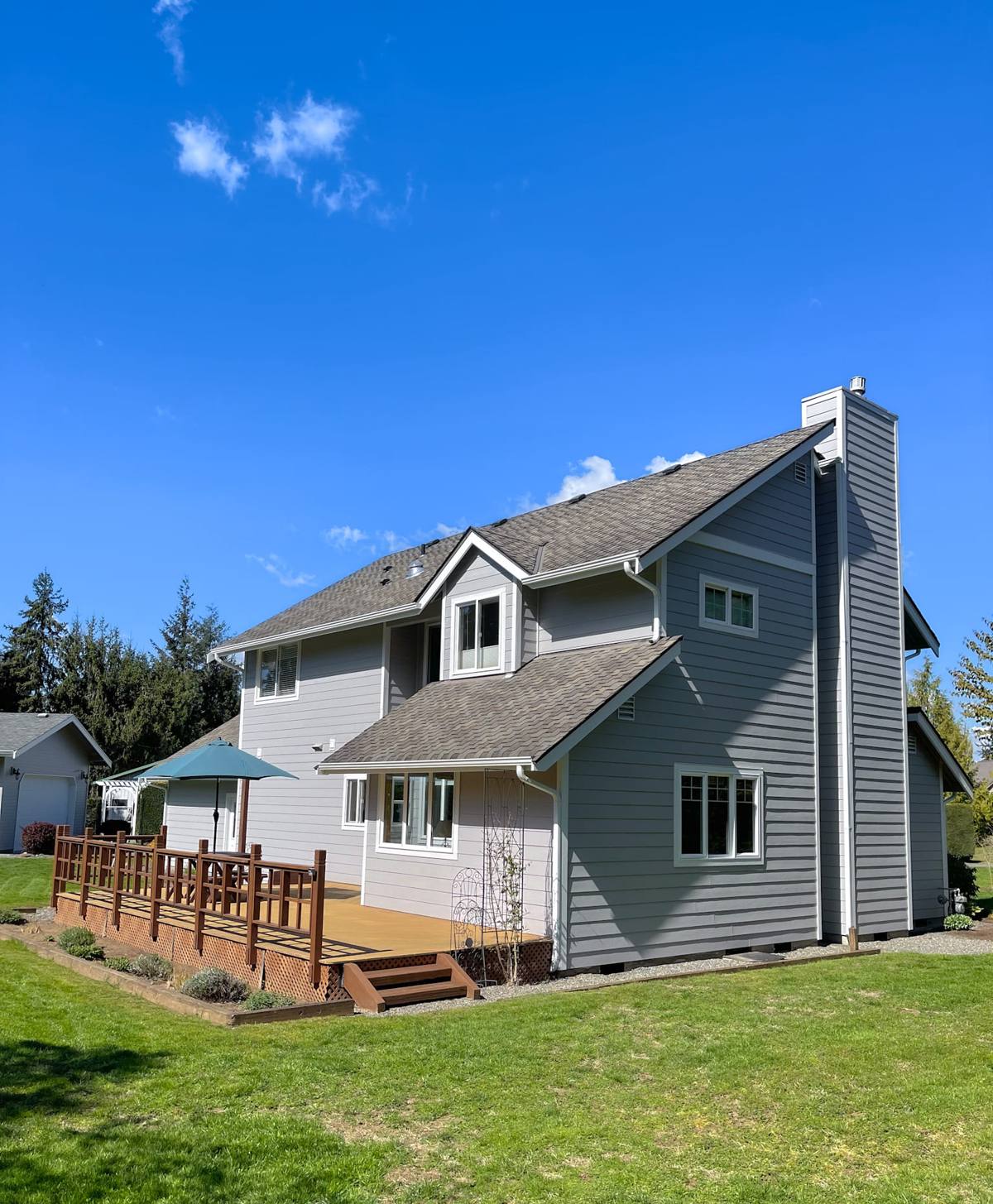
What Fiber Cement Needs to Do Right in This Neighborhood
Fiber cement siding is a strong fit for Sehome precisely because it's dimensionally stable and doesn't rely on a paint film alone to keep water out the way older wood siding does. But "fiber cement" isn't one product — quality, core formulation, and factory finish vary a lot between manufacturers, and installation details matter as much as the material itself. For a Sehome home, that means:
- A moisture-resistant core that won't swell, delaminate, or lose integrity when it stays damp for extended stretches under tree cover
- A factory-applied finish tough enough to resist fading and cracking under repeated freeze-adjacent, wet-dry cycling
- Proper clearance and flashing details at every horizontal surface, since standing moisture is what actually causes rot and mold — not rain itself
- A surface and color that resists the visual effect of moss and mildew staining, which shows up faster in shaded yards than on sun-exposed elevations
Get any one of those wrong and you end up with a house that looks fine for a year or two and then starts showing streaking, soft spots, or panel movement — right around the time most homeowners assume the "new siding" problem is behind them.
Why Moss Season Specifically Matters
Whatcom County's moss season isn't a cosmetic footnote — it's a sign of how much moisture the exterior of a home is holding onto. Moss and algae need sustained dampness to establish, and siding that's trapping water behind it (rather than shedding it) gives them exactly that environment. A well-installed fiber cement system sheds water fast and dries out between rain events, which starves moss of the conditions it needs to take hold on the siding itself, even in shaded parts of a Sehome lot.
Why We Install Only James Hardie Fiber Cement
We made a deliberate decision as a company to install James Hardie products exclusively, and to not install LP SmartSide, vinyl siding, other fiber cement brands, or wood siding like cedar or primed spruce. That's not a marketing position — it's a standard we hold ourselves to because we've seen how each of those materials performs over a full Pacific Northwest weather cycle, not just in a showroom.
LP SmartSide is an engineered wood product, and engineered wood — however well treated — still relies on an intact resin-saturated shell to keep moisture out. Once that shell is compromised at a cut edge, fastener hole, or joint, wood-based cores can swell and soften in ways fiber cement simply doesn't. Vinyl siding is inexpensive and easy to install, but it's a thin plastic product that expands and contracts significantly with temperature, can crack in impacts, and its color is baked all the way through a material that fades and chalks over time rather than holding a factory finish. Cedar and primed spruce are beautiful but demand real ongoing maintenance — refinishing, caulking, and vigilance — to survive constant coastal moisture without rot.
James Hardie's fiber cement is non-combustible, dimensionally stable, and backed by a factory finish system engineered for exactly this kind of climate. We'd rather install one product very well than offer five products we'd have reservations about putting on our own homes.
The James Hardie Lines We Use in Sehome
James Hardie makes several siding profiles, and we select based on the home's style and exposure, not a one-size-fits-all default.
- HardiePlank lap siding — the most common choice for traditional Sehome home styles, available in several exposure widths and textures
- HardiePanel vertical siding — used for board-and-batten looks or accent sections on more contemporary exteriors
- HardieTrim — matching trim boards around windows, corners, and fascia so the whole exterior system is consistent, not mixed materials aging at different rates
Where relevant, we also specify Hardie's climate-engineered HZ product lines, which are formulated for regional moisture and temperature patterns rather than a single national spec. For Western Washington, that means a formulation built around sustained damp exposure rather than dry-climate freeze-thaw concerns.
ColorPlus Factory Finish
Most of what we install uses Hardie's ColorPlus finish — a multi-coat, baked-on finish applied at the factory under controlled conditions, rather than field-painted on site. That matters in a climate like Sehome's because field-applied paint has to cure in whatever weather shows up that week, and Bellingham weather doesn't always cooperate. A factory finish goes on cured and consistent before the siding ever reaches the house, and it comes with a substantially longer finish warranty than a typical field paint job.
What a Correct Installation Actually Involves
The siding material only does half the job. The other half is installation detail, and this is where most of the long-term difference between a good exterior and a problem exterior comes from.
| Detail | Why It Matters in Sehome's Climate |
|---|---|
| Proper clearance above rooflines, decks, and grade | Prevents wicking and standing moisture in a climate with extended wet seasons |
| Correct flashing at windows, doors, and horizontal trim | Directs wind-driven rain away from the wall assembly instead of behind it |
| Proper fastener placement and spacing | Keeps panels secure through wind events without over- or under-driving fasteners that crack the material |
| Correct panel gaps and joint treatment | Allows for expansion and prevents water from bridging seams |
| House wrap and drainage plane integration | Gives any moisture that does get past the siding a path to drain and dry out |
Every one of these is a place where a rushed or unfamiliar crew can cut corners that don't show up as problems until a few wet seasons in — which, in Sehome, doesn't take long to test.
Our Process, Start to Finish
1. On-Site Assessment
We walk the exterior, check the condition of the existing wall assembly, and look for the moisture, rot, or venting issues that need to be addressed before new siding goes on — not covered up underneath it.
2. Honest Scope and Estimate
You get a written scope covering material, prep work, flashing details, and trim — not just a square-footage number.
3. Prep and Moisture Barrier
Any damaged sheathing gets addressed, and house wrap or a drainage plane is installed correctly before the first piece of siding goes up.
4. Installation to Manufacturer Spec
We install to James Hardie's published fastening, clearance, and flashing requirements — the specs that keep the product warranty intact and the wall assembly dry.
5. Final Walkthrough
We review the finished job with you directly, including any ColorPlus touch-up needs, so you know exactly what was done and why.
Maintenance That Actually Fits This Climate
One advantage of a correctly installed fiber cement system in a shaded, damp neighborhood like Sehome is how little maintenance it actually needs compared to wood. It's not maintenance-free, but the list is short:
- An occasional gentle rinse to clear pollen, dust, and early moss or mildew film before it sets in
- Keeping gutters clear so overflow doesn't run down and streak the siding face
- Trimming back vegetation that holds moisture against the wall or blocks airflow and sun exposure
- A visual check after major storms for any caulking or trim that needs attention
That's a far shorter list than what wood siding demands in this same climate, and it's a large part of why fiber cement has become the standard choice for homes that see Sehome's level of shade and moisture.
Why Local Experience in Sehome Matters
A crew that already understands how Sehome's tree cover, hillside exposure, and proximity to the bay affect a home's exterior isn't guessing at flashing details or clearance requirements — they've already seen how those choices hold up here specifically. That local familiarity shows up in small decisions: where extra flashing attention is worth it, which elevations need more careful moss and moisture planning, and how Whatcom County's permitting and inspection process actually works for a siding project. It's the difference between a generic installation and one built for the house's actual conditions.
If you're weighing a siding replacement for a home in Sehome, we're happy to walk the property, look at what's actually going on with your current exterior, and give you a straightforward, no-pressure estimate using the form below.