 Bellingham Exterior
 Fiber Cement Siding for Cordata Homes
Cordata sits on the north end of Bellingham, close enough to the water and the lowland drainage of Whatcom County that its houses take a specific kind of weather beating year-round. Homes here deal with wind-driven rain off the Strait, a damp marine air layer that never fully dries out between storms, and a moss season that can stretch from October into May. Siding that isn't built for that combination fails in predictable ways — swelling at the seams, soft spots behind trim, green streaking that keeps coming back no matter how often it's washed off. We install James Hardie fiber cement siding on Cordata homes because it's the one product system we trust to hold up to that cycle without turning into a maintenance project every spring.
This page is specific to fiber cement siding work in Cordata — what the climate actually does to a house here, what a correctly done Hardie installation looks like, and why a crew that already works this part of Bellingham catches problems a stranger to the area might miss.
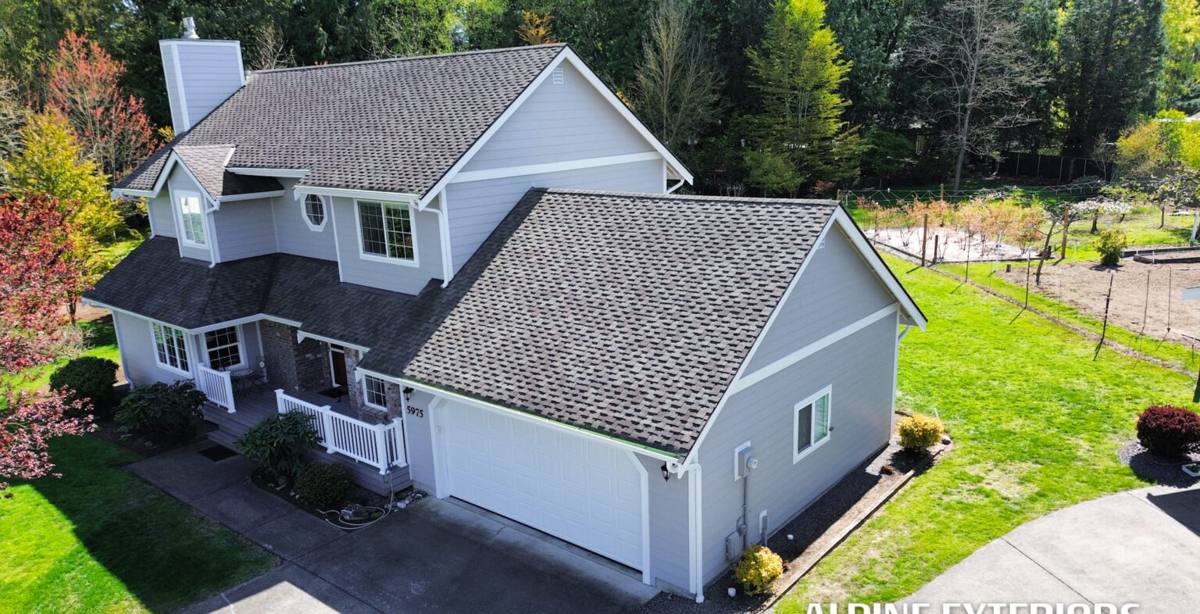
What Cordata's Climate Does to Siding
Salt Air and Driving Rain
Proximity to salt water means siding, fasteners, and trim in this part of Bellingham are exposed to airborne salt in addition to ordinary rain. Salt accelerates corrosion in exposed fasteners and metal flashing, and it speeds up the breakdown of finishes that weren't engineered to resist it. Combine that with wind-driven rain — the kind that hits siding at an angle instead of running straight down — and you get moisture forced up under laps and around penetrations that would stay dry in a calmer climate.
The Moss Season
Whatcom County's long wet season keeps north-facing walls, shaded siding runs, and anything near overhanging trees damp for weeks at a stretch. That's exactly the environment moss and algae need to take hold. On porous or absorbent siding materials, moss doesn't just sit on the surface — it holds moisture against the wall behind it, which is where the real damage starts. Siding that resists moisture absorption at the material level, not just at the paint layer, is what actually slows this down.
Why Absorption Matters More Than Paint
A lot of siding problems in this climate aren't paint failures — they're moisture management failures. Wood-based and wood-derived products absorb water at cut edges, fastener holes, and butt joints even when the face is well-coated. Once moisture gets into the substrate, freeze-thaw cycles and constant damp-dry swings do the rest. Fiber cement doesn't behave the same way, which is a big part of why it holds up better through a Cordata winter.
Why We Install James Hardie — and Nothing Else
We're a Hardie-only siding contractor. We don't install vinyl, LP SmartSide, Cemplank, Allura, or primed wood species like spruce or cedar, and we won't quote them for a Cordata job even if asked. That's not a sales position — it's a standard we hold because we've seen how each of those materials performs over time in this specific climate, and we'd rather turn down work than install something we don't think will last here.
- Non-combustible core: Hardie fiber cement doesn't feed a fire the way wood-based siding can, which matters given the wildfire smoke seasons the Pacific Northwest has seen in recent years.
- Factory-applied ColorPlus finish: baked-on in a controlled environment rather than field-painted, so the color layer holds up more evenly against UV and salt air than a job-site paint job.
- Climate-engineered HZ product lines: Hardie's HZ5 formulation is specifically engineered for wetter, cooler climates like ours — moisture and temperature swings are part of the design spec, not an afterthought.
- Transferable warranty: a real, documented warranty structure that follows the house if it's sold, not a marketing promise.
- Proven track record when installed to spec: the material only performs as advertised if the installation follows Hardie's fastening, clearance, and flashing requirements — which is most of what the rest of this page is about.
What a Correct Fiber Cement Installation Involves
Fiber cement siding is only as good as the installation behind it. In a climate like Cordata's, the details that get skipped on a rushed job are exactly the details that cause callbacks two or three years later.
Water Management Comes First
Before a single piece of siding goes up, the wall needs a proper water-resistive barrier and correctly lapped flashing at every window, door, and penetration. Flashing has to shed water down and out, never trap it behind the siding. This is the step that determines whether driving rain off the Strait ends up running down the outside of the house or working its way behind it.
Clearances Matter More Here Than in Drier Climates
Hardie's installation instructions call for specific clearances between the bottom edge of siding and roofing, decks, and grade — typically a minimum of a few inches, depending on the application. In a wet climate, skipping this clearance is one of the most common causes of moisture wicking into the bottom edge of a board. We hold these clearances even when it means adjusting trim or grading details other crews might skip to save time.
Fastening and Joint Treatment
Fasteners have to be corrosion-resistant and driven to Hardie's specified depth — not too shallow, not overdriven, which cracks the board's edge and creates an entry point for moisture. Butt joints at the ends of boards need to be properly sealed or shielded with flashing, since end grain on any siding material is where water intrusion usually starts.
Caulking and Sealant Details
Sealant belongs at specific transition points — around penetrations, at trim-to-siding junctions — not smeared across every seam as a substitute for proper flashing. Over-caulking is often a sign a crew is compensating for a shortcut somewhere else in the installation.
Installation Step Checklist
- Remove old siding and inspect sheathing for hidden rot or soft spots
- Repair or replace damaged sheathing before moving forward
- Install or verify weather-resistive barrier across the full wall
- Flash all windows, doors, and penetrations before siding goes on
- Confirm clearances at roofline, deck, and grade meet Hardie spec
- Install starter strip and first course level and true
- Fasten each course to Hardie's depth and spacing requirements
- Seal and flash butt joints and trim transitions correctly
- Final walkthrough for fastener pattern, caulking, and finish consistency
Fiber Cement vs. What We Won't Install
| Factor | James Hardie Fiber Cement | Vinyl / Wood-Based Alternatives |
|---|---|---|
| Moisture absorption | Very low — engineered cement composite | Wood-based products absorb at cut edges and joints; vinyl can trap moisture behind panels |
| Salt air / coastal exposure | Holds up well with proper fastener choice | Vinyl can become brittle; wood-based trim degrades faster near salt air |
| Moss and algae resistance | Better resistance since less moisture is held at the surface | Porous or textured surfaces often hold more moisture, feeding moss growth |
| Fire resistance | Non-combustible core | Wood-based products are combustible; vinyl can melt or deform |
| Finish durability | Factory-baked ColorPlus finish | Field-applied paint or factory vinyl color that can fade unevenly |
| Warranty | Documented, transferable | Varies widely by manufacturer and material |
Our Process for a Cordata Siding Project
1. On-Site Assessment
We walk the exterior with you, looking specifically for the failure patterns common in this climate — soft trim near ground contact, moss buildup on shaded walls, staining below window sills that points to flashing problems. This tells us what's driving the need for new siding, not just what the surface looks like.
2. Scope and Estimate
You get a clear, written scope: what's being removed, what sheathing repairs are anticipated, which Hardie products and colors are being used, and a straightforward cost breakdown. No pressure, no inflated urgency.
3. Sheathing and Barrier Work
Before any new siding goes up, we confirm the wall underneath is sound. This is the stage where hidden problems from years of moisture exposure get found and fixed — skipping it just buries the same problem under new siding.
4. Installation to Spec
Siding goes on following Hardie's fastening, clearance, and flashing requirements exactly. This is where a lot of jobs cut corners under time pressure; we don't build our schedule around skipping these steps.
5. Final Walkthrough
We inspect the finished work with you, checking course lines, fastener patterns, caulking, and trim details before calling the job done.
Cost Factors for Cordata Siding Projects
Every house is different, but the following factors are what actually move the price on a fiber cement project in this area — general ranges, not fixed quotes, since scope varies by house.
| Factor | Why It Affects Cost |
|---|---|
| Sheathing condition | Hidden rot or moisture damage found during tear-off adds repair scope |
| Home size and wall complexity | More corners, gables, and trim details mean more labor and cut waste |
| Siding profile and color | Lap width, shingle-style panels, and ColorPlus premium colors vary in material cost |
| Access and site conditions | Multi-story sections, tight lot lines, or landscaping can slow install time |
| Trim and accessory scope | Fascia, soffit, and window trim replacement adds to the total beyond field siding |
Signs Cordata Homeowners Should Watch For
- Persistent green or black staining on north-facing or shaded walls
- Soft or spongy siding near the ground, deck ledgers, or downspouts
- Paint that's bubbling or peeling in patches rather than fading evenly
- Visible gaps or separation at butt joints and corner trim
- Interior wall staining near exterior corners after heavy rain
Why a Local Crew Matters
A crew that already works Cordata and the surrounding Bellingham neighborhoods has already seen how this specific stretch of Whatcom County weather behaves against different wall orientations, roof pitches, and lot conditions. That familiarity shows up in small decisions — where extra flashing attention is warranted, which wall exposures need closer moss-prevention detailing, how clearances should be adjusted for a particular lot's drainage. It's the difference between a generic installation and one built for the house it's actually going on.
If you're dealing with siding that's showing its age in Cordata, we'd be glad to take a look and give you a straightforward, no-pressure estimate for a James Hardie fiber cement installation built for this climate.