 Bellingham Exterior
 Why Birch Bay Siding Takes More Punishment Than You'd Think
Birch Bay sits right on the water, and that changes what siding has to deal with year-round. Salt-laden air moves off the bay and settles on exterior walls, wind-driven rain finds its way into any gap in the weather barrier, and the shaded, damp stretches of the year give moss and algae plenty of time to take hold before summer sun ever dries things out. A siding product that performs fine twenty miles inland in Whatcom County doesn't necessarily hold up the same way a few hundred yards from the water.
That combination — salt exposure, sustained moisture, and a long moss season — is hard on paint, hard on seams, and hard on any material that swells, wicks water, or breaks down when it stays wet for weeks at a stretch. It's also exactly the environment James Hardie fiber cement siding was engineered to handle, which is why it's the only siding product we install on Birch Bay homes.
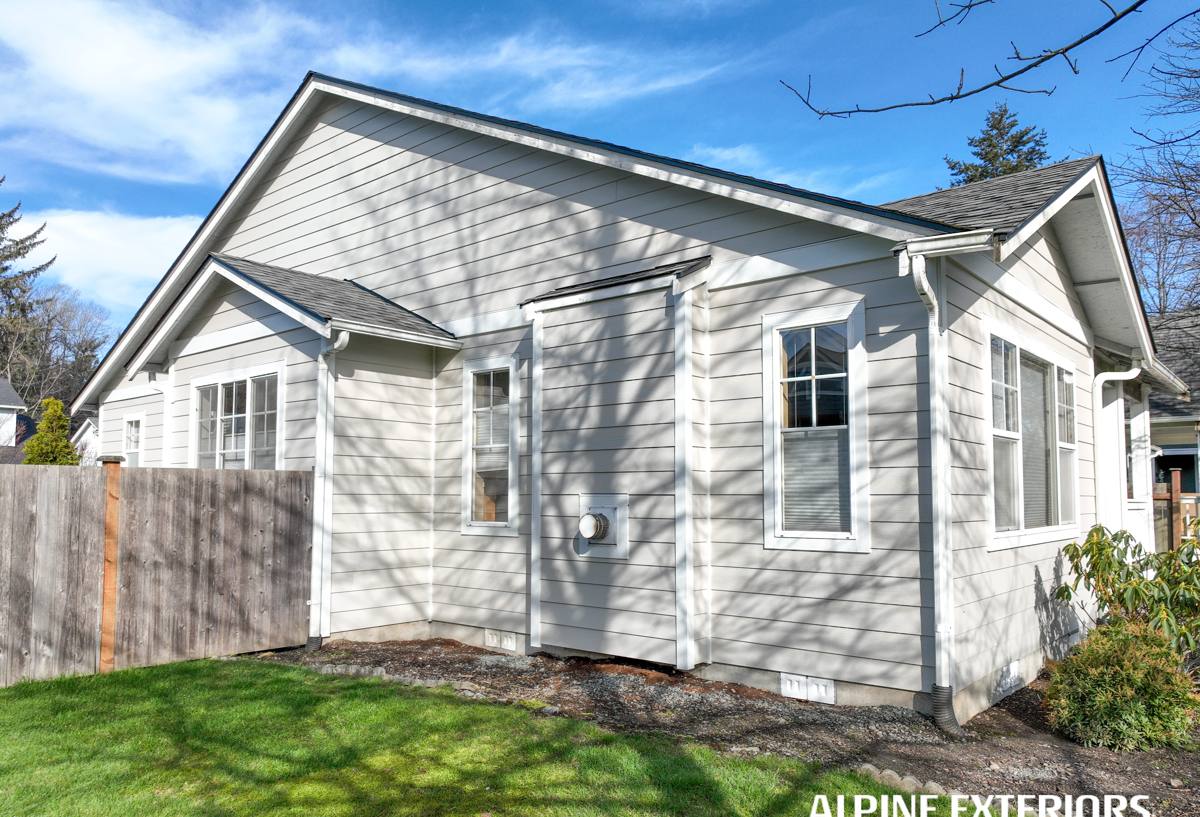
What Birch Bay's Climate Actually Does to a House
Salt Air and Coastal Moisture
Airborne salt is corrosive to fasteners and hardware, and it accelerates the breakdown of finishes that aren't formulated to resist it. Homes closer to the water see this first — chalking paint, early fastener corrosion, and finishes that fade or fail years ahead of schedule compared to the same product installed inland.
Driving Rain and Wind-Driven Water
Storms coming off the water don't just fall straight down — wind pushes rain sideways into laps, seams, and trim joints. Any siding system that isn't installed with correct overlaps, flashing, and clearances will eventually let that water find a way behind the cladding, where it does the real damage: rot, mold, and sheathing failure that you don't see until it's expensive.
Moss, Algae, and Extended Damp Periods
Whatcom County's gray, wet stretches give moss and algae a long runway. Materials that hold moisture at the surface — or that have organic content that mold and algae can actually feed on — stay damp longer and show growth sooner. Siding that sheds water and dries quickly is a real advantage here, not a marketing point.
Why We Install Only James Hardie Fiber Cement
We don't offer vinyl, LP SmartSide, Cemplank, Allura, or bare cedar and primed spruce as options on Birch Bay homes, and that's a deliberate standard, not an oversight. Each of those products has legitimate strengths, but each also has a real-world weakness that shows up faster in a salt-air, high-moisture coastal environment than it does in a dry inland climate.
- Vinyl can warp or distort in temperature swings and reflected heat, and its seams and J-channels give wind-driven coastal rain more opportunities to get behind the cladding.
- Engineered wood products (LP SmartSide) use wood strand substrates that are more moisture-sensitive at cut edges and panel joints — a real risk when a house sits in near-constant damp air.
- Other fiber cement brands (Cemplank, Allura) are chemically similar to Hardie but don't carry the same climate-specific engineering, factory finish warranty, or the fitted trim and accessory system that makes a coastal installation perform as one integrated assembly.
- Bare or primed wood siding (cedar, primed spruce) needs a maintenance schedule — recoating, caulking, spot repair — that most homeowners underestimate, and it's the least forgiving product in this climate if that maintenance slips even one season.
James Hardie fiber cement is non-combustible, dimensionally stable, and doesn't swell or rot the way wood-based products can. Its ColorPlus factory finish is baked on under controlled conditions rather than field-applied, which matters directly for salt-air fading and gives you a real, transferable warranty behind the color — not just the board.
Hardie's HZ5 Engineering and Why It Matters Here
James Hardie makes climate-specific product lines, and the HZ5 formulation is engineered for regions that see more moisture cycling and freeze-thaw stress — which describes the Pacific Northwest well, and Birch Bay's waterfront exposure in particular. HZ5 boards are formulated for that moisture behavior from the start, rather than being a general-purpose product used everywhere regardless of climate.
That climate-engineering shows up in a few practical ways for a Birch Bay homeowner:
| Concern | What HZ5 Fiber Cement Does |
|---|---|
| Moisture cycling | Formulated for regions with sustained damp weather and freeze-thaw swings |
| Salt air exposure | Non-combustible cement composition doesn't corrode like metal or degrade like untreated wood |
| Moss and algae growth | Dense, engineered surface sheds water rather than absorbing it, slowing organic growth |
| Color and finish life | Factory-applied ColorPlus finish resists fading and chalking better than field-applied paint |
| Fastener and trim performance | Matched Hardie trim and accessory system installed as one integrated assembly, not mixed parts |
What a Correct Fiber Cement Installation Involves
The product is only half the equation — in a coastal environment like Birch Bay, installation detail is what actually keeps water out. A correct Hardie installation includes:
- A proper weather-resistive barrier installed and lapped correctly behind the siding, not just tacked up as an afterthought
- Correct flashing at every window, door, and roof-to-wall transition, where wind-driven rain is most likely to find a way in
- Manufacturer-specified clearances at grade, decks, and roof lines so siding isn't sitting in standing water or trapped moisture
- Proper fastener spacing, type, and placement — Hardie specifies these precisely, and shortcuts here show up years later as fastener pops or panel movement
- Correctly caulked and sealed joints at trim, corners, and penetrations, using materials rated for the exposure
- Field-cut edges properly sealed or primed so the cut edge doesn't become the weak point in an otherwise engineered product
Skip any one of these and you can install genuine James Hardie board and still end up with the moisture problems the product was supposed to prevent. This is where the difference between a siding product and a siding system really shows.
Our Process for Birch Bay Homes
1. On-Site Assessment
We look at your home's specific exposure — how close you are to the water, which walls take the worst of the wind-driven rain, existing moisture or trim damage, and what's actually happening behind the current siding where we can access it.
2. Product and Line Selection
We walk through Hardie's plank, shingle, and panel lines and color options, and talk through what fits your home's exposure and the look you want — there's rarely one "right" answer, but there is a right answer for your specific wall conditions.
3. Tear-Off and Sheathing Check
Old siding comes off and we inspect the sheathing underneath before anything new goes up. If there's existing moisture damage from a prior installation, you want to know now, not after new siding is covering it.
4. Weather Barrier and Flashing
This is the step that actually keeps Birch Bay's driving rain out, and it happens before a single piece of Hardie board goes up.
5. Installation to Manufacturer Spec
Fastener pattern, clearances, joint treatment, and trim — installed to Hardie's published specifications, which is also what keeps the manufacturer's warranty intact.
6. Final Walkthrough
We go over the finished work with you, including care basics for a coastal property, before we call the job done.
Why Local Experience in Birch Bay Matters
A crew that regularly works Whatcom County's waterfront communities already knows which walls on a Birch Bay home take the brunt of the weather, how far up a wall salt spray typically reaches, and where moss tends to establish first on a north-facing or shaded elevation. That's not something you learn from a spec sheet — it's pattern recognition from doing this work in this specific environment, and it shapes real decisions on your job: where extra flashing attention goes, which trim details get reinforced, and how the installation is sequenced against the weather.
It also means a straightforward path if anything ever needs attention after the job is done — a local crew that's still working in the area, not a name from an out-of-town crew that moved on to the next region.
What Fiber Cement Siding Typically Involves — A Practical Checklist
- Full tear-off of existing siding and inspection of the sheathing underneath
- Repair or replacement of any damaged sheathing before new material goes up
- Installation of a code-compliant weather-resistive barrier
- Correct flashing at all windows, doors, and roof intersections
- James Hardie HZ5 plank, shingle, or panel siding installed to manufacturer spec
- Matched Hardie trim, corners, and accessories for a single integrated system
- Proper clearance at grade, decks, and roof lines
- Final caulking, sealing, and cleanup
If your Birch Bay home's siding is showing chalking, staining, moss buildup, or soft trim, or if you're planning ahead for a full replacement, we're happy to take a look and walk you through what we'd recommend for your specific exposure. Reach out for a free, no-pressure estimate using the form below.