 Bellingham Exterior
 Roofing in Ferndale Means Building for the Coast
Ferndale sits close enough to salt water and open exposure that roofs here take a different kind of beating than roofs twenty miles inland. Salt-laden air accelerates the breakdown of metal flashing and fasteners. Driving rain off Bellingham Bay and the Strait doesn't just fall straight down — wind pushes it sideways, up under shingle edges and into any gap a lazy installation left behind. And because Whatcom County stays wet and shaded for much of the year, moss and moisture-loving growth get a long runway to take hold on north-facing slopes and anything shaded by fir or cedar cover.
None of that makes asphalt shingle roofing a bad choice for Ferndale. It makes the details of the installation the whole ballgame. A shingle roof installed the same way you'd install one in a dry inland climate will underperform here. A shingle roof installed for this climate — correct underlayment, correct ventilation, correct flashing at every penetration — holds up as well as almost anything else on the market, at a fraction of the cost of metal or slate.
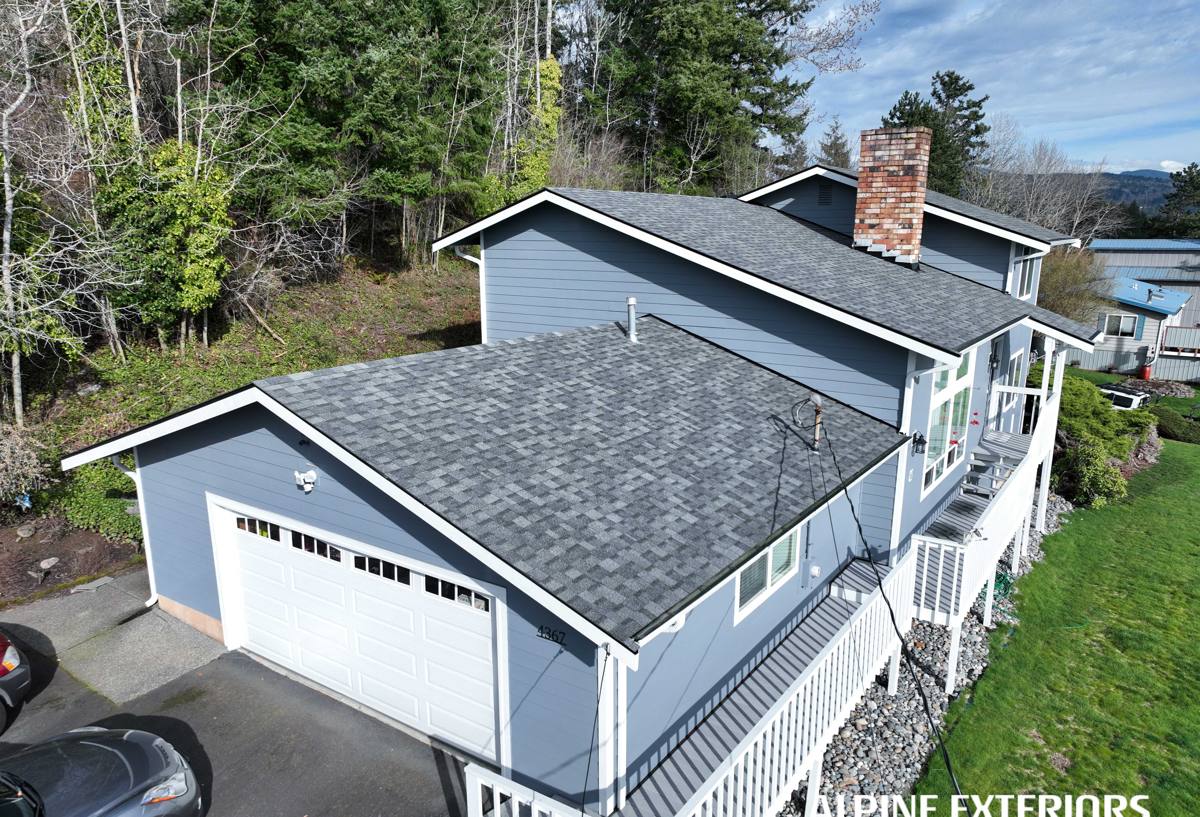
Why Asphalt Shingles Still Make Sense for Ferndale Homes
We get asked, fairly often, why we'd recommend asphalt shingles in a climate this wet. The honest answer is that asphalt shingle roofing has come a long way, and for the vast majority of homes in Ferndale it remains the best balance of upfront cost, lifespan, and repairability.
- Algae-resistant (AR) shingles with copper or zinc granules actively resist the moss and algae staining that's common on shaded, north-facing roofs in this area.
- Modern architectural shingles carry wind ratings well above what Whatcom County typically sees, when installed with the correct nailing pattern.
- Repairs are straightforward and localized — a damaged section can be cut out and replaced without disturbing the rest of the roof, which isn't true of every roofing material.
- Asphalt shingles give homeowners a wide range of colors and profiles to match Ferndale's mix of older farmhouses, newer developments, and everything in between.
The trade-off is that asphalt shingle roofs are only as good as their installation. That's true everywhere, but the margin for error is smaller here than in a dry climate, because a small mistake gets tested by rain within days, not months.
What a Correct Installation Actually Includes
"Asphalt shingle roof" describes the finished look, not the job. What's underneath the shingles is what determines whether the roof performs for fifteen years or twenty-five. For a coastal Whatcom County home, here's what we consider non-negotiable:
Ice and Water Shield at Vulnerable Points
Even though Ferndale doesn't see the ice-dam problems that colder climates deal with, self-adhering waterproof membrane still matters — along eaves, valleys, around chimneys, and at any roof-to-wall transition. These are the spots where wind-driven rain finds its way in, and a membrane layer there is cheap insurance against a leak years down the road.
Synthetic Underlayment, Not Just Felt
Synthetic underlayment sheds water better than old-style felt paper, holds up to job-site weather delays without tearing or wrinkling, and gives the whole roof system a second line of defense if wind ever lifts a shingle edge. In a climate that sees this much sustained rain, that second layer isn't optional.
Flashing Done Right, Every Time
Chimneys, skylights, plumbing vents, and roof-to-wall junctions are where the overwhelming majority of roof leaks actually start — not in the open field of shingles. New step flashing, counter-flashing, and pipe boots at every penetration, rather than reusing old flashing to save time, is standard on our jobs. Salt air corrodes cheap galvanized flashing faster than people expect; we use materials rated to hold up to it.
Balanced Attic Ventilation
Ventilation doesn't show up in a photo of a finished roof, but it's one of the biggest factors in how long that roof actually lasts. Intake at the eaves paired with exhaust at the ridge keeps moist attic air moving instead of condensing against the roof deck — a real issue in a climate this humid. Poor ventilation also raises the temperature swings the shingles endure, which shortens their lifespan regardless of the brand.
Starter Strips, Hip and Ridge Caps
The starter course along the eaves and rakes, and the cap shingles along hips and ridges, are the roof's first and last line of defense against wind uplift. Skipping factory starter strips or cutting standard three-tab shingles into makeshift ridge caps is a corner some crews cut. We don't.
Choosing the Right Shingle for This Climate
Not every asphalt shingle is built the same, and the differences matter more in a wet coastal climate than they would somewhere dry. Here's how the common tiers stack up for a Ferndale roof:
| Shingle Type | Typical Wind Rating | Algae Resistance | Best Fit For |
|---|---|---|---|
| Standard 3-Tab | Lower | Limited unless AR-rated | Budget-driven projects, secondary structures |
| Architectural / Laminated | High | Good, especially with AR granules | Most Ferndale homes — the standard recommendation |
| Premium Designer Shingles | High | Good to excellent | Homes prioritizing curb appeal, steep or highly visible roofs |
For most homes we work on in Ferndale, a mid-to-upper-tier architectural shingle with algae-resistant granules is the sweet spot — enough wind performance for the exposure, enough moss resistance to slow down the growth that shaded, damp roofs are prone to, and a manufacturer warranty that reflects real-world coastal conditions rather than a lab in a dry state.
How We Approach a Ferndale Re-Roof
Every roof starts with an actual inspection, not a drive-by estimate. That means getting on the roof, checking the deck for soft spots or delamination, looking at existing ventilation, and checking flashing conditions around every penetration before we ever quote a number.
- Inspection and scope — we document the roof's condition, note any deck repair likely needed, and confirm the ventilation setup.
- Tear-off — old shingles, underlayment, and any failed flashing come off down to the deck. We don't install a new roof over an old one.
- Deck repair — any soft or delaminated sheathing gets replaced before anything new goes down. This is where hidden water damage from years of small leaks usually shows up.
- Underlayment and waterproofing — ice-and-water membrane at eaves, valleys, and penetrations, synthetic underlayment across the field.
- Flashing — new flashing at every chimney, vent, skylight, and wall transition.
- Shingle installation — correct nailing pattern for the wind exposure, starter strips, and properly lapped courses.
- Ridge, hip, and ventilation — cap shingles and ridge venting installed to spec, intake checked at the eaves.
- Cleanup and final walkthrough — magnetic sweep for nails, gutters cleared of debris, and a walkthrough so you know exactly what was done.
The Moss Problem, and What Actually Slows It Down
Whatcom County's long wet season means moss isn't a matter of if, it's a matter of when and how fast — especially on north-facing slopes and roof sections shaded by trees. Moss holds moisture against the shingle surface, works its way under shingle edges over time, and can lift granules that protect the shingle from UV and weather. It's a maintenance issue more than a structural emergency, but ignoring it shortens the roof's life.
Algae-resistant shingles slow the growth significantly, but they don't eliminate the need for basic upkeep. The most effective long-term approach combines the right shingle, adequate airflow so the roof surface can dry out between rain events, and periodic gentle cleaning rather than waiting until moss is thick enough to hold standing water.
Roof Maintenance Checklist for Ferndale Homeowners
- Clear overhanging branches so roof sections get more light and airflow, especially on the north side.
- Keep gutters and downspouts clear — clogged gutters back water up under the eave line, exactly where ice-and-water membrane matters most.
- Have moss removed gently — soft washing or hand removal, never pressure-washing shingles, which strips protective granules.
- Walk the roofline visually after major windstorms and check for lifted or missing shingles.
- Check attic ventilation isn't blocked by insulation stuffed into soffit vents during past projects.
- Schedule a professional inspection every few years, or after any significant wind event.
What Drives the Cost of a Ferndale Shingle Roof
We don't publish blanket pricing because every roof is different, but the honest cost drivers on most jobs in this area are consistent:
| Factor | Why It Matters Here |
|---|---|
| Roof size and pitch | Steeper roofs take longer and require more safety setup |
| Number of penetrations | Each chimney, vent, or skylight needs new flashing — more penetrations, more labor |
| Deck condition | Hidden water damage from old leaks often isn't visible until tear-off |
| Shingle tier chosen | Algae-resistant and higher wind-rated shingles cost more but perform better in coastal exposure |
| Access and site conditions | Tree cover, tight lots, and multi-story homes affect setup time and disposal logistics |
The number we give you reflects what your specific roof needs — not a generic per-square rate that ignores the deck condition or flashing count until change orders start showing up mid-project.
Why It Matters That We Already Work in Ferndale
A crew that only sees Ferndale roofs occasionally has to relearn the local conditions on every job. A crew that works this area regularly already knows how the wind moves off the water, which roof orientations take the worst of the driving rain, and how aggressive the moss growth gets on a shaded north slope compared to a roof with open southern exposure. That local pattern recognition shows up in small decisions — where we add extra fastening, which penetrations get the most attention, how we sequence the tear-off around a wet forecast — that a roof crew unfamiliar with Whatcom County simply wouldn't think to make.
It also matters for accountability. We're not a crew that disappears after the invoice clears. If something comes up with a roof we installed in Ferndale, we're a short drive away, not a call center routing you to a subcontractor.
Ready for a Straight Answer on Your Roof?
If your Ferndale roof is showing granule loss, moss buildup, curling edges, or you're just planning ahead, we're happy to take a look and give you an honest read on what it actually needs — repair, partial replacement, or full re-roof. Reach out below for a free, no-pressure estimate.