 Bellingham Exterior
 Edgemoor Siding Faces a Tougher Climate Than Most Bellingham Neighborhoods
Edgemoor sits close to the water, and that proximity comes with a trade-off. Homes here catch salt-laden air off Bellingham Bay, sit under heavy tree canopy that keeps siding shaded and damp longer than homes on open lots, and take driving rain straight off the water during winter storms. Add Whatcom County's long, gray moss season and you have a set of conditions that wears down siding faster than almost anywhere else in the Bellingham area. Repairs that would be minor cosmetic fixes in a drier inland neighborhood can turn into real structural problems here if they sit too long.
We've repaired siding on enough Edgemoor homes to know the failure patterns are consistent: moisture intrusion at trim and butt joints, moss and algae staining on north- and west-facing walls, and paint or finish breakdown from repeated wet-dry cycling. Understanding those patterns is what separates a repair that actually holds up from one that fails again in two winters.
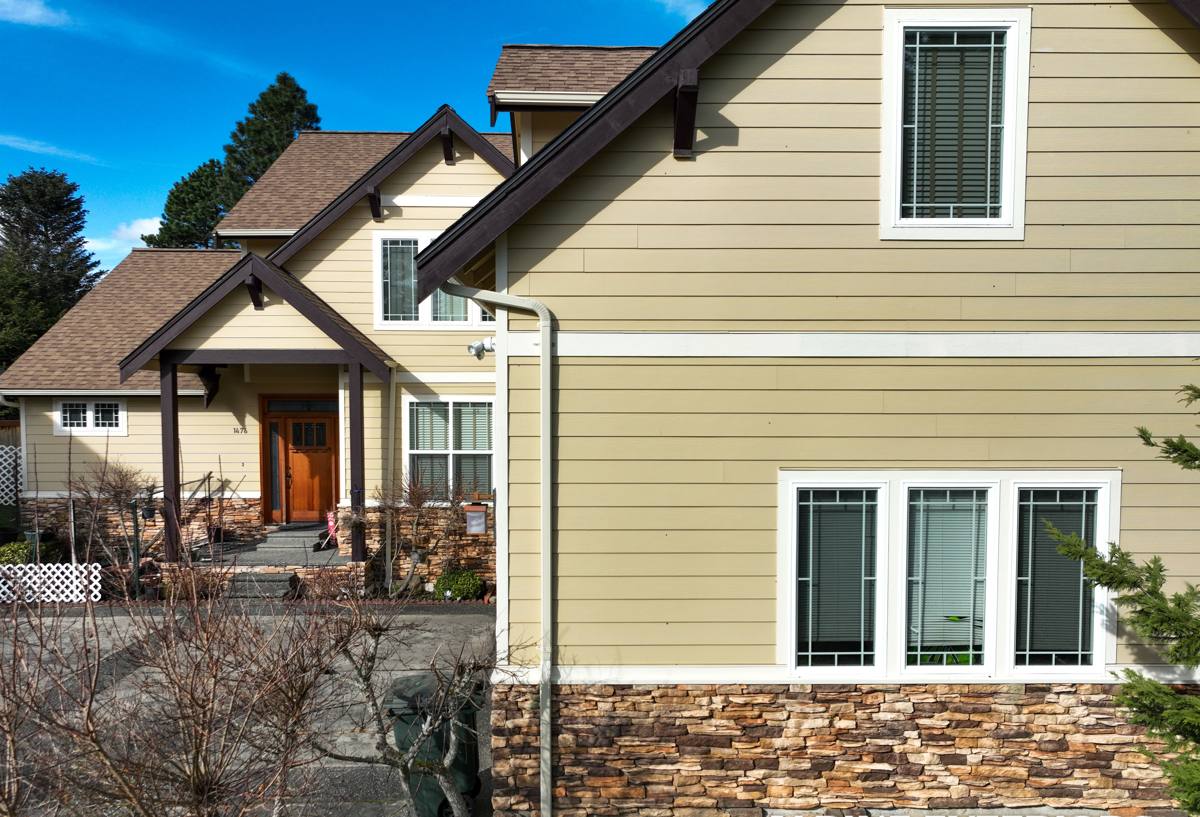
Why Salt Air, Rain, and Moss Matter for Siding Repair
Salt Air
Airborne salt from Bellingham Bay settles on siding surfaces and accelerates corrosion of fasteners, flashing, and any exposed metal trim. It also breaks down paint films faster than inland exposure, which means color and finish integrity fail sooner near the water than a few miles east.
Driving Rain
Wind-driven rain off the bay pushes water sideways into laps, joints, and butt seams rather than letting it simply run down the face of the siding. Any gap in caulking, flashing, or house wrap becomes an entry point, and once water gets behind the siding, it can travel and damage sheathing well beyond the visible problem spot.
Moss and Organic Growth
Edgemoor's tree cover keeps siding shaded and slow to dry, which is exactly what moss, algae, and lichen need to take hold. Left alone, organic growth holds moisture against the siding surface around the clock, which speeds up rot in wood-based products and accelerates finish degradation on nearly everything else.
Signs Your Edgemoor Home May Need Siding Repair
Most siding failures give warning signs well before they become expensive problems. On a property with this much moisture exposure, it pays to check more often than the standard once-a-year walkaround.
- Soft or spongy spots when you press on the siding, especially near the bottom courses
- Persistent moss, algae, or dark streaking that keeps returning after cleaning
- Visible gaps, cracks, or separation at butt joints and trim edges
- Peeling, bubbling, or chalking paint, particularly on shaded or bay-facing walls
- Warping, buckling, or panels that no longer sit flat against the wall
- Staining or discoloration on interior walls near exterior corners, a sign water has already gotten behind the siding
- Visible fastener corrosion or rust streaks running down from nail heads
- Soft trim boards or window casings adjacent to siding seams
What a Correct Siding Repair Actually Involves
A siding repair that just patches the visible damage and stops there is a repair that's likely to fail again. Done right, repair work in a climate like Edgemoor's has to address what's happening behind the siding, not just what you can see from the sidewalk.
Diagnosing the Real Cause
Before any siding comes off, the damage needs a real cause, not a guess. Is this a flashing failure above a window, a caulking joint that's opened up, a drainage plane that was never installed correctly, or simple age and UV wear? Repairing the symptom without fixing the cause means the same spot fails again.
Checking What's Behind the Siding
Once damaged siding is removed, the house wrap, flashing, and sheathing underneath need to be inspected. In a wet climate, it's common to find sheathing that's absorbed moisture even when the siding itself looked fine on the surface. Any compromised sheathing or house wrap gets addressed before new siding goes back on — otherwise you're sealing a problem back up instead of solving it.
Matching Materials and Finish
Replacement pieces need to match the existing siding in profile, exposure, and finish as closely as possible. On homes with painted wood or older fiber cement, this sometimes means custom-matching paint color rather than assuming a factory match will blend in.
Correcting Flashing and Drainage
Most repeat siding failures near the water trace back to flashing that wasn't detailed correctly the first time — above windows, at trim transitions, or where decks and roof lines meet the wall. A proper repair corrects the flashing detail, not just the siding panel sitting on top of it.
Repair vs. Replacement: How We Help You Decide
Not every damaged wall needs full replacement, and not every repair is worth doing if the underlying siding is near the end of its life. We walk Edgemoor homeowners through this decision honestly, based on the extent of damage and the condition of what's underneath.
| Factor | Repair Usually Makes Sense | Replacement Usually Makes Sense |
|---|---|---|
| Extent of damage | Isolated to one wall, corner, or a handful of boards | Widespread across multiple elevations |
| Sheathing condition | Dry and sound once opened up | Soft, delaminating, or water-stained in several areas |
| Age of existing siding | Mid-life, otherwise in good shape | Near or past expected service life |
| Material | Fiber cement or sound wood with a localized issue | Original material is failing systemically (chronic rot, chalking, warping) |
| Cost over time | Lower upfront cost, targeted fix | Higher upfront cost, resets the clock on the whole exterior |
When damage is contained and the wall assembly underneath is sound, a well-executed repair is the right call and a good use of your money. When we find recurring rot, multiple failure points, or siding that's simply worn out, we'll tell you that directly rather than patching something that's going to keep costing you money.
Why We Repair — and Rebuild — With James Hardie Fiber Cement
When a repair calls for new siding material, whether it's a few boards or a full wall, we use James Hardie fiber cement exclusively. We don't install vinyl, LP SmartSide, primed spruce, cedar, or other fiber cement brands, and that's a deliberate standard, not a limitation of what we're capable of installing.
In a climate like Edgemoor's, the reasons matter in practical terms. Fiber cement doesn't absorb water and swell the way wood-based products can, which matters enormously under a heavy tree canopy that keeps siding damp. It's non-combustible, which is a real consideration anywhere in Whatcom County given regional wildfire risk in dry summer months. James Hardie's HZ product lines are engineered specifically for climate zones like ours, with formulations built to handle sustained moisture exposure rather than a generic one-size-fits-all product. And the factory-applied ColorPlus finish holds color and resists the chalking and peeling that salt air and UV exposure cause on field-applied paint — which means a repaired section is more likely to still match years down the road instead of visibly fading faster than the rest of the wall.
That consistency is especially useful for repair work. Patching a wall with material that weathers differently than what's already there is how you end up with mismatched siding in a few years, even if the initial repair looked great.
Our Siding Repair Process for Edgemoor Homes
1. On-Site Inspection
We look at the damaged area and the surrounding siding, checking for signs the problem extends further than what's visible — moisture staining, soft spots, or flashing issues nearby.
2. Honest Assessment
We tell you plainly whether this is a straightforward repair, a repair with some sheathing or flashing work involved, or a situation where replacement is the smarter long-term move.
3. Material Matching
For repairs, we source or match James Hardie profiles and finishes as closely as possible to your existing siding so the repaired section blends in rather than standing out.
4. Correcting the Root Cause
We fix the flashing, caulking, or drainage issue that caused the failure in the first place — not just the visible damage.
5. Clean Finish and Walkthrough
We finish with clean caulk lines and paint or color matching where needed, and walk the repair with you before we consider the job done.
Why Local Experience in Edgemoor Matters
Edgemoor's wooded, bay-facing lots come with practical realities that a crew unfamiliar with the neighborhood can miss — limited driveway and staging space on some properties, mature landscaping that has to be protected during work, and siting conditions (shade, slope, wind exposure off the water) that vary noticeably from block to block. A crew that's worked this neighborhood before knows to plan for those constraints upfront rather than discovering them mid-job.
Local experience also means recognizing the failure patterns specific to this stretch of Bellingham. A siding crew that mostly works dry, sun-exposed neighborhoods inland may not immediately recognize how far moisture has traveled behind a bay-facing wall, or how much moss growth is a symptom of a drainage problem rather than just a cleaning issue.
Maintaining Your Siding After a Repair
A good repair buys you years of protection, but Edgemoor's climate means siding needs a bit more ongoing attention than it would in a drier part of Whatcom County.
- Rinse siding periodically to clear salt residue and organic buildup, especially on bay-facing and shaded walls
- Keep gutters clean and downspouts directed away from the foundation to reduce splash-back onto lower siding courses
- Trim back vegetation and tree limbs that keep siding shaded and slow to dry
- Re-caulk joints and trim as needed rather than waiting until gaps are visible
- Address moss or algae growth early, before it has months to hold moisture against the surface
- Have siding inspected every year or two, particularly after a hard winter storm season
If you're seeing signs of siding damage on your Edgemoor home, or you just want an honest read on whether a section is worth repairing versus replacing, we're happy to take a look. Reach out using the form below for a free, no-pressure estimate.