 Bellingham Exterior
 Deck Replacement Built for Edgemoor's Conditions
Edgemoor sits close to the water, under heavy tree cover, in one of the wetter corners of Whatcom County — which means decks here take a beating that inland neighborhoods just don't see. Salt-laden air off Bellingham Bay accelerates corrosion on fasteners and hardware. Driving rain off the water finds every gap in flashing and framing. And the moss season, which in this part of Washington can stretch from fall through spring, turns any north-facing or shaded deck surface into a slick, moisture-holding mat if it isn't built and maintained to shed water.
A deck that was installed for a drier climate, or built without local conditions in mind, tends to show its age fast in Edgemoor — soft boards, rusted fasteners, spongy framing, and a green film that keeps coming back no matter how often it's scrubbed. Replacement done right accounts for all of this from the ground up, not just the surface boards.
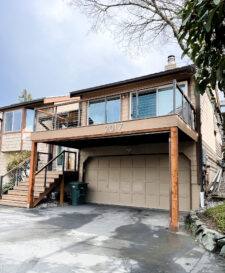
What Salt Air, Rain, and Moss Actually Do to a Deck
Salt Air and Corrosion
Being close to saltwater means airborne salt settles on metal hardware — joist hangers, screws, bolts, and structural connectors — and speeds up rust and corrosion well beyond what you'd see a few miles inland. Once fasteners start failing, the structural integrity of the deck is compromised even if the decking boards on top still look fine.
Driving Rain and Water Intrusion
Wind-driven rain doesn't just fall straight down — it gets pushed sideways into ledger boards, under flashing, and into any seam that isn't properly sealed. Over years, this shows up as rot at the house connection point, the single most common structural failure point on older decks in this area.
Moss, Algae, and Shade
Edgemoor's tree canopy is part of what makes the neighborhood attractive, but it also means many decks get limited direct sun. Combined with regular rainfall, that creates ideal conditions for moss and algae growth on wood and composite surfaces alike. Moss holds moisture against the decking material long after a storm has passed, which accelerates wood decay and can make walking surfaces genuinely slippery and unsafe.
Signs a Deck Needs Replacement, Not Just Repair
Homeowners often ask whether a deck can be patched instead of replaced. Sometimes it can — but there are signs that point to full replacement being the honest recommendation:
- Soft, spongy, or visibly sagging deck boards, especially near the house
- Rust staining running down from fasteners or metal connectors
- A ledger board that's separating from the house or shows soft wood when probed
- Support posts or footings that have shifted, settled, or show rot at ground contact
- Persistent moss or dark staining that returns within weeks of cleaning
- A deck older than 15-20 years that has never had structural components replaced
If the framing and footings are still sound, we'll say so — resurfacing or targeted repair is sometimes the right call, and we'd rather tell you that than sell a full replacement you don't need. But if the structure underneath is compromised, replacing boards on top of bad framing just delays the real problem and costs more in the long run.
Choosing Decking Material for This Climate
Every decking material handles moisture, salt air, and shade differently. There's no universal "best" choice — it depends on your budget, how much sun the deck gets, and how much maintenance you're willing to keep up with.
| Material | How It Handles Edgemoor Conditions | Maintenance Reality |
|---|---|---|
| Pressure-treated wood | Affordable, but needs consistent sealing to resist rot and moss in shaded, damp spots | Annual cleaning and re-staining/sealing recommended |
| Cedar | Naturally rot-resistant and handles moisture well, but softer surface can hold moss without upkeep | Periodic cleaning and oil/sealant every 1-2 years |
| Composite decking | Resists rot and doesn't need sealing; some early-generation composites held moisture at the surface — modern capped composites shed water much better | Occasional washing to clear moss film; no staining or sealing |
| PVC/synthetic decking | Fully non-organic surface, best resistance to moss growth and moisture damage | Lowest maintenance; periodic washing only |
We install all of the above depending on what fits the project. Our standard is to always pair the decking material with corrosion-resistant fasteners and hardware rated for coastal or high-moisture use — using standard interior-grade hardware in this environment is a shortcut that shows up as rust stains and loose boards within a couple of years.
What a Correct Deck Replacement Actually Involves
Deck replacement is more than swapping old boards for new ones. A correct job addresses everything underneath the walking surface, since that's what determines how long the deck actually lasts here:
Ledger and House Connection
The ledger board — where the deck attaches to the house — is the point most exposed to wind-driven rain and the most common source of hidden rot. We install proper flashing that directs water away from the house structure rather than letting it pool at the connection.
Framing and Joists
Joists and beams get inspected and, where needed, upgraded to pressure-treated or naturally durable lumber sized correctly for the span and load. Undersized or aging framing is a safety issue, not just a cosmetic one.
Footings and Posts
Footings need to be set to the correct depth for our frost line and soil conditions, and posts need proper post bases that keep wood off standing water. This matters more in low-lying or heavily shaded yards where ground moisture doesn't evaporate quickly.
Fasteners and Hardware
Given the salt air exposure common in this neighborhood, we use corrosion-resistant or coastal-rated fasteners and structural hardware throughout — not just where it's visible.
Surface Decking and Drainage Detail
Board spacing and slope are set to shed water and reduce standing moisture, which directly reduces how much moss and algae can take hold between cleanings.
Our Replacement Process
- On-site assessment — we inspect the existing deck's framing, ledger, footings, and hardware, not just the surface boards, so you know exactly what's driving the recommendation.
- Honest scope and estimate — you get a clear breakdown of what's being replaced, what materials are being used, and why, before any work starts.
- Permitting — most deck replacement work in Bellingham requires a permit, particularly for structural work or decks above a certain height; we handle that process as part of the job.
- Demolition and structural rebuild — old decking, framing, and hardware are removed and the structural components are rebuilt to current code.
- Decking installation — surface material is installed with attention to drainage, fastener corrosion resistance, and proper spacing.
- Final walkthrough — we go over the finished deck with you, including what maintenance (if any) it needs going forward.
Permits and Code Considerations Locally
Deck replacement in Bellingham and unincorporated Whatcom County generally falls under building permit requirements once you're dealing with structural framing, footings, or decks attached to the house above a certain height. Homeowners are sometimes surprised that a "like for like" replacement still needs a permit — but if the ledger, footings, or framing are being touched, it almost always does. We handle the permit process as part of the job so you're not left navigating it alone, and so the finished deck is inspected and documented correctly, which matters when you eventually sell the home.
Maintaining Your New Deck in This Climate
Whatever material you choose, a little regular maintenance goes a long way toward keeping moss and moisture damage from creeping back in:
- Sweep leaves and debris off the deck regularly, especially in fall — trapped organic matter feeds moss growth
- Rinse or wash the surface a few times a year to clear early moss and algae film before it takes hold
- Check and clear any drainage gaps or gutters near the deck so water isn't pooling against it
- Inspect fasteners and hardware periodically for early rust staining, especially in the first few years
- For wood decks, re-seal or re-stain on the schedule recommended for the specific product used
- Trim back overhanging branches where practical to increase sun exposure and airflow
Why a Crew That Already Works Edgemoor Matters
A contractor who mostly works drier, sunnier regions will often spec the same materials and details they'd use anywhere else. A crew that regularly works Bellingham's waterfront-adjacent neighborhoods already knows which fasteners hold up to the salt air here, how deep footings need to go given our soil and frost conditions, and which decking products actually resist the moss problem instead of just looking good in a showroom. That local experience shows up in fewer callbacks and a deck that's still solid well past the point where a poorly-matched build would already be showing rot.
We also know the practical side of working in established, tree-covered neighborhoods like Edgemoor — narrower access points, protecting landscaping during demolition, and coordinating around mature trees and shared driveways without causing unnecessary disruption.
If your deck is showing rust stains, soft spots, or moss that keeps coming back, we're happy to take a look and give you a straight answer on repair versus replacement. Request a free, no-pressure estimate using the form below — there's no obligation, just an honest assessment of what your deck needs.