 Bellingham Exterior
 Cordata's Climate Puts Real Demands on Exterior Siding
Cordata sits in the north Bellingham area of Whatcom County, close enough to the water and the weather patterns coming off Bellingham Bay and the Salish Sea that homes here take a steady beating from moisture, wind-driven rain, and salt-laden air. Add in the long gray stretch from fall through spring when shaded siding barely dries out between storms, and you get a moss season that can run half the year. Siding in this neighborhood isn't just a cosmetic choice — it's a weather barrier that has to perform, year after year, without babysitting.
We install James Hardie fiber cement siding exclusively. Not vinyl, not LP SmartSide, not cedar or primed spruce, not other fiber cement brands. This page is specifically about what that means for a home in Cordata: what the climate demands, what a correct installation actually involves, and why the crew doing the work matters as much as the product itself.
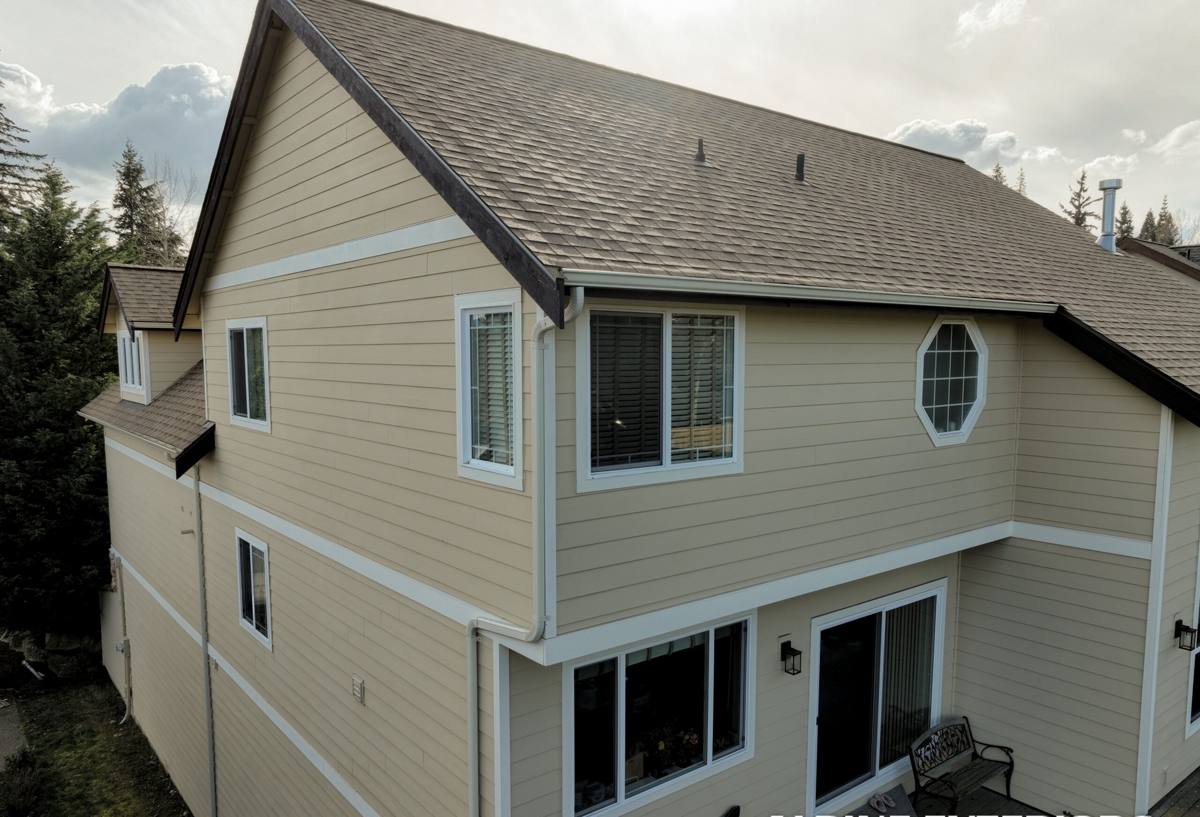
What Bellingham's Weather Does to Siding Over Time
Salt Air and Driving Rain
Homes closer to the water deal with airborne salt that accelerates corrosion on fasteners, trim, and any material that isn't built to handle it. Combine that with wind-driven rain that gets pushed sideways into wall assemblies, and you need a siding system where the water management — not just the surface material — is done correctly. Gaps, flashing, and clearances matter as much as the panel itself.
The Long Moss Season
North-facing walls, areas under mature trees, and anywhere airflow is limited hold moisture longer in Whatcom County than in drier climates. Moss and algae don't just look bad — sustained organic growth on a wall surface holds water against it, which is a problem for siding that isn't dimensionally stable or properly finished. Wood-based products are the most vulnerable here because moss growth accelerates rot once moisture gets past the surface.
Freeze-Thaw Cycling
Bellingham doesn't get brutal winters, but it does get repeated freeze-thaw swings through the colder months. Any siding material that absorbs water will expand and contract with those cycles. Over years, that's what causes swelling, cracking, and paint failure on materials not engineered for it.
Why We Standardized on James Hardie Instead of the Alternatives
We get asked why we don't offer vinyl, LP SmartSide, cedar, or other fiber cement brands. The honest answer is that we looked at how each performs in exactly this climate over a 20-30 year window, not just at install day, and James Hardie held up as the standard we're willing to put our name behind.
- Vinyl is affordable and low-maintenance, but it's a thin plastic product that can warp in heat, crack in cold, and fade — and it doesn't stop wind-driven rain from getting behind it the way a properly flashed fiber cement wall assembly does.
- LP SmartSide is engineered wood. It performs well when maintained perfectly, but any breach in the factory coating exposes wood substrate to exactly the sustained moisture and moss growth Cordata sees for months at a time.
- Cedar and primed spruce look great initially but require real, recurring maintenance — refinishing, caulking, and vigilance against rot — that most homeowners underestimate until the first sign of trouble shows up.
- Other fiber cement brands (Cemplank, Allura) are chemically similar to Hardie, but Hardie's HZ5 product line is specifically engineered for wet, marine-influenced Pacific Northwest climates, and its ColorPlus factory finish and warranty structure are what we've found most reliable to stand behind long-term.
None of these are "bad" products in every context. They're just not what we're willing to install on a Cordata home given what this specific climate does to a wall over decades.
What Correct James Hardie Installation Actually Involves
The material is only half the equation. Most siding failures we see on older homes in this area trace back to installation shortcuts, not the product itself. A correct Hardie install in a climate like this includes:
- Proper starter strip and flashing at every horizontal transition, window, and door — this is where wind-driven rain finds its way in if it's skipped or rushed.
- Correct fastener placement and spacing per Hardie's engineering specs, not general carpentry habits — over- or under-driven nails compromise the water-resistive barrier.
- A weather-resistive barrier and rainscreen approach appropriate for high-moisture walls, giving water a way to drain and the wall a way to dry.
- Manufacturer-specified gaps and clearances at trim, corners, and ground level so panels aren't wicking standing water.
- Factory-primed cut edges sealed on-site — an exposed raw edge is a moisture entry point that undermines the whole system.
- Caulking and sealant used only where Hardie's install guide calls for it — over-caulking traps moisture just as badly as under-caulking lets it in.
Skipping any one of these doesn't show up as a problem on day one. It shows up three, five, or ten winters later as a soft spot, a moss-covered stain line, or a paint failure — right around when most homeowners assume the siding should still be performing perfectly.
James Hardie Product Lines That Fit This Neighborhood
| Product | Best Use | Why It Fits Cordata |
|---|---|---|
| HardiePlank Lap Siding (HZ5) | Primary wall cladding | Engineered for wetter, harsher climates with enhanced moisture and freeze-thaw resistance |
| HardiePanel Vertical Siding | Accent walls, modern facades | Clean lines with the same fiber cement durability against driving rain |
| HardieTrim Boards | Corners, fascia, window trim | Non-combustible, dimensionally stable trim that won't rot where water collects |
| HardieShingle Siding | Gables, accent sections | Cedar-shake look without the maintenance burden wood shingles demand here |
Color selection matters too. Hardie's ColorPlus factory finish is baked on under controlled conditions and backed by its own finish warranty — a meaningfully more consistent result than field-applied paint, especially in a climate where paint has limited dry-time windows to cure properly.
Our Process for a Cordata Siding Project
- On-site assessment — we look at your home's exposure (wind direction, shade, tree cover, proximity to water) since that changes which details need extra attention.
- Moisture and substrate check — before any new siding goes up, we confirm what's underneath is sound. Covering a moisture problem is worse than not covering it at all.
- Detailed proposal — product line, color, trim package, and a clear scope of what water management work is included, not just "siding installed."
- Installation to Hardie's published specs — fastener schedules, clearances, and flashing details are followed exactly, not adjusted for speed.
- Final walkthrough — we go over what maintenance (if any) is actually needed and what your warranty covers.
Why Hiring a Crew That Already Works in This Area Matters
A crew that installs Hardie across Whatcom County day in and day out already knows which walls in this kind of neighborhood need extra flashing attention, which orientations grow moss fastest, and how local moisture patterns behave differently than a install manual's generic assumptions. That's not something a crew unfamiliar with the region picks up on the first project. It shows up in the small decisions — where to add an extra course of flashing, how tight to run a gap at ground level, which corners get reinforced trim — that don't cost much more at install time but make the difference between siding that looks right for two years and siding that performs right for thirty.
We also only install one product system, which means we're not guessing at install specs across four different manufacturers' manuals. Every crew member knows Hardie's requirements cold because it's the only thing we put on a wall.
What to Check Before You Hire Anyone for Hardie Siding
- Ask whether the crew is factory-trained or certified on Hardie installation specifically, not just "experienced with siding in general."
- Confirm they're pulling permits where required — siding work that touches structural sheathing or water barriers often needs one.
- Ask what happens if they find rot or moisture damage once old siding comes off — a vague answer here is a red flag.
- Get the warranty terms in writing: manufacturer product warranty, ColorPlus finish warranty, and the contractor's own labor warranty are three separate things.
- Ask about their flashing and rainscreen approach directly — a contractor who can explain it clearly usually does it correctly.
Get a Straight Answer for Your Home
Every Cordata home has its own mix of sun exposure, tree cover, and wind direction, and that changes what your siding actually needs — not just which color you pick. If you'd like a straightforward look at your home's siding, with no pressure and no upsell into products we don't stand behind, request a free estimate below and we'll walk the property with you.