 Bellingham Exterior
 Board & Batten Siding for Sudden Valley Homes
Sudden Valley sits on the south shore of Lake Whatcom, wrapped in second-growth forest, with its own private road network and homeowners association. Board and batten's vertical lines suit the wooded, cabin-and-craftsman character of the community well, which is part of why we get asked about it here more than in some of the more open, in-town parts of Bellingham. But board and batten is a joint pattern before it's a look — every seam between a board and the batten covering it is a place moisture can try to work its way behind the siding. On a lot buried in tree canopy, where walls can stay damp for days after a storm passes, how that joint is built matters as much as which product goes on the wall.
We install James Hardie fiber cement board and batten exclusively. On a property like a typical Sudden Valley lot, where shade and lake humidity keep siding wet longer than almost anywhere else in Whatcom County, we build every fastening pattern and flashing detail around what this specific microclimate does to a wall over decades, not around what looks right on the day the crew packs up.
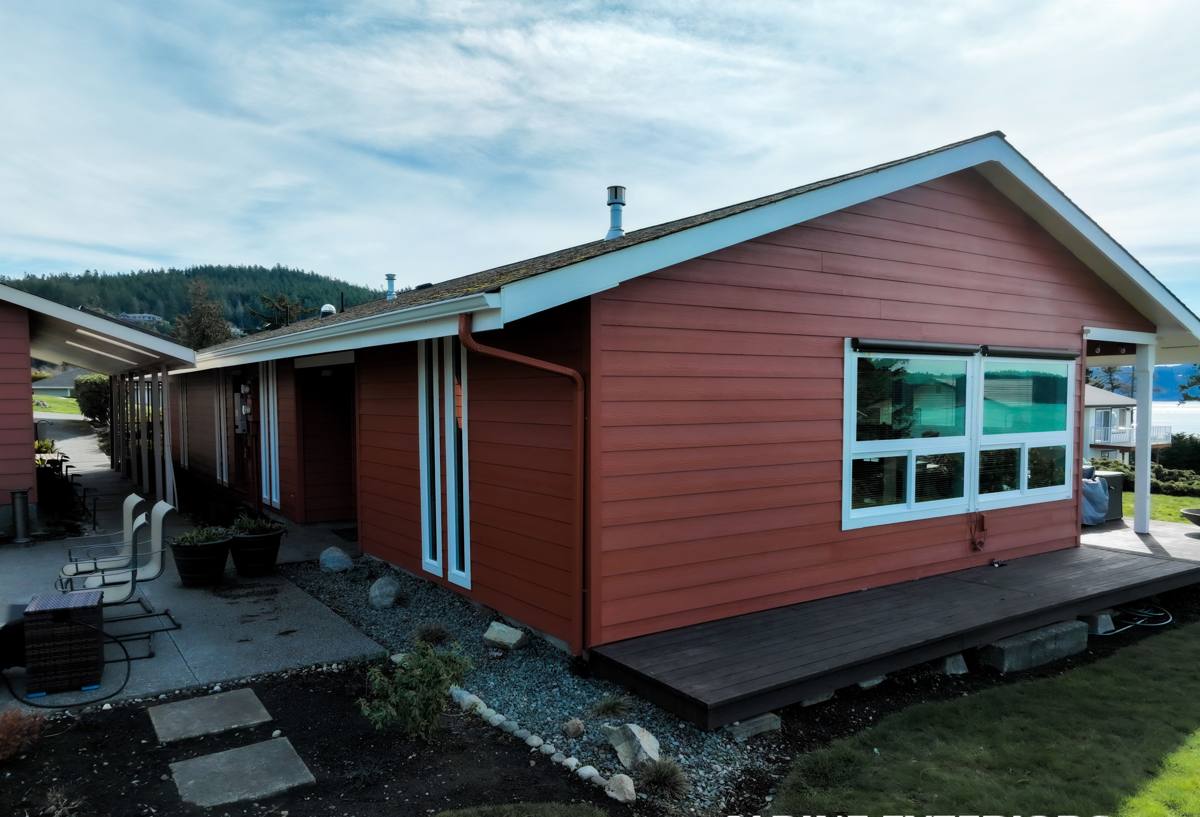
What Sudden Valley's Climate Asks of a Board & Batten Wall
Heavy Shade That Slows Every Seam's Drying Time
Most Sudden Valley lots sit under substantial tree cover, and it's common for a home to have one or two elevations that get little direct sun for most of the year. Board and batten's vertical battens create narrow channels that hold water against the wall after rain; on a sun-exposed wall that moisture evaporates within a day, but on a shaded Sudden Valley wall it can linger far longer. A batten set without proper clearance traps that lingering dampness right at the joint instead of letting it dry.
Lake Humidity and Driving Rain at Uneven Angles
Lake Whatcom keeps the air noticeably more humid here than it is further from the water, and Sudden Valley's hilly terrain means homes sit at a range of elevations and orientations relative to the lake and surrounding ridgelines. That variability sends wind-driven rain into different walls of the same house with different force. A board and batten wall on the lake-facing side of a home may need a heavier drainage detail than a wall tucked behind a rise, and a correct install accounts for that rather than treating every elevation the same.
A Moss Season That Barely Lets Up
Shade, humidity, and mild temperatures are exactly what moss and mildew need, and Sudden Valley's dense canopy keeps that combination active for most of the year. Battens on shaded elevations are prime real estate for it, especially where a batten is caulked tight instead of properly vented — that trapped moisture behind the seam is what turns a cosmetic moss problem into softened substrate and early paint failure.
Why Product Choice Matters More on This Profile, in This Location
Board and batten has roughly twice the fastener count and joint length of a standard lap profile, so it amplifies whatever weaknesses a siding material already has. In a shaded, lake-humid setting like Sudden Valley, that amplification is worse than it would be on an open, sun-exposed lot elsewhere in Bellingham. It's why we don't offer LP SmartSide, vinyl, Cemplank, Allura, primed spruce, or cedar board and batten. Those are legitimate products, and other contractors install them competently — but on a profile this seam-heavy, on lots this consistently damp, we made the call to stand behind one system completely rather than offer something cheaper that shifts the maintenance risk onto the homeowner down the line.
| Material | Behavior at Batten Seams in Heavy Shade | Maintenance on a Shaded Sudden Valley Lot | Realistic Lifespan Here |
|---|---|---|---|
| James Hardie fiber cement | Dimensionally stable; doesn't swell or cup even when seams stay damp for days | Low; factory finish resists moss staining and fading without direct sun | 30+ years with proper install |
| LP SmartSide (engineered wood) | Moisture-sensitive at cut edges and fastener holes, worse without sun to dry it out | Moderate to high; edge sealing needs more frequent attention in constant shade | 15-25 years, shorter under heavy canopy |
| Vinyl | Battens and seams can trap moisture behind panels in poorly ventilated, shaded walls | Low upfront, but hidden dampness is hard to catch until damage shows | Variable; shorter on consistently shaded elevations |
| Cedar | Absorbs moisture readily at every seam and rarely gets a full day of sun to release it | High; refinishing on a tighter cycle than a sunnier property would need | 15-25 years with consistent upkeep, less without |
Fiber cement's dimensional stability is the property that matters most here — it doesn't expand and contract with the moisture cycling that a shaded, lake-adjacent wall goes through far more than a sunny one. The factory-applied ColorPlus finish also means the board faces themselves are never depending on field-applied paint to hold up through a Sudden Valley winter; only the cut edges we prime on site carry that burden.
What a Correct Board & Batten Install Actually Involves
The finished look is simple: vertical boards, battens over the seams. What holds that look up for decades on a shaded, humid lot involves a lot more than most homeowners expect:
- House wrap or weather-resistive barrier installed and correctly lapped before any siding goes up, so the wall assembly behind the battens starts dry
- A drainage gap or rainscreen behind the siding so moisture that reaches the surface can actually dry out instead of sitting against a shaded wall indefinitely
- Corrosion-resistant fasteners at the manufacturer's specified spacing for both boards and battens, not just enough to hold the material up
- Battens set with the clearance Hardie's install spec calls for rather than caulked tight, so damp seams can vent instead of trapping water
- Properly flashed, lapped transitions at windows, doors, corners, and the base of the wall, tuned to which elevation faces the lake and which sits in deeper shade
- Factory-cured ColorPlus finish preserved by cutting boards face-down and priming every field-cut edge before it goes up
Skip any one of these on a sunny, open lot and it might take several years to show. Skip it on a shaded Sudden Valley wall that rarely gets a full day of direct light, and the same mistakes — staining at seams, soft spots at the base, early paint failure along the battens — tend to surface much sooner.
Our Process for a Sudden Valley Board & Batten Project
Walkthrough and Assessment
We start by looking at which walls of your home sit in the deepest shade, which face the lake and take the most direct wind-driven rain, and whether the existing wall assembly already has moisture issues that need addressing before new siding goes up. Installing board and batten over a wall with hidden rot just buries the same problem under new material and a nicer finish.
Detailing the Plan Before Install Day
We work out batten spacing, corner details, and how the siding meets windows, trim, and rooflines before crews start cutting material — and we note which elevations need extra drainage attention because of shade or lake exposure. On a profile with this many seams, planning those details on paper first avoids field improvisation, which is where corners tend to get cut.
Installation to Manufacturer Spec
Every fastener, gap, and flashing lap follows James Hardie's published requirements for this climate zone. That's what keeps the manufacturer's warranty intact, and it's what lets the wall perform the way it's supposed to for decades in a setting this consistently damp, rather than years.
Final Walkthrough
We walk the finished job with you, cover the (minimal) maintenance board and batten actually needs, and point out what to watch for on your specific shaded elevations if you ever want to check the wall yourself.
Why Hire a Crew That Already Works Sudden Valley
Sudden Valley is a private community with its own road network and homeowners association, and a crew that regularly works here already understands the practical side of that — scheduling around community access, and how much the terrain and tree cover change exposure from one lot to the next even within the same stretch of the neighborhood. That familiarity also shows up in judgment calls that don't appear on a spec sheet: which elevations need a wider drainage gap because they never see direct sun, how much batten clearance actually holds up in air this humid versus what a generic install guide assumes, and where lake-facing wind-driven rain calls for extra flashing attention. That's the difference between a board and batten wall that still looks and performs the same in fifteen years and one that's showing seam staining by year five.
Before You Hire, Ask
- What siding material they install and why, and whether they'll put a written warranty behind it
- Whether they carry current Washington contractor licensing and active liability insurance
- How they handle batten clearance and drainage detailing on walls with heavy shade or tree cover
- Whether they have experience working within HOA or private-road communities like Sudden Valley, including access and scheduling
- For a clear, written scope of work before any contract is signed
Cost Factors for Board & Batten in Sudden Valley
Board and batten typically runs more per square foot than standard lap siding, largely because of the added batten material and the extra labor of fastening and detailing two layers instead of one. A few things move the price further on a specific Sudden Valley home:
| Factor | Why It Matters Here |
|---|---|
| Wall shade and exposure mix | Elevations facing the lake or sitting in deep shade may need heavier drainage detailing than others on the same house |
| Existing wall condition | Moisture damage found during tear-off, more likely on long-shaded walls, needs repair before new siding goes up |
| Batten spacing and reveal | Tighter spacing uses more material and more fastening labor |
| Trim and window detailing | More openings mean more flashing and finish work around each one |
| Site access | Sudden Valley's private roads, driveways, and terrain can affect staging and labor time |
We'll walk your specific property and give real numbers rather than a rough estimate off square footage alone — two Sudden Valley homes with the same footprint can carry very different board and batten costs depending on how much of each wall sits in shade versus open exposure.
Getting It Right the First Time
Board and batten is not a forgiving profile to redo, since the battens cover the seams between boards and correcting a bad install usually means pulling battens, boards, or both. That's part of why we treat planning and detailing as seriously as the install itself on a Sudden Valley project — the cost of getting it right the first time is a lot lower than the cost of tearing out a wall that trapped moisture behind it for a few wet seasons before anyone noticed.
If you're weighing board and batten for a home in Sudden Valley, we're happy to walk the property, talk through what your specific walls need given their shade and lake exposure, and give you a straightforward, no-pressure estimate. There's a form below — reach out and we'll set up a time to take a look.