 Bellingham Exterior
 Birchwood Decks Take a Different Kind of Beating
Birchwood sits close enough to Bellingham Bay and the Puget Sound marine layer that decks here deal with more than ordinary Pacific Northwest rain. Salt-laden air corrodes fasteners and hardware faster than it would inland, driving rain gets pushed sideways under railings and against ledger boards, and the long, mild moss season means shaded and north-facing decks stay damp for months at a stretch. None of that means a deck is doomed — it means repairs have to account for moisture and corrosion, not just wear and tear.
We've worked on enough decks in this part of Whatcom County to know the pattern: the deck looks fine from a few feet away, but the damage that actually matters is happening where you can't see it — under the ledger flashing, inside a post base, or underneath a board that looks solid until you press on it.
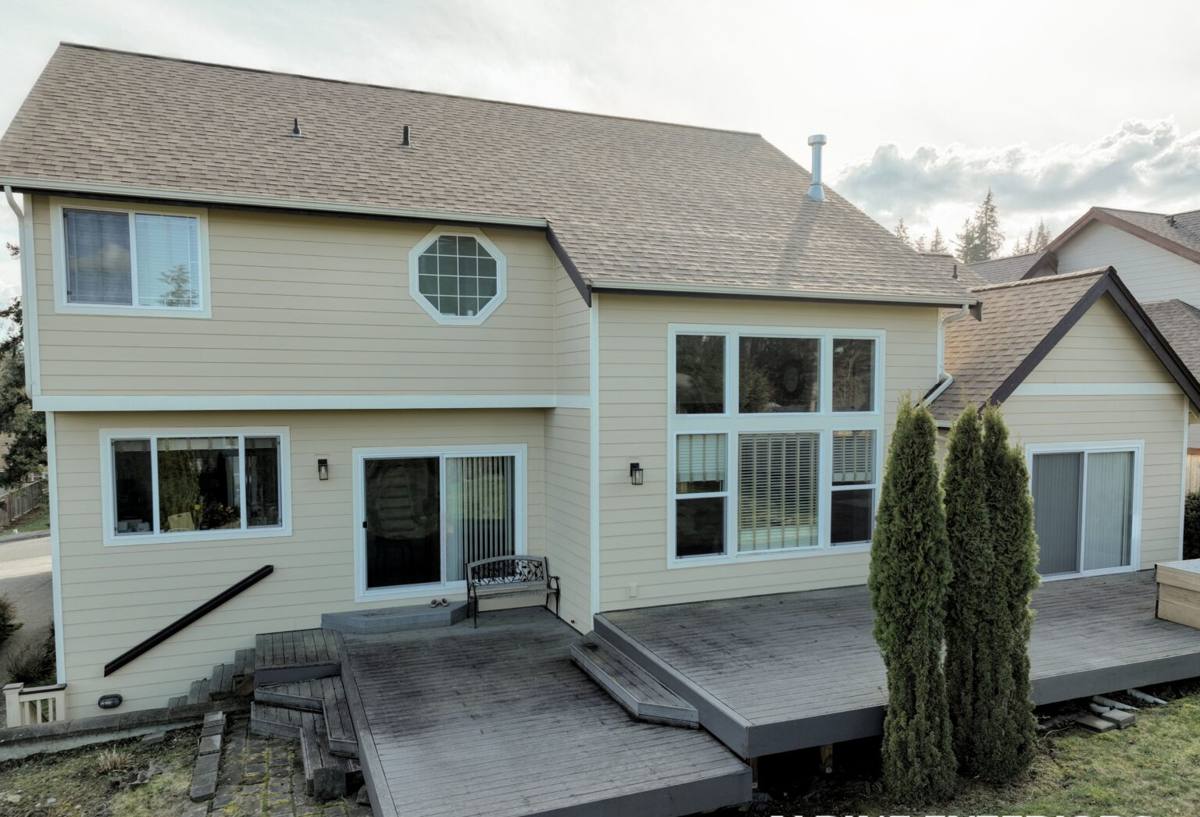
Signs Your Deck Needs Repair, Not Just a Cleaning
A pressure wash or a coat of stain can make a tired deck look better without fixing what's actually wrong. Before you spend money on cosmetic work, it's worth checking for the signs that point to a real structural or moisture problem underneath.
- Boards that feel spongy, springy, or soft when you walk across them, especially near the house
- Any bounce, sway, or looseness when you lean on the railing
- Rust streaks below screw heads or around joist hangers
- Gaps opening up where the deck meets the house siding
- Persistent moss or dark staining on the same boards year after year, even after cleaning
- Nails or screw heads that have backed out or are visibly popping up
- Cracks running along the length of a board rather than just surface checking
- Stairs that feel less solid than the rest of the deck
Any one of these on its own might be minor. Two or three together, especially near the ledger board or stairs, usually mean it's time for a closer look before someone gets hurt.
The Deck Repair Issues We See Most Often in This Area
Ledger Board and Flashing Failures
The ledger board — the piece that attaches the deck directly to the house — is the single most important structural connection on most decks, and it's also the one most exposed to water intrusion if flashing wasn't installed correctly or has failed over time. In a climate with this much driving rain, a ledger without proper flashing will eventually let water track behind the siding and into the rim joist. By the time you can see rot at the ledger from outside, the framing behind it is often already compromised. This is the repair we take most seriously, because it's a safety issue, not just a cosmetic one.
Rotted Joists, Beams, and Posts
Framing lumber that stays wet for long stretches — under decking with poor drainage, or where debris has collected against a post — softens and rots from the inside before it shows on the surface. We check joist ends, beam pockets, and the base of every post where it meets a footing or concrete pier, since that's where moisture tends to sit longest.
Failing Fasteners and Hardware
Salt air speeds up corrosion on fasteners and joist hangers that weren't rated for coastal exposure. Rust weakens the connection long before it's visible from the top of the deck, and it's one of the more common reasons an otherwise sound-looking deck fails a closer inspection.
Decking Board Damage
Cupping, splintering, soft spots, and persistent moss growth are the most common issues on the wood decking itself. Some of this is normal wear that can be sanded or spot-repaired; some of it means the board has absorbed enough water that it needs to come out.
Railings and Guardrails
Loose posts, wobbly railings, and baluster spacing that no longer meets code are common on older decks, especially ones that have had ad-hoc repairs over the years. Railings take a lot of hidden stress every time someone leans on them, so a loose railing post is one of the higher-priority repairs we look for.
Repair or Replace? How We Help You Decide
Not every problem means tearing out the whole deck, and not every deck is worth patching. The decision usually comes down to how much of the structure underneath is still sound.
| Component | Repair is usually enough when | Replacement is usually needed when |
|---|---|---|
| Ledger board / flashing | Flashing has failed but framing behind it is still solid wood | Rot has spread into the rim joist or house framing |
| Joists / beams | Damage is limited to one or two sections and joists can be sistered | Multiple joists are soft, or the beam itself has lost structural integrity |
| Posts / footings | Post base shows surface rot but the footing and post above it are sound | Post has rotted through or the footing has shifted or cracked |
| Decking boards | A handful of boards are damaged and the rest are in good shape | Most boards show cupping, soft spots, or splintering across the deck |
| Railings | Posts are loose but the connection points are still solid wood | Multiple posts are rotted or the layout no longer meets current code |
As a general ballpark, spot repairs to framing, fasteners, or a handful of boards often run in the low-to-mid hundreds of dollars, while ledger or framing repairs that require opening up the deck typically run higher depending on access and extent of damage. A full deck replacement is its own separate conversation — we'll always tell you honestly which category your deck falls into before we recommend a direction.
Our Deck Repair Process
- On-site inspection. We walk the deck, check the ledger connection, probe joists and posts for softness, and look at drainage underneath before quoting anything.
- Honest scope. We tell you what's cosmetic, what's structural, and what can wait — in writing, before work starts.
- Open it up where needed. If we suspect hidden rot at the ledger or framing, we open that section up rather than guessing or covering it back over.
- Repair or sister the framing. Damaged joists and beams get sistered, replaced, or reinforced to match the original structural capacity, not patched over.
- Correct the water problem. Any repair that doesn't fix the underlying flashing, drainage, or fastener issue that caused the damage is just a repeat repair waiting to happen — so we address the cause, not just the symptom.
- Match materials and finish. New boards and hardware are selected to hold up to this climate and blend reasonably with the existing deck.
- Final walkthrough. We check railings, stairs, and fastener lines together with you before calling the job done.
Materials We Use — and Why
For structural repairs, we use pressure-treated lumber rated for ground or moisture contact and stainless steel or coated fasteners suited to a marine-influenced climate — standard fasteners corrode faster here than in drier parts of the state, and replacing a rusted screw is a lot cheaper than replacing a rotted joist caused by one. For decking board replacement, we'll talk through wood versus composite honestly:
| Factor | Wood decking | Composite decking |
|---|---|---|
| Upfront cost | Generally lower | Generally higher |
| Maintenance | Needs periodic cleaning, sealing, or staining | Lower maintenance, but still needs regular cleaning in this climate |
| Moss/algae resistance | More prone to surface moss without upkeep | More resistant, though not immune in shaded, damp areas |
| Repair approach | Individual boards can be replaced to match existing decking | Matching an exact discontinued color/profile can be harder |
Neither option is wrong — it depends on your budget, how much upkeep you want to do, and how much sun the deck gets. We'll give you our honest recommendation for your specific deck rather than pushing one product across the board.
Moss, Algae, and Keeping a Repaired Deck Repaired
A long moss season is just part of living in this part of Whatcom County, and it's one of the biggest drivers of repeat deck damage we see. Moss and algae hold moisture against the wood, which is exactly what leads to the soft boards and rot pockets described above. After a repair, the deck will hold up longer if it's kept clear of debris in the fall, gets a periodic gentle cleaning rather than an aggressive pressure wash that can damage wood fibers, and has any drainage under the deck kept clear so water isn't sitting against framing. We're happy to point out the trouble spots on your specific deck during the estimate so you know what to watch.
Permits, Code, and Why Local Experience Matters
Structural deck repairs — especially anything touching the ledger board, framing, or guardrails — can fall under Whatcom County or City of Bellingham permitting requirements depending on the scope of work and the deck's height and location. We'll tell you upfront if your repair is likely to need a permit rather than leaving you to find out later. Current guardrail height and baluster spacing requirements come from the building code adopted locally, and older decks in established Bellingham neighborhoods were often built to a different set of standards than what's required today — something worth knowing if your repair touches the railings.
A crew that already works in and around Bellingham knows what this climate does to a deck over a few years, knows what tends to fail first on homes in this area, and isn't guessing at local permitting requirements. That local familiarity is part of what keeps a repair from turning into a repeat visit.
If you've got a deck in Birchwood that's showing any of the signs above, we're glad to come take a look and give you a straight answer on what it needs. Reach out for a free, no-pressure estimate using the form below.