 Bellingham Exterior
 Birch Bay Siding Takes a Different Kind of Beating
Birch Bay sits right on the water, and that changes what siding has to survive compared to a home a few miles inland in Bellingham. Salt-laden air off the bay works on fasteners, trim, and paint film year-round. Wind-driven rain off the Strait of Georgia doesn't just fall straight down — it drives sideways into wall assemblies during winter storms, finding every gap in flashing and caulk. And Whatcom County's long, wet moss season means anything shaded or north-facing stays damp for months at a time. Siding that would hold up fine in a drier climate can fail early here if it wasn't installed with these specific conditions in mind.
That's the backdrop for every repair call we take in Birch Bay. We're not just patching a hole or replacing a cracked board — we're evaluating whether the repair will actually hold up against the same salt air, rain, and moss exposure that caused the damage in the first place.
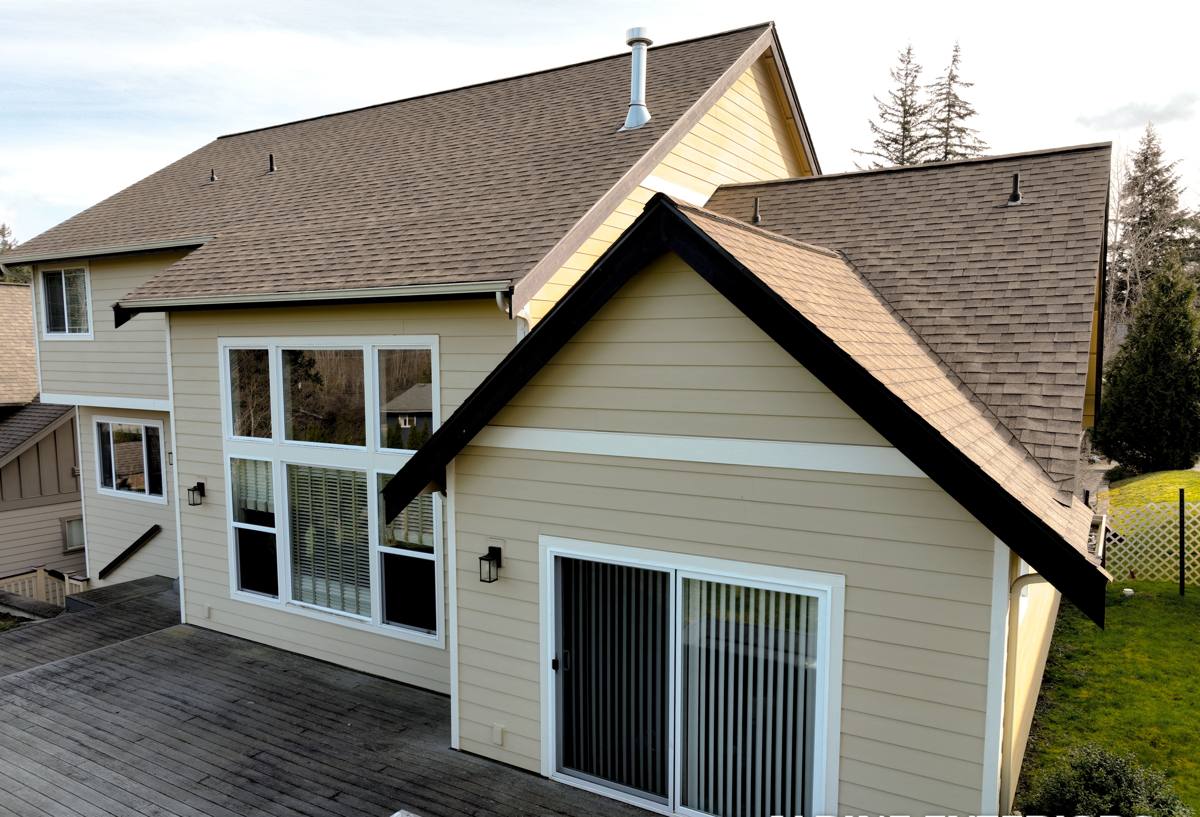
Signs Your Birch Bay Home Needs Siding Repair
Visible Damage
Some problems are easy to spot: cracked or split boards, corners pulling away from the wall, caulk joints that have shrunk and separated, or paint that's peeling in sheets rather than just fading. On homes closer to the water, you'll often see corrosion staining around nail heads and metal trim well before the siding itself looks bad — that's the salt air at work.
Hidden Damage
The more serious signs are the ones you can't see from the driveway. Soft or spongy spots when you press on the siding, dark staining at seams or butt joints, and swelling around window and door trim usually mean moisture has already gotten behind the surface. Moss and algae growth on siding faces — especially on the shaded north and west sides of a house — holds moisture against the material and accelerates whatever damage is already underway. None of these are cosmetic issues; they're signs that water is finding a path into the wall assembly.
What a Correct Siding Repair Job Actually Involves
A repair that's done right starts before anyone touches the siding itself.
Diagnose Before You Patch
We pull back damaged sections to check the condition of the house wrap, flashing, and sheathing underneath before deciding what to replace. Patching over wet or compromised sheathing just locks the problem inside the wall, where it keeps working.
Match the Existing Material
Fiber cement siding varies by manufacturer, profile, and factory finish, so a repair patch needs to match the plank size, exposure, and texture of what's already on the house — otherwise it reads as an obvious patch and can create a water-shedding mismatch at the seams.
Flashing and Sealant Come First
Any repair around windows, doors, corners, or butt joints gets new flashing tape and manufacturer-approved sealant before the new siding piece goes on. In a location like Birch Bay, where wind-driven rain is a regular event, the flashing detail matters more than the siding piece itself — it's what actually keeps water out.
Fasteners That Won't Corrode
Near the water, standard fasteners corrode faster than they would inland. Corrosion-resistant fasteners, installed to the manufacturer's nailing pattern, are non-negotiable on repair work this close to the bay.
Repair vs. Replacement: How We Make the Call
Not every siding problem calls for a full re-side, and not every repair is worth doing instead of replacing a section wholesale. Here's how we think through it on a Birch Bay home:
| Factor | Favors Repair | Favors Replacement |
|---|---|---|
| Extent of damage | Isolated to one or two wall sections | Spread across multiple elevations |
| Sheathing condition | Dry, sound wood behind the siding | Soft, stained, or rotted sheathing found |
| Siding age | Under 10-15 years, still in good shape elsewhere | Near or past expected service life |
| Cause of damage | Isolated impact, one failed flashing detail | Systemic moisture intrusion or failed original install |
| Material match | Same product still available or close match exists | Discontinued product, poor match likely |
When damage is isolated and the wall assembly underneath is dry, a targeted repair is the honest recommendation — there's no reason to spend money re-siding a whole elevation. When we find rot, widespread moisture damage, or an installation that was flawed from the start, we'll tell you that plainly rather than patch over a bigger problem.
Why We Repair With — and Recommend — James Hardie Fiber Cement
Our crew installs and repairs James Hardie fiber cement siding exclusively. We don't install vinyl, LP SmartSide, Cemplank, Allura, or primed wood siding, and in a climate like Birch Bay's, that's a deliberate standard, not a sales pitch.
Vinyl siding expands and contracts significantly with temperature swings, and in driving rain it relies heavily on lap joints and J-channel staying tight — small gaps that open over time let wind-driven water behind the panels. Wood-based and engineered wood products (like LP SmartSide) are more vulnerable to the kind of sustained moisture exposure that comes with a long moss season; if water gets past the surface, wood-based cores can swell and deteriorate in ways fiber cement doesn't. Other fiber cement brands exist, but James Hardie's HZ product lines are engineered specifically for climate zones like ours, and its ColorPlus factory-applied finish is baked on under controlled conditions rather than field-painted — that matters when you're trying to avoid repeat paint failures from salt air and UV exposure.
None of this means other products can't perform when installed well. It means that after years of doing repair and replacement work in this region, fiber cement — installed correctly — is what we've seen hold up best against salt air, wind-driven rain, and moss, and it's the only thing we'll put our name behind.
Our Process for a Birch Bay Repair Call
- On-site inspection — we look at the damaged area and the surrounding siding, not just the spot you called about.
- Moisture check — we open up the affected section to check sheathing and house wrap condition before quoting anything.
- Honest scope — you get a clear answer on whether it's a repair, a partial re-side, or something bigger, along with why.
- Material match — we source matching Hardie profile, exposure, and color, or discuss the closest available match if the original run is discontinued.
- Repair and reseal — new flashing and sealant go in first, then the siding, with corrosion-resistant fasteners throughout.
- Final walk-through — we show you what was found and what was fixed before we call the job done.
Between Repairs: A Maintenance Checklist for Birch Bay Homes
A little seasonal attention goes a long way toward avoiding repeat repair calls in this climate:
- Rinse salt residue off siding a few times a year, especially on elevations facing the water
- Check and clear moss or algae growth on shaded sides before it spreads across a wall face
- Look at caulk joints around windows, doors, and trim each fall before the wet season sets in
- Keep gutters clear so overflow isn't running down siding faces during heavy rain
- Trim back vegetation that keeps siding shaded and damp longer than it needs to be
- Have any soft spots, staining, or corroded fasteners looked at promptly rather than waiting
Why a Local Crew That Already Works Birch Bay Matters
Siding repair in a coastal community isn't the same trade as siding repair fifteen miles inland. A crew that regularly works Birch Bay knows which elevations take the worst of the wind-driven rain, how fast moss establishes on shaded walls here, and how much faster standard fasteners and trim corrode this close to salt water. That local pattern recognition changes what we check first, what we flag as a repeat risk, and what we recommend for materials and fastener choices. It's the difference between a repair that solves the visible problem and one that also accounts for why the problem happened here in the first place.
We're a Bellingham-based crew, and Birch Bay and the surrounding Whatcom County coastline are part of our regular service area — not a special trip. That means we've seen how homes in this specific stretch of coastline age, and we bring that into every repair estimate.
Get a Straight Answer on Your Siding
If you're dealing with damaged, stained, or aging siding on a Birch Bay home, we're happy to take a look and give you an honest read on whether it needs a repair, a partial replacement, or nothing urgent at all. Reach out for a free, no-pressure estimate using the form below.