 Bellingham Exterior
 Birch Bay's Climate Is Harder on Siding Than Most People Realize
Birch Bay sits right where the Salish Sea meets the wind, and that location shapes everything about how a home's exterior ages. Homes here take a steady dose of salt-laden air off the water, driving rain that comes in sideways during winter storms, and a shaded, damp growing season that lets moss and algae establish themselves on anything that stays wet too long. It's a different set of stresses than a home fifteen minutes inland in Bellingham proper deals with, and siding that isn't built for it shows the wear early — chalking, swelling, soft spots, and streaking that no amount of pressure washing fully resolves.
Salt air is corrosive to exposed metal fasteners and trim, and it accelerates the breakdown of coatings and caulking. Combine that with Whatcom County's wet season — long stretches of low-intensity rain punctuated by hard, wind-driven storms off the water — and you get siding assemblies that need to shed water fast and dry out completely between events. When they don't, that's when moss gets a foothold, and moss holds moisture against the wall longer than the siding was ever designed to tolerate.
Why James Hardie Fiber Cement Is the Right Answer for This Environment
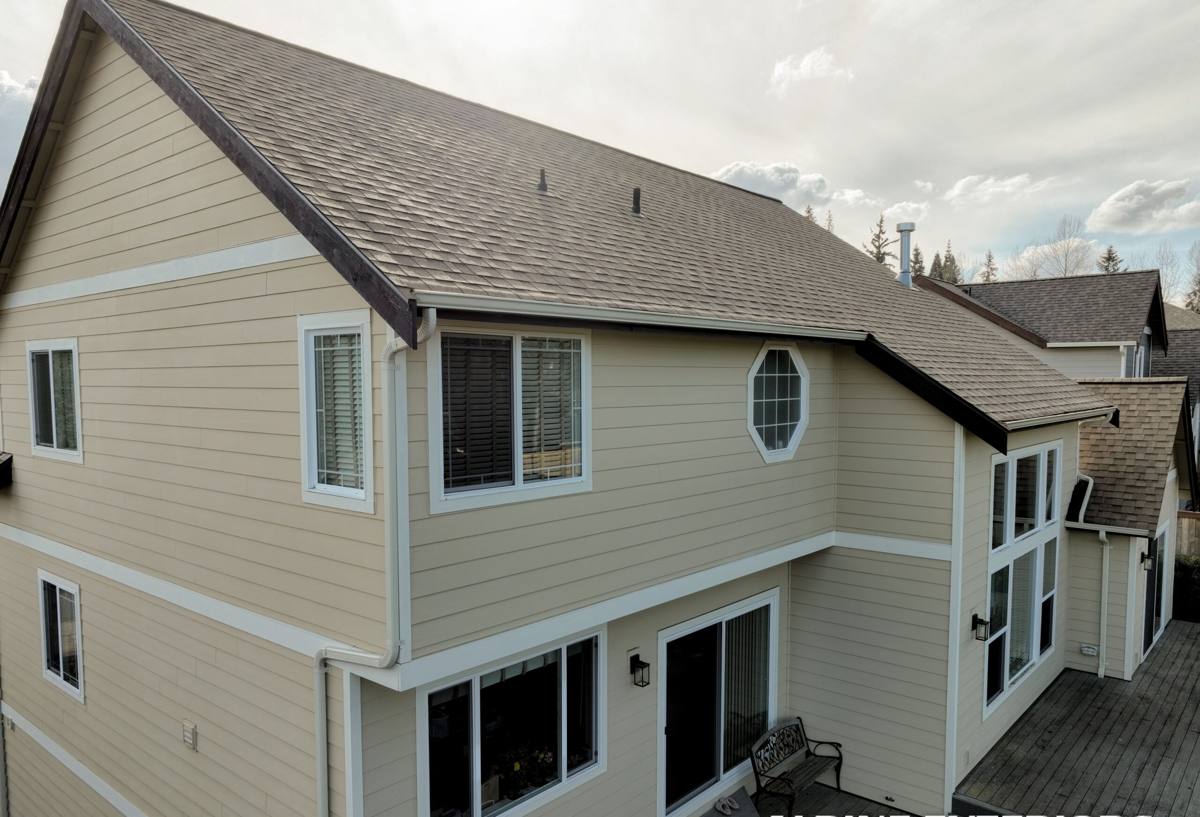
We install James Hardie fiber cement exclusively, and Birch Bay is a good example of why. Fiber cement is made from cement, sand, and cellulose fibers — it doesn't absorb and swell the way wood-based products can, and it isn't affected by the salt-air corrosion that degrades some coatings and trim over time. It's also non-combustible, which matters for peace of mind regardless of the season.
The factory-applied ColorPlus finish is baked on under controlled conditions and backed by its own finish warranty, which matters in a coastal environment where field-applied paint has to fight salt residue and constant moisture just to cure properly, let alone hold up for years. A correctly installed and maintained Hardie exterior gives a Birch Bay home a fighting chance against all three of the area's biggest stressors — salt, rain, and moss — at once, rather than trading strength against one for weakness against another.
HZ5 Engineering for Pacific Northwest Exposure
James Hardie makes climate-specific product formulations, and homes in our region qualify for the HZ5 line, engineered for wetter, harsher climates than the HZ10 formulation used in drier parts of the country. For a home exposed directly to Birch Bay's marine air and winter storm rotation, that distinction isn't marketing — it's the product being built to actually handle the moisture cycling this location sees every year.
What a Correct Installation Actually Involves
Fiber cement siding is only as good as the assembly behind it. Most of the siding failures we get called out to inspect on the coast trace back to installation shortcuts, not the material itself. A correct job on a Birch Bay home includes:
- A code-compliant weather-resistive barrier installed with proper shingle-lap sequencing so water is directed out, not trapped in
- Rainscreen or drainage-plane detailing where the wall assembly calls for it, so moisture that gets behind the cladding has somewhere to go
- Correct fastener type, spacing, and embedment per Hardie's fastening schedule — under-driven or over-driven nails are a common cause of early panel movement
- Proper clearance at grade, decks, and roof lines so siding never sits in standing water or constant splash-back
- Factory-cut and factory-primed edges kept intact, with field cuts sealed per manufacturer specification
- Flashing at every window, door, and penetration, lapped correctly with the water-resistive barrier
- Caulking only where Hardie's install guide specifies it — not as a substitute for correct flashing and lap sequencing
Skip any one of these steps and the material's climate engineering doesn't matter much — water will find the gap. This is also why we don't treat siding as a standalone product install; it's a water-management system, and the cladding is just the visible layer of it.
How Different Siding Materials Hold Up in a Salt-Air, High-Moisture Environment
Homeowners in Birch Bay often ask how the material options actually compare once you factor in the location, not just the showroom sample. Here's an honest look at how common siding choices tend to perform under sustained coastal exposure:
| Material | Moisture Behavior | Salt Air Exposure | Moss/Algae Resistance | Typical Maintenance |
|---|---|---|---|---|
| James Hardie fiber cement | Does not swell or rot; engineered HZ5 formulation for wet climates | Not corroded by salt; factory finish resists fading | Smooth ColorPlus surface sheds spores better than porous materials | Periodic rinse; repaint only when the factory finish eventually ages out |
| Cedar | Absorbs moisture, prone to cupping and rot without diligent upkeep | Finish breaks down faster in salt air | Porous surface is a favorite for moss and mildew | Frequent refinishing and moss treatment |
| Vinyl | Doesn't rot, but can warp or crack under repeated wet-dry and temperature cycling | Can chalk and fade faster near the water | Seams and laps trap moisture and debris | Cleaning; replacement of warped panels |
| LP SmartSide (engineered wood) | Wood-based core is vulnerable if any moisture gets past the coating | Coating durability is a factor in salt exposure | Any coating breach invites moisture and organic growth | Vigilant caulk and coating inspection |
This isn't a knock on any of these materials in the right application — it's why we standardized on Hardie for the homes we work on in coastal Whatcom County specifically. A Birch Bay exterior spends its whole life inside the toughest column of that table, and that's the environment we're building for.
Our Process for a Birch Bay James Hardie Project
Every home is different, but the sequence we follow doesn't change:
- On-site assessment — we look at the existing siding, sheathing condition, trim, flashing, and any moisture or moss patterns already visible, since those tell us where the wall has been struggling
- Tear-off and sheathing check — old siding comes off and we inspect the sheathing underneath for rot or soft spots before anything new goes up
- Weather barrier and drainage detailing — installed to spec for our climate, with attention to any areas with direct wind and rain exposure off the water
- James Hardie installation — HZ5 product, correct fastening, flashing, and clearances as outlined above
- Trim, caulking, and finish detail — completed per manufacturer guidelines, not shortcuts
- Final walkthrough — so you understand what was done and what basic upkeep, if any, we recommend going forward
Cost Factors on a Coastal Job Like This
Every estimate depends on the specific home, but a few factors tend to move the number more on a Birch Bay property than an inland one:
| Factor | Why It Matters Here |
|---|---|
| Existing wall condition | Homes with past moisture intrusion may need sheathing repair before new siding goes on |
| Wind and exposure orientation | Sides of the home facing open water or prevailing storms may need extra attention to flashing and drainage detailing |
| Trim and detail complexity | Corners, window surrounds, and fascia detail add labor time regardless of material |
| Access | Waterfront lots, retaining walls, or tight setbacks can affect staging and scaffolding |
| Product line and profile | Lap width, panel vs. plank, and ColorPlus color selection all factor into material cost |
We'd rather walk your home and give you real numbers than guess in the abstract — broad ranges without seeing the actual wall condition and exposure don't do you much good.
Living With Moss Season — What Actually Helps
Even the right material benefits from a little homeowner attention. Keep gutters clear so water isn't sheeting down the wall face, trim back vegetation that shades siding and keeps it damp longer than it needs to be, and do a periodic gentle rinse to keep spores from establishing on the surface. None of this is a substitute for correct installation — it's just the difference between siding that looks good for its full service life and siding that needs attention sooner than it should.
Why Hiring a Crew That Already Works Birch Bay Matters
A crew that works this stretch of coast regularly already knows what a Birch Bay wall assembly is up against — the wind exposure on water-facing elevations, how fast moss can establish in the shaded, damp months, and where past installs in this area have gone wrong. That's institutional knowledge you don't get from a crew that mostly works dry, inland jobs and treats every coastal home the same as one in town.
Before hiring anyone for a siding project on the coast, it's worth asking:
- Are they a certified James Hardie installer, or installing it without that manufacturer training?
- Will they show you the weather-resistive barrier and flashing detail before it's covered up, or just the finished panels?
- Do they have experience specifically with marine or high-exposure sites, not just general residential siding?
- What does their warranty actually cover — labor, material, or both — and for how long?
- Are they licensed and insured to work in Washington, and can they provide proof without hesitation?
A contractor who answers those plainly, without getting defensive, is usually one worth hiring.
Ready for a Straight Answer on Your Birch Bay Home?
If your siding is showing streaking, soft spots, or moss buildup that keeps coming back no matter how often it's cleaned, that's usually a sign the wall assembly underneath is struggling, not just a cosmetic issue. We'll walk the exterior, tell you honestly what we see, and put together a free, no-pressure estimate for a James Hardie install built for what Birch Bay actually throws at it. Use the form below to get started.