 Bellingham Exterior
 Blaine's Coastal Climate Is Tougher on a Roof Than Most Homeowners Realize
Blaine sits right on the water at the top of Whatcom County, and that location shapes what a roof has to deal with year-round. Salt-laden air off the bay works its way into fasteners, flashing, and vent hardware faster than it does even a few miles inland. Add the driving, wind-blown rain that comes through in fall and winter storms, plus a moss and algae season that can run eight months or longer under the tree cover common in this area, and you've got a roof environment that punishes shortcuts. A shingle roof that would coast along for twenty-five years in a dry inland climate can start showing real wear in half that time here if it wasn't installed with this specific combination of exposures in mind.
None of that means asphalt shingles are a bad choice for a Blaine home — they're not. It means the installation details matter more here than they would somewhere drier and calmer, and it means the roofer doing the work needs to actually understand what Whatcom County's coastal weather does to a roof over time, not just how to nail down shingles on a sunny day.
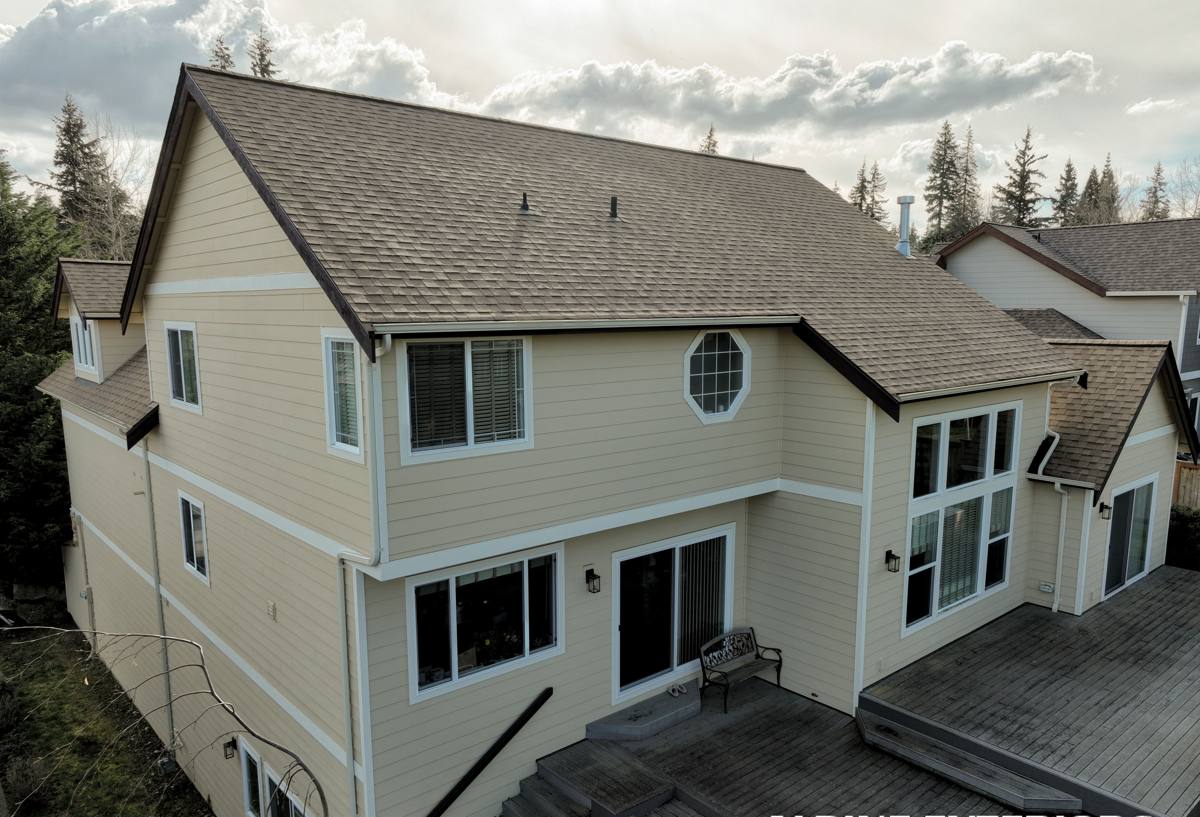
What a Correctly Installed Shingle Roof Needs in Blaine
A roof that holds up under salt air and sideways rain isn't just "shingles on plywood." It's a system, and every layer of that system has a job to do.
Underlayment and Water Barrier
Driving rain doesn't just fall straight down — wind pushes it up under shingle tabs and around edges. A synthetic underlayment with good wind and water resistance, backed by a self-adhered ice-and-water membrane at eaves, valleys, and any low-slope transitions, gives the roof a second line of defense when wind-driven rain gets past the shingles themselves. On a Blaine roof, we treat that second layer as essential, not optional, especially on the windward sides of the house.
Ventilation That Actually Balances
Moisture that gets trapped in an attic — whether from humid coastal air or from everyday household use — needs somewhere to go. Balanced intake at the soffits and exhaust at the ridge keeps air moving, which does two things: it protects the roof deck from the underside, and it keeps the shingles themselves from cooking and curing prematurely in trapped heat during the warmer months. A lot of older Blaine and Whatcom County homes have ventilation that was adequate when they were built but hasn't kept pace with insulation upgrades or added living space. We check this on every job, not just when there's an obvious problem.
Flashing at Every Transition
Chimneys, skylights, dormers, sidewall intersections — these are where roofs actually fail, far more often than in the open field of shingles. Salt air accelerates corrosion on cheap or mismatched flashing metal, so we use flashing rated for coastal exposure and detail it so water sheds away from the house rather than getting a chance to work its way behind it.
Choosing a Shingle for This Environment
Not every asphalt shingle product performs the same way under salt air, moss pressure, and heavy rain. Here's how the common options compare for a Blaine home:
| Shingle Type | Wind/Rain Performance | Algae & Moss Resistance | Typical Lifespan Locally |
|---|---|---|---|
| 3-tab (standard) | Adequate, lighter weight | Poor without treatment | Shorter end of the range |
| Architectural/dimensional | Stronger wind rating, better rain shedding profile | Better if algae-resistant granules specified | Mid-to-long range |
| Algae-resistant (copper-infused granules) | Same as base product line | Best available in asphalt category | Longest, with proper ventilation |
For most Blaine homes, we steer people toward an architectural shingle with algae-resistant granules. It costs a bit more up front than a basic 3-tab, but given how quickly moss and algae take hold under this area's tree cover and moisture, that upfront difference tends to pay for itself in reduced staining, less pressure-washing, and a longer realistic service life. We'll walk through the actual trade-offs for your specific roof and budget rather than pushing one product by default.
Our Process for a Blaine Roofing Job
The steps themselves aren't unusual — what matters is doing each one with this climate in mind.
- Inspection and assessment. We look at the existing roof deck, flashing, ventilation, and any signs of moisture intrusion before quoting anything. If the deck has soft spots or rot from past leaks, that gets addressed as part of the scope, not discovered mid-project.
- Tear-off (when needed). A full tear-off lets us actually see and fix the deck and flashing underneath, rather than layering new shingles over hidden problems.
- Deck repair. Any damaged sheathing gets replaced before anything else goes down.
- Ice-and-water membrane and underlayment. Installed at eaves, valleys, and transitions, then across the full deck.
- Flashing. New or upgraded flashing at every penetration and transition point.
- Shingle installation. Nailed to manufacturer spec for the local wind exposure, with proper starter courses and ridge caps.
- Ventilation check and adjustment. Intake and exhaust confirmed to be balanced for the attic size and layout.
- Final walkthrough. We go over what was done, what to expect, and what basic upkeep looks like going forward.
Moss, Algae, and Ongoing Roof Care
Even a well-installed roof needs some basic seasonal attention in a moss-heavy area like Blaine. Moss holds moisture against the shingle surface, and over time that shortens the roof's life and can work its way under tabs at the edges. Regular, gentle upkeep — not aggressive pressure washing, which can strip granules and do more harm than the moss itself — is the right approach.
- Keep gutters clear so water isn't backing up under the shingle edge, especially before the fall rains start
- Trim back overhanging branches to cut down on shade and debris buildup, both of which feed moss growth
- Have moss and debris removed with low-pressure methods designed for shingle roofs, not a pressure washer set for a driveway
- Watch for granule buildup in gutters and downspouts, which can signal a shingle surface that's wearing down
- Schedule a walk-on or visual inspection after major windstorms, since that's when flashing and ridge caps are most likely to get disturbed
- Address small leaks immediately — in this climate, a slow leak has a lot of months to do damage before a dry season gives it a break
Signs a Blaine Roof Needs a Closer Look
Most roof failures don't happen all at once — they show warning signs first. Worth calling someone out for a look if you notice any of the following:
- Shingles that are curling, cupping, or losing granules faster than the rest of the roof
- Dark streaking or thick moss growth concentrated on north-facing or heavily shaded slopes
- Daylight visible through the attic roof deck, or damp insulation after a storm
- Soft or spongy spots when walking the roof (a sign for a professional to check, not a DIY test)
- Rust staining or gaps around chimney, skylight, or vent flashing
- Granules collecting in gutters in noticeably larger amounts than in past years
Any one of these on its own might not mean an emergency, but they're worth a proper inspection rather than a wait-and-see approach, especially heading into Whatcom County's wetter months.
Why It Matters That We Already Work in Blaine
Roofing specs written for a generic climate don't always hold up on the coast. A crew that works Blaine and the surrounding Bellingham area regularly has a working sense of which slopes take the worst wind-driven rain, how fast moss actually comes back on a shaded roof here versus a drier inland lot, and which flashing and fastener choices hold up against salt air over years, not just on paper. That local pattern recognition shows up in small decisions throughout a job — where to add extra ice-and-water membrane, how much ventilation a particular attic layout actually needs, which details are worth the extra time given what this specific coastline does to a roof.
It also means someone local who already knows the area is available if a question comes up after the job is done — not a crew that did one job in Blaine and moved on.
Warranty and What "Correct Installation" Actually Protects
Manufacturer warranties on asphalt shingles are only as good as the installation underneath them. Most shingle warranties have ventilation and installation requirements built in, and skipping those details — inadequate attic airflow, wrong nailing pattern, missing ice-and-water membrane in vulnerable areas — can affect warranty coverage even if the shingles themselves are top quality. Part of doing this job correctly in Blaine is making sure the installation actually matches what the manufacturer requires, so the warranty is worth something if it's ever needed.
We also stand behind our own workmanship separately from the manufacturer's product warranty, and we'll explain clearly what's covered by which before any work starts — no fine print surprises after the fact.
Get a Straight Answer About Your Roof
If you're not sure whether your Blaine home needs a repair, a partial re-roof, or nothing more than a moss cleanup right now, that's exactly what an inspection is for. We'll take a look, tell you honestly what we find, and put together a free, no-pressure estimate — whether that means fixing something small now or planning ahead for a full replacement down the road. Use the form below to get started.