 Bellingham Exterior
 Why Sudden Valley Homes Wear Out Siding Differently
Sudden Valley sits in the trees along Lake Whatcom, southeast of Bellingham, and that setting changes how siding ages compared to a home out in the open. Heavy tree canopy means more shade, more standing humidity against exterior walls, and slower drying after every rain. Combine that with Whatcom County's long wet season and the driving rain that blows in off the water, and you get siding that stays damp for days at a stretch rather than drying out between storms.
That combination is exactly what drives moss and algae growth on siding, trim, and fascia. On a lot with full sun, a wall might dry out in an afternoon. On a shaded Sudden Valley lot backed up against fir and cedar, that same wall can stay damp through an entire work week. Over years, that constant moisture exposure is what breaks down lower-grade siding materials from the inside out, long before the paint film on the surface shows obvious wear.
What This Means for Material Choice
Homes in this kind of setting need a siding material that doesn't absorb and hold water, doesn't feed mold or moss growth, and holds its finish without repainting every few years just to keep ahead of the moisture. That's a different set of priorities than a house on a dry, sunny lot might have — and it's why we treat Sudden Valley siding jobs differently from a straightforward re-side out on open ground.
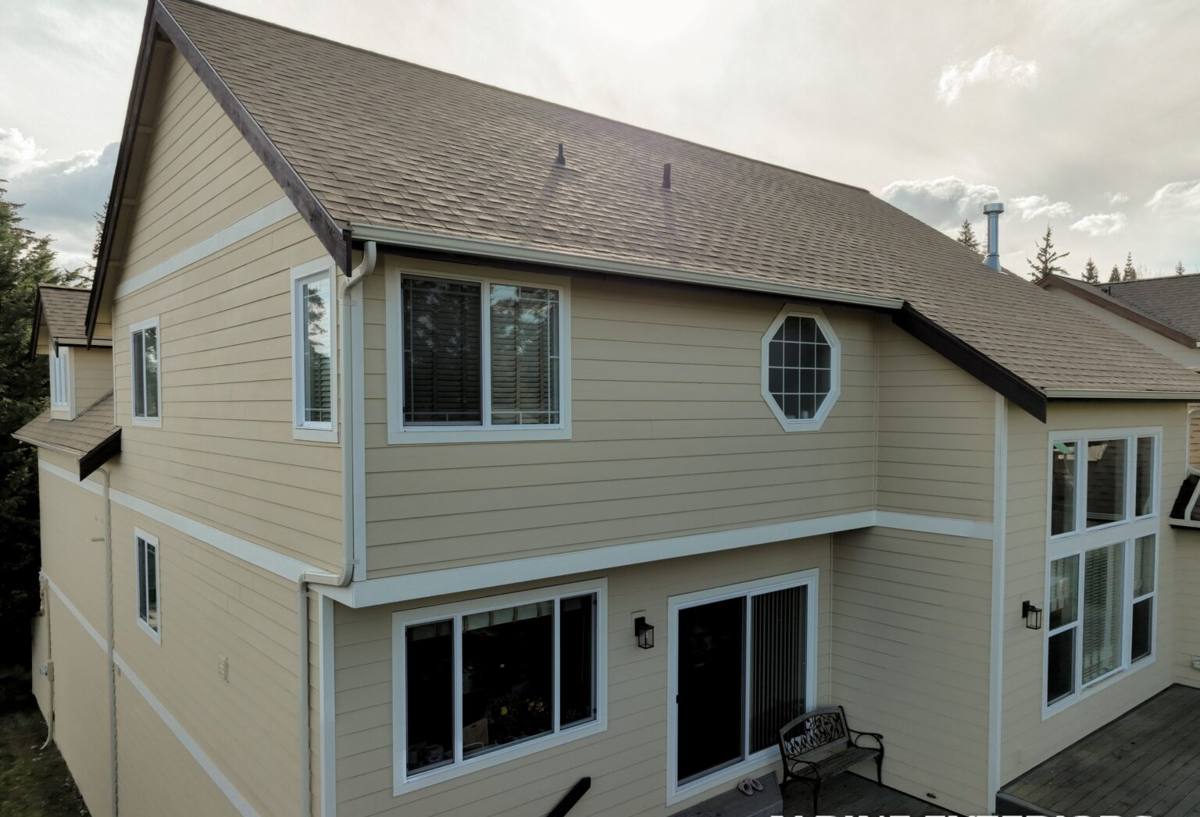
Signs a Sudden Valley Home Needs Replacement, Not Repair
Not every siding problem calls for a full tear-off. But in a damp, shaded environment, small issues escalate faster than homeowners expect. Here's how we sort repair situations from replacement situations.
| Sign | Usually Repairable | Usually Needs Replacement |
|---|---|---|
| Isolated cracked or split boards | Yes, if sheathing behind is dry | No, unless widespread |
| Persistent moss/algae staining that returns after cleaning | Sometimes | Often — sign the material is holding moisture |
| Soft or spongy spots when pressed | Rarely | Yes — usually means rot behind the surface |
| Paint failing every 2-3 years despite good prep | No | Yes — material is no longer sealing properly |
| Warping, buckling, or gapping panels | No | Yes |
| Visible daylight or drafts at seams | No | Yes — moisture intrusion likely already underway |
The pattern we see most often in this neighborhood is repeated moss staining and paint failure on the shaded, tree-facing side of a house well before the sunnier side shows the same wear. That's a strong signal the siding material itself, not just the finish coat, has reached the end of its useful life on that wall.
What a Correct Siding Replacement Actually Involves
Pulling old siding off and nailing up new boards is the easy part to see. The parts that actually determine whether a Sudden Valley home stays dry for the next few decades happen underneath, where nobody looks after the job is done.
Tear-Off and Inspection
Full removal of the old siding is the only way to find out what's actually happening behind it. In a shaded, damp lot, we routinely find soft sheathing, degraded house wrap, or rusted fasteners that a surface-level repair would have hidden rather than fixed. Any water-damaged sheathing gets replaced before anything new goes up — new siding over compromised sheathing just repeats the same failure in a few years.
Moisture Management Layer
A weather-resistive barrier (house wrap) goes on with properly lapped and taped seams, and flashing is installed at every window, door, and penetration so water is directed out and down rather than trapped behind the cladding. This layer matters more in a shaded, high-humidity setting than almost anywhere else — it's the difference between siding that sheds incidental moisture and a wall assembly that slowly rots from the inside.
Fastening and Installation
James Hardie fiber cement has a specific fastening schedule, clearance requirements from grade and roof lines, and joint treatment that has to be followed to keep the manufacturer warranty valid and to actually perform as designed. Installed loose, over-driven, or without the right gaps at butt joints, even the best siding material will trap water and fail early. We follow Hardie's published installation specs, not a generalized "siding is siding" approach.
Trim, Caulking, and Finish
Corner boards, trim, and caulking joints are where a lot of moisture problems start on any home, and they matter even more where shade keeps things damp longer. We use trim and sealants rated for sustained exterior moisture exposure, not builder-grade materials meant for a drier climate.
Why We Install Only James Hardie Fiber Cement
We standardized on James Hardie for every siding replacement we do, including here in Sudden Valley, and we don't install vinyl, LP SmartSide, cedar, or other fiber cement brands. That's a deliberate call based on what holds up in this specific climate.
Vinyl's Trade-Offs in a Shaded, Wet Setting
Vinyl is inexpensive and low-maintenance in a lot of climates, and we're not going to pretend otherwise. But it expands and contracts significantly with temperature swings, which opens seams over time, and it doesn't stand up well to the kind of moss and algae growth that thrives in shaded, damp conditions — vinyl's surface texture gives organic growth plenty to hold onto, and it can't be pressure-washed as aggressively as fiber cement without damage. In a lot surrounded by trees, that's a maintenance headache we'd rather homeowners avoid.
Wood-Based Products (Cedar, LP SmartSide, Primed Spruce)
Wood and engineered-wood siding look great and plenty of homeowners love the appearance, but they're organic materials at their core — they're the products most susceptible to the rot and moisture absorption that a shaded, wet lot accelerates. Keeping them looking good means a repainting and recaulking cycle that's shorter and more frequent than most owners expect once they're living with it, especially on the shaded side of a heavily treed property.
Why Hardie Fits This Climate
James Hardie fiber cement is engineered from cement, sand, and cellulose fibers — it doesn't absorb water the way wood-based products do, it's non-combustible, and it holds a factory-applied ColorPlus finish that resists fading and chipping far longer than field-applied paint. Hardie's HZ5 product line is specifically engineered for climates like the Pacific Northwest, where sustained moisture exposure is the norm rather than the exception. It also carries a strong transferable warranty backed by a manufacturer with a long track record, which matters when you're making a once-in-a-generation decision about your home's exterior.
Our Process, Start to Finish
- On-site assessment: We walk the property, check current siding condition, note shaded/high-moisture areas, and inspect for existing moisture damage.
- Written estimate: A clear scope and price, no vague allowances, covering material, tear-off, sheathing repair contingencies, and trim work.
- Material selection: Choosing the right Hardie profile and ColorPlus color for the home, factoring in how shade and tree cover will affect long-term appearance.
- Tear-off and sheathing inspection: Old siding removed, sheathing checked and repaired as needed before anything new is installed.
- Moisture barrier and flashing: House wrap, taped seams, and flashing installed at every penetration.
- Installation to Hardie spec: Correct fastening, clearances, and joint treatment throughout.
- Final walkthrough: We review the finished work with the homeowner before calling the job complete.
What Affects Cost on a Sudden Valley Job
Every home is different, but a few factors come up consistently in this neighborhood and are worth understanding before you get quotes.
| Cost Factor | Why It Matters Here |
|---|---|
| Existing sheathing condition | Shaded, damp walls more often need sheathing repair discovered during tear-off |
| Home access and driveway grade | Sloped, wooded lots can complicate material staging and equipment access |
| Amount of trim and detail work | Multi-story homes with more corners, gables, and window trim take longer |
| Siding profile and color selection | Certain ColorPlus finishes and plank widths carry different material costs |
| Number of stories | Second- and third-story work requires more scaffolding and labor time |
We give a specific, written number after seeing the home in person — broad ranges without an on-site look aren't useful to homeowners trying to plan a real budget.
Caring for New Siding in a Shaded, Wet Lot
New Hardie siding needs far less upkeep than the wood or vinyl it likely replaced, but a few habits go a long way in a setting like Sudden Valley where moss and moisture pressure are constant.
- Rinse siding gently once or twice a year to clear moss spores and organic debris before they take hold, especially on tree-facing walls
- Keep gutters clear so overflow doesn't run down the siding face during heavy rain
- Trim back branches and foliage that keep siding in constant shade or hold moisture against the wall
- Check caulking at trim joints and penetrations annually and touch up as needed
- Address any impact damage (branches, equipment) promptly so moisture doesn't get behind the panel
Why Local Experience in Sudden Valley Matters
Sudden Valley isn't a typical Bellingham subdivision — it's a wooded, lake-adjacent community, and many homes here fall under community covenants that govern exterior colors and materials. A crew that's worked in the neighborhood before knows to check those covenants early, understands how the tree cover and lot grading affect access and staging, and has already seen how moisture behaves on homes in this specific setting. That local familiarity saves time and avoids surprises mid-project — both for the homeowner and for the schedule.
If you're weighing a siding replacement for a Sudden Valley home, we're happy to come take a look and walk you through what we're seeing, no pressure and no obligation. Use the form below to request a free estimate.