 Bellingham Exterior
 Why Roofs Age Differently in Puget's Marine Climate
Puget sits close enough to the water that homes here deal with a combination most inland Washington neighborhoods don't: salt-laden air, wind-driven rain that comes at the roof sideways instead of straight down, and long stretches of shade and dampness that keep moss growing for much of the year. Any one of these would shorten a roof's life on its own. Together, they mean a roof built to a generic national spec often underperforms in Bellingham compared to how it would in a drier, sunnier climate.
Salt air accelerates corrosion on exposed metal — fasteners, flashing edges, and vent stacks — well before a manufacturer's rated lifespan runs out. Driving rain finds any weak point in a roof's water-shedding details, not just the shingles themselves, which is why flashing and underlayment quality matter as much as the shingle brand. And moss doesn't just look bad; it holds moisture against the roofing material, works its way under shingle tabs, and can lift them enough to let water in. A new roof installation in Puget needs to be planned around all three of these factors from day one, not patched around them later.
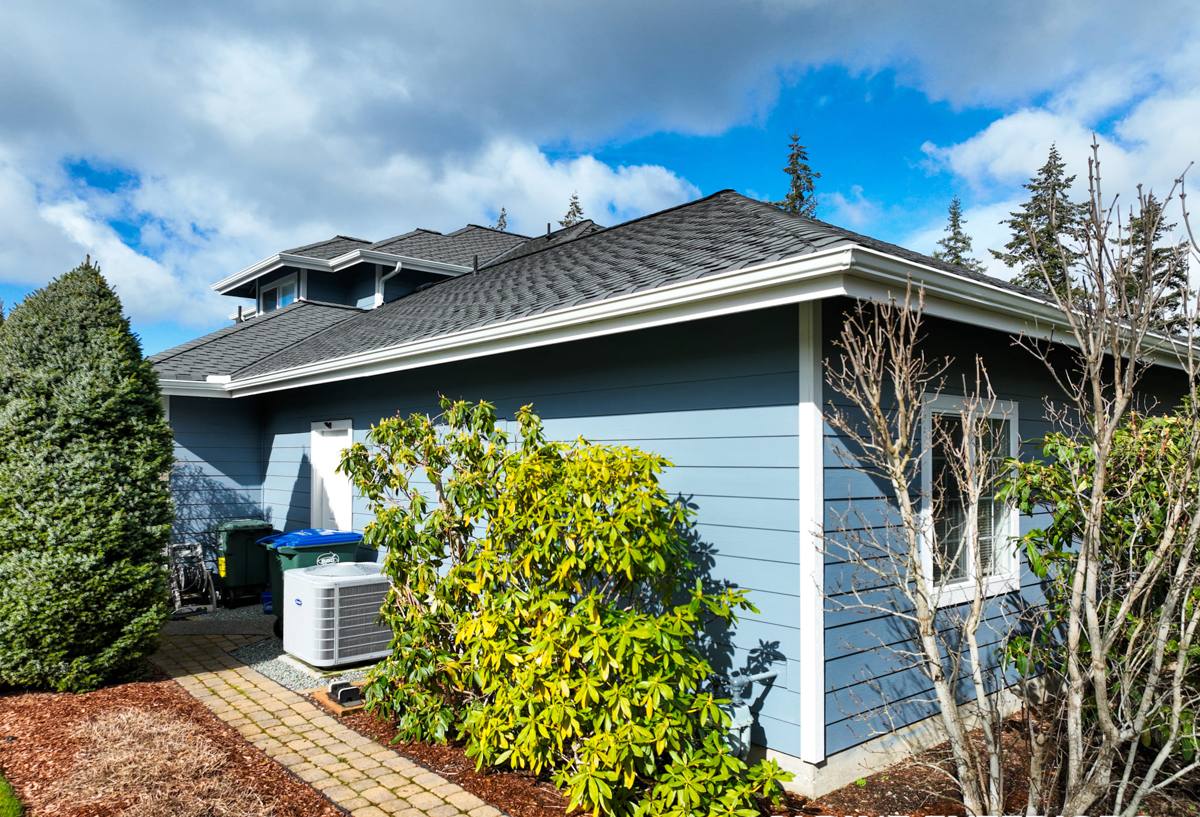
Signs It's Time for a New Roof, Not Another Repair
Homeowners often ask us to look at a leak and end up learning the roof itself is past the point where another patch makes sense. A few signs tend to show up together on Bellingham homes:
- Granules collecting in gutters or at downspout outlets, indicating the shingle surface is wearing thin
- Shingles that are curling, cupping, or cracking, especially on south- and west-facing slopes
- Moss or dark algae staining that comes back within a season or two of cleaning
- Soft or spongy spots underfoot, which usually mean the decking underneath has taken on moisture
- Leaks showing up in more than one location, or in a different spot each time it rains
- A roof that's already had one layer of shingles installed over an older layer
Any single item on that list might be repairable. Several at once, or a roof already in its second or third decade, is usually a sign that ongoing repairs are just delaying an inevitable full replacement — and often at a higher total cost than doing it once, correctly.
What a Correct New Roof Installation Actually Involves
"New roof" covers a lot of ground, and the difference between a roof that holds up through Bellingham winters and one that doesn't usually comes down to details most homeowners never see once the shingles are down.
Tear-Off and Deck Inspection
We remove the old roofing down to the deck rather than layering over it. That's the only way to actually inspect the plywood or plank decking underneath for soft spots, rot, or delamination caused by years of trapped moisture — problems that are common on older Puget homes and invisible from above. Any damaged decking gets replaced before anything new goes down; installing new roofing over a compromised deck just guarantees an early failure.
Underlayment and Water Protection
Given how much wind-driven rain this area sees, we treat underlayment as a real second layer of defense, not an afterthought. That means a quality synthetic underlayment across the full roof, with self-adhering ice-and-water membrane at the eaves, valleys, and other spots where water tends to back up or pool. These are the details that keep a roof watertight during a sideways winter storm, long after the shingles alone would have let water through.
Flashing Work
Most roof leaks we're called out to trace back to flashing, not the field shingles. Step flashing along walls and chimneys, valley flashing where two roof planes meet, and properly sealed penetrations for vents and pipes all have to be done correctly and replaced as part of the job, not reused from the old roof. It's slower work than just laying shingles, but it's where a roof's long-term watertightness actually gets decided.
Ventilation
A roof deck needs balanced intake and exhaust ventilation to let moisture escape from the attic space. Without it, warm, humid air gets trapped against the underside of the deck, which speeds up rot and gives moss and mildew more to work with from below as well as above. We check existing ventilation as part of every replacement and correct it where it's inadequate — a common issue on older Bellingham homes that predate current ventilation standards.
Choosing the Right Roofing Material for Puget Homes
There's no single "best" roofing material — the right choice depends on how much upkeep a homeowner wants to do, how long they plan to stay in the home, and how much shade and moss pressure the specific roof faces. Here's how the common options compare for a climate like this one.
| Material | Typical Lifespan | Moss & Moisture Behavior | Maintenance |
|---|---|---|---|
| Architectural (dimensional) asphalt shingle | 25–30+ years | Moderate moss resistance; needs periodic cleaning in shaded areas | Low — occasional debris and moss removal |
| Standing seam metal | 40–50+ years | Sheds moisture quickly; smooth surface resists moss buildup | Very low, but higher upfront investment |
| 3-tab asphalt shingle | 15–20 years | Less resistant to wind-driven rain and moss than architectural shingle | Low, but shorter service life overall |
| Synthetic/composite shingle | 30–40+ years | Good moisture and moss resistance depending on product line | Low, similar to architectural shingle |
For most Puget homes, we recommend architectural asphalt shingle as the balance point between upfront cost, appearance, and how well it holds up to the local combination of rain and shade. Metal roofing is a strong option for homeowners planning to stay long-term or dealing with heavier tree cover, since its smooth, sloped surface gives moss less to grip onto. We'll walk through the honest trade-offs of each option for your specific roof rather than pushing one product across the board.
How We Approach a Roof Replacement in Puget
- On-site inspection and estimate. We look at the existing roof, decking access points (attic or eave), ventilation, and any problem areas before quoting anything.
- Material and scope selection. We go over the options above in plain terms, including what each one means for cost and long-term upkeep.
- Permitting. Bellingham requires permits for full roof replacements; we handle that paperwork so it isn't left to the homeowner.
- Tear-off and disposal. Old roofing comes off completely and is hauled away — nothing gets layered.
- Deck repair. Any compromised decking found during tear-off is replaced before underlayment goes down.
- Underlayment, flashing, and roofing installation. Installed in that order, with attention to the eaves, valleys, and penetrations most exposed to driving rain.
- Cleanup and magnetic sweep. Yards and driveways are cleared of debris and stray fasteners before we consider the job done.
- Final walkthrough. We go over the finished roof with the homeowner and answer any questions before wrapping up.
Why a Crew That Already Works in Puget Makes a Difference
A roofing crew that regularly works in Bellingham neighborhoods like Puget has already seen how the local combination of rain exposure, tree cover, and salt air plays out on real roofs over time — which slopes tend to hold moss longest, which flashing details fail first, and where extra ventilation typically pays off. That experience shows up in fewer surprises during tear-off and fewer callbacks after the job is finished.
It also matters for the practical side of the project. A local crew knows the City of Bellingham and Whatcom County permitting process, understands typical lot access and staging constraints in established neighborhoods, and is close enough to respond quickly if a question comes up after installation. That's a different level of accountability than a crew that's only in the area for a single job.
Keeping a New Roof Performing Through Bellingham's Moss Season
A correctly installed roof still needs some basic upkeep to get its full lifespan in this climate. None of this is complicated, but skipping it is the most common reason a good roof underperforms.
- Keep overhanging tree branches trimmed back so the roof gets more sun and airflow, which slows moss growth
- Clear leaves and needles out of valleys and behind chimneys before fall rains set in
- Keep gutters and downspouts clear so water isn't backing up under the roof edge
- Have moss treated or removed before it spreads, rather than waiting until it's visible from the street
- Avoid pressure washing shingles — it strips granules and shortens the roof's life; a low-pressure moss treatment is safer
- Have the roof looked at after any major windstorm, since that's when flashing and shingle edges are most likely to get disturbed
What Affects the Cost of a New Roof
Every roof replacement quote depends on the specifics of the house, so we don't give ballpark numbers without seeing the roof. The main factors that move the price up or down are the same ones that matter for how well the roof performs afterward:
- Roof size and pitch — steeper roofs take longer and require more safety setup
- Number of existing layers to tear off and haul away
- Condition of the decking underneath, which isn't known until tear-off begins
- Material chosen — asphalt, metal, and synthetic products all have different material and labor costs
- Roof complexity — valleys, dormers, skylights, and chimneys all add flashing work
- Site access — how easily materials and equipment can reach the roof
We walk through each of these during the on-site estimate so the number you get reflects your actual roof, not a generic average.
If your roof in Puget is showing its age or you're just planning ahead, we're happy to take a look and give you a straightforward, no-pressure estimate — use the form below to get started.