 Bellingham Exterior
 Building New in Lynden: Why This Is a One-Shot Job
When you're framing a new home in Lynden, the window install isn't a standalone project you can revisit in five years without consequence — it's baked into the wall assembly. Once siding goes up over the weather-resistive barrier and trim, the flashing details around every rough opening are sealed away. If they're done wrong, you don't find out until there's a stain on the drywall below a window, or rot in the sheathing that nobody sees until a remodel years later. New-construction window installation is the one phase of a build where "close enough" isn't a phrase we use.
Lynden sits inland in Whatcom County's agricultural valley, away from the direct salt exposure that coastal Bellingham neighborhoods deal with, but it shares the same marine-influenced weather pattern: long stretches of steady, wind-driven rain, high humidity for much of the year, and short, gray winter days that don't give a poorly flashed opening much chance to dry out between storms. That combination is exactly why the flashing and water-management details matter more here than in a drier climate — mistakes don't get baked out by sun and low humidity, they get compounded by the next rain.
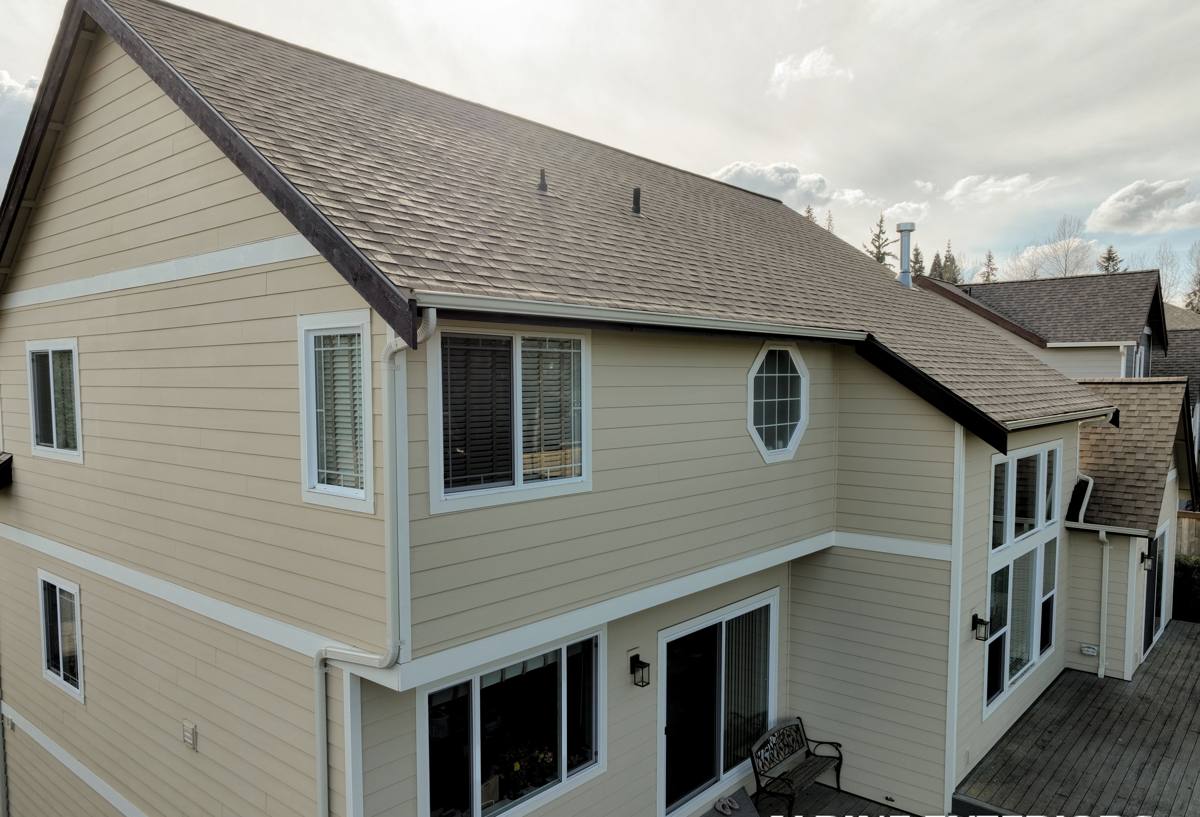
What Whatcom County's Climate Actually Demands
New-construction windows aren't just a product decision — they're a system decision. The window unit itself is only part of the equation. What actually keeps water out of a Lynden home over the next 30 years is how that window integrates with the sill pan, the weather-resistive barrier, the flashing tape, and the siding above it.
- Extended wet season: Whatcom County sees consistent rainfall across fall, winter, and spring, which means rough openings need to shed water immediately, not "eventually."
- Wind-driven rain: Storms off the Strait of Georgia and Puget Sound push rain sideways into wall assemblies, not just straight down — a detail that punishes shortcuts at the head flashing and jambs.
- Moss and mildew season: Whatcom County's long damp stretches feed persistent moss and mildew growth on siding, trim, and sills — any spot where water pools or drainage is blocked becomes a growth site over time.
- Temperature swings: Cold, damp winters and warmer summers mean the frame and glazing need to handle repeated expansion and contraction without opening up gaps at the seals.
A window that's a great fit for a dry inland climate can still underperform here if the installation doesn't account for how much water this region throws at a building envelope over a typical year.
Flashing and Water Management: The Part Homeowners Never See
This is the single biggest difference between a window that lasts and one that leads to a callback in a few years. A correct new-construction install follows a specific sequence, and skipping or reordering any step creates a path for water to get behind the siding.
The order that matters
- Sill pan flashing installed first, sloped slightly to the exterior so any water that gets past the window has somewhere to go.
- Weather-resistive barrier (WRB) cut and integrated with the rough opening using a proper "shingle-lap" method — each layer overlapping the one below it, never the reverse.
- Window unit set, leveled, plumbed, and fastened per the manufacturer's instructions — not just "close enough by eye."
- Jamb flashing applied over the nailing fin, then head flashing installed last, lapping over the jamb flashing and tucked behind the WRB above the opening.
- Backer rod and sealant at the interior and exterior gaps, sized correctly — too little or too much sealant both cause problems.
Every layer in that sequence exists to make sure water is directed out, never trapped behind the cladding. On a new build, this only gets done right once — there's no siding to pull back and inspect later without real cost.
Choosing the Right Window for a Lynden New Build
Frame material and glazing package both affect how a window holds up to this climate, and how much upkeep it asks of you over the years. There's no single "best" choice — it depends on your budget, the home's design, and how much maintenance you want to take on.
| Frame Material | Upfront Cost | Moisture Resistance | Maintenance | Typical Lifespan |
|---|---|---|---|---|
| Vinyl | Lower | Good — won't rot, some flex in temperature swings | Low | 20–30 years |
| Fiberglass | Mid–higher | Excellent — dimensionally stable, resists warping | Low | 30–40+ years |
| Wood, clad exterior | Higher | Good on the exterior; interior wood needs care | Moderate | 30+ years with upkeep |
| Aluminum | Mid | Fair — prone to condensation without thermal breaks | Low | 20–30 years |
For most new construction in this area, we steer clients toward vinyl or fiberglass for the bulk of the house, reserving clad-wood for feature windows where the interior wood look matters. Aluminum without a thermal break tends to sweat in our humid winters, which we flag as a trade-off rather than a defect — it's simply a poor fit for this climate, not a poor product everywhere.
Glazing and performance
Double-pane, low-E glass with argon fill is standard for new construction in Washington and meets current state energy code for most window-to-wall ratios. Homes with larger window areas, north-facing glazing, or an all-electric heating plan sometimes benefit from a step up in performance glass — we'll walk through the numbers for your specific plans rather than upselling a package you don't need.
Our New-Construction Window Installation Process
On a Lynden new build, we typically get involved right after the sheathing and WRB are up and before siding starts. Our process looks like this:
- Plan review: We confirm rough opening sizes against the ordered window schedule before anything ships, catching mismatches before they become framing changes.
- Rough opening check: Square, plumb, and correctly sized openings, with any needed shimming or blocking addressed before the window goes in.
- Sill pan and flashing installed per sequence — no skipped layers, no relying on caulk alone to do a flashing membrane's job.
- Window set, shimmed, and fastened to manufacturer spec, checked for square and smooth operation before final fastening.
- Head and jamb flashing integrated with the WRB so the whole assembly sheds water downward and outward.
- Interior and exterior sealant applied at the correct joints, leaving the assembly ready for siding and interior trim.
- Final walkthrough confirming operation, seal, and flashing before we sign off.
Nailing Fin vs. Block Frame — Which Fits Your Build
Most new-construction vinyl and fiberglass windows in this region use a nailing-fin frame, which attaches directly to the sheathing and integrates with the WRB in the sequence described above. Some designs — particularly masonry or certain modern flush-exterior details — call for a block-frame window set into a rough opening with different flashing methods. We'll tell you early which approach your plans call for, since it affects both the window order and how the framing crew details the opening. Getting this decided before framing is finished avoids costly rework later.
Energy Code and Permitting in Whatcom County
New construction in Lynden falls under Washington State's energy code, which sets minimum performance requirements for window U-factor and solar heat gain, especially as they relate to the home's total glazing area. Permits for new builds go through the applicable local building department, and window specs are typically part of the plan set reviewed before permit issuance. We coordinate window selection with what's on the approved plans so there's no mismatch discovered at inspection — a problem that can delay a build far more than it costs to check up front.
Why Hiring a Crew That Already Works in Lynden Matters
A lot of window problems on new builds trace back to a crew that's used to a different climate or a different jurisdiction's inspection expectations. A team that regularly works Whatcom County new construction knows:
- How local inspectors expect flashing details documented and installed.
- Which window lines hold up reliably to a wet, marine-influenced climate versus which ones are better suited to drier regions.
- How to sequence window installation with the framing and siding trades so nothing sits exposed to weather longer than it has to.
- What rough opening tolerances actually work with common window lines available in this market, avoiding on-site surprises.
That local familiarity is the difference between a smooth install and a change order mid-build.
A Practical Checklist Before You Sign
- Does the quote specify sill pan flashing, not just caulk-and-fin installation?
- Is the flashing sequence (sill, jamb, head) spelled out, or just "flash per code"?
- Does the installer carry the right licensing and insurance for Whatcom County work?
- Are window U-factor and SHGC values matched to your approved plans and energy code path?
- Who coordinates timing with your framer and siding crew so openings aren't left exposed?
- Is there a written warranty covering both the window and the installation, not just the manufacturer's product warranty?
If you're planning a new build in Lynden and want window installation done right the first time, we're happy to walk your plans, talk through window options for this climate, and give you a straightforward, no-pressure estimate. Use the form below to get started.