 Bellingham Exterior
 Why Sunnyland's Siding Has to Work Harder Than the Brochure Suggests
Sunnyland sits close enough to Bellingham Bay and the surrounding waterways that homes here take on a different mix of weather stress than siding fifteen minutes inland. Salt-laden air off the water accelerates corrosion on fasteners and trim metal that isn't rated for it. Driving rain off winter storms pushes moisture sideways into every gap, seam, and butt joint in a wall assembly, not just straight down. And Whatcom County's long, damp shoulder seasons give moss, algae, and lichen months of ideal growing conditions on any surface that stays shaded and wet. None of that is unique to Sunnyland, but the combination is more constant here than in drier parts of the state, and it's exactly the kind of environment that separates siding installed correctly from siding that just looks fine on installation day.
The material matters, but the installation matters more. A high-quality siding product installed with the wrong flashing details, wrong clearances, or wrong fastening pattern will fail in this climate faster than a correctly installed product with fewer bells and whistles. That's the lens we bring to every Sunnyland job: the product has to be right for the region, and the install has to respect what this weather actually does to a wall over twenty or thirty years.
What Correct Fiber Cement Installation Actually Involves
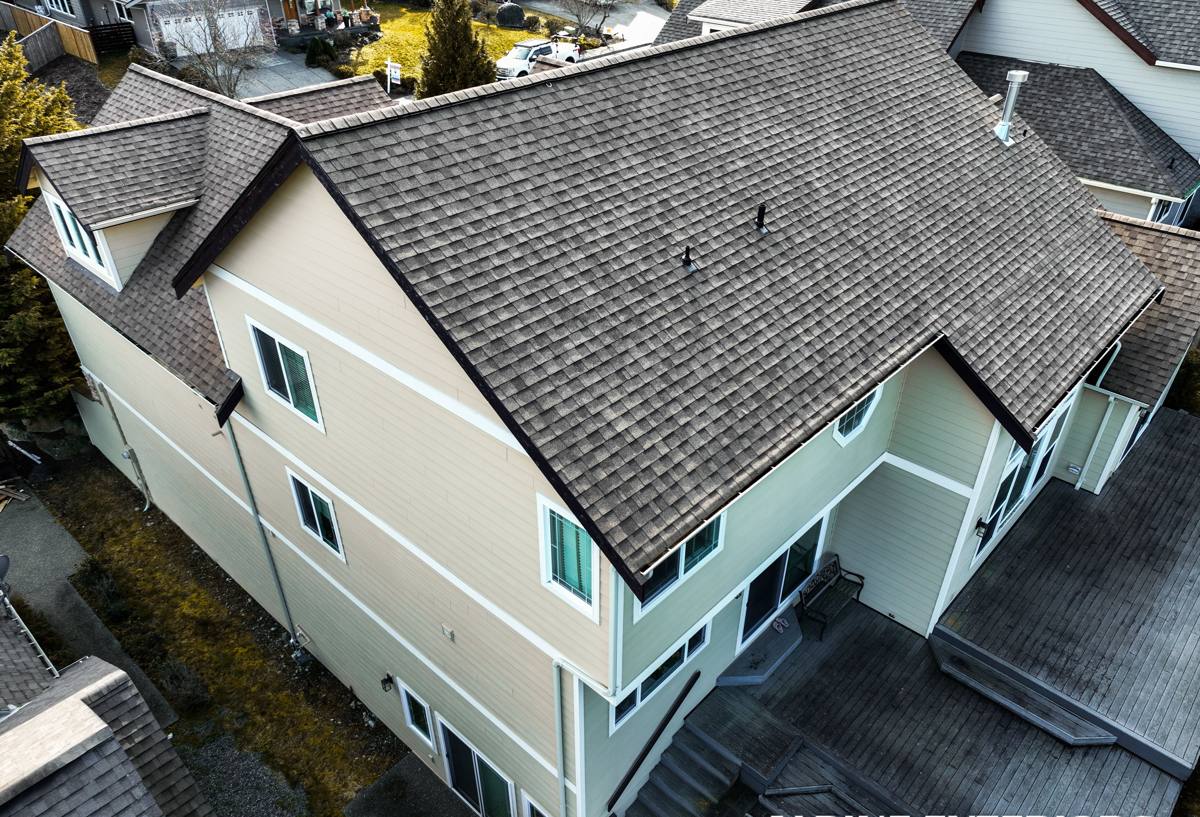
Fiber cement siding is only as good as the assembly behind and around it. On every Sunnyland project, that means paying attention to details that don't show up in a drive-by look at the finished house:
- Weather-resistive barrier and rainscreen gap — a drainage plane behind the siding lets any moisture that does get past the surface find its way back out instead of sitting against the sheathing.
- Flashing at every penetration — windows, doors, hose bibs, light fixtures, and vents each need proper head, jamb, and sill flashing so wind-driven rain can't track behind the siding at those weak points.
- Correct clearances — siding held up off decks, patios, and grade, and separated from roof lines, keeps the bottom edge of the board from sitting in standing water or snow.
- Butt joint treatment — every horizontal seam either backed with flashing or sealed per manufacturer spec, since joints are the single most common place fiber cement siding fails prematurely.
- Corrosion-resistant fasteners — stainless or coated fasteners rated for coastal-influenced air, not the cheapest galvanized option, so trim and boards stay tight instead of rust-streaking or working loose.
Skip any one of these and the siding can still look good for a year or two. The problems show up later, as trapped moisture, soft sheathing, or streaking around fasteners — and by then the fix costs a lot more than doing it right the first time would have.
Why We Install Only James Hardie
We standardized on James Hardie fiber cement and we don't install LP SmartSide, vinyl, Cemplank, Allura, primed spruce, or cedar. That's not brand loyalty — it's a decision built around what holds up in this climate with the least amount of homeowner maintenance over time.
Hardie's fiber cement is non-combustible, dimensionally stable in wet-dry cycling, and available with a factory-applied ColorPlus finish that's baked on under controlled conditions rather than field-painted. For a neighborhood dealing with salt air and long wet seasons, that factory finish matters: it resists fading and moisture intrusion at the surface far better than a job-site paint job, and it carries a real, transferable finish warranty behind it. Hardie also engineers separate product lines for different climate zones — HZ5 boards are built for regions like ours that see sustained moisture rather than dry heat, with formulations tuned to resist that specific kind of wear.
We're not going to tell you every other product on the market is bad. Vinyl and engineered wood sidings have real advantages, mostly around upfront cost. But we've made a professional judgment that for the moisture load, salt exposure, and moss season Sunnyland homes face, Hardie's combination of material stability, factory finish, and warranty structure gives homeowners the best long-term outcome for what they're paying — and it's the only product we're willing to put our installation behind.
Matching the Right Hardie Profile to Sunnyland's Housing Stock
Sunnyland has a mix of home styles — mid-century ranch homes, post-war cottages, and a scattering of newer builds and remodels. Hardie's product lines cover that range without forcing every house into the same look.
| Hardie Profile | Typical Look | Works Well On |
|---|---|---|
| HardiePlank Lap Siding | Traditional horizontal lap, smooth or cedar-textured | Ranch and cottage-style homes wanting a classic Northwest look |
| HardieShingle | Staggered or straight-edge shingle panels | Accent gables, dormers, or full facades on cottage and craftsman-influenced homes |
| HardiePanel | Vertical smooth or stucco-textured sheets | Modern remodels, accent walls, and contemporary additions |
| HardieTrim | Corner boards, fascia, window and door trim | Every project — matched trim finishes the moisture-management detailing at edges |
Color selection follows the same logic as the profile choice: ColorPlus finishes hold up best when the color and sheen are chosen with the home's sun exposure and surrounding tree cover in mind, since shaded, damp-facing walls are where moss and mildew take hold first regardless of siding brand.
Our Process, Start to Finish
Every Sunnyland project follows the same sequence, because skipping steps is where corners get cut on someone's house.
- On-site assessment — we look at the existing siding, sheathing condition, moisture history, and any trouble spots (north-facing walls, areas under trees, low-clearance sections) before we quote anything.
- Written estimate — profile, color, trim package, and scope spelled out, with tear-off and any sheathing repair called out separately so there are no surprises mid-project.
- Tear-off and inspection — old siding comes off and we inspect the sheathing underneath for rot or moisture damage before anything new goes on.
- Weather barrier and rainscreen installation — the drainage plane goes in correctly the first time, since it's the layer you won't see again once siding is up.
- Flashing and trim — all penetrations and trim details installed to manufacturer spec before the field siding goes up around them.
- Siding installation — correct fastening pattern, joint treatment, and clearances throughout, not just on the visible street-facing walls.
- Final walkthrough — we go over the finished job with you directly so you know what was done and why.
What Drives Cost on a Sunnyland Siding Project
Every home is different, so we won't quote a number without seeing the house, but these are the factors that move an estimate up or down:
| Factor | Why It Matters |
|---|---|
| Existing siding removal | Tear-off of old material and disposal adds labor before new siding can start |
| Sheathing condition | Moisture-damaged sheathing found during tear-off needs repair before siding goes back on |
| Wall complexity | Dormers, multiple gables, and cut-ins take more trim work and labor than flat wall runs |
| Profile and trim selection | Shingle and panel details generally run more labor-intensive than straight lap siding |
| Access and site conditions | Tight lot lines, slopes, or landscaping close to the house affect staging and scaffolding |
| Color and finish choice | Standard ColorPlus colors versus premium finishes carry different material costs |
Living With Fiber Cement Through Whatcom County's Moss Season
No siding is maintenance-free, but a correctly installed Hardie system keeps the maintenance list short. The biggest recurring issue we see on older siding in this area — Hardie or otherwise — is organic growth on shaded, damp-facing walls: moss and algae that take hold during the wet months and stain the surface if left alone. That's a surface-level issue, not a structural one, and it's manageable with periodic gentle washing rather than pressure-washing, which can force water behind boards or damage the finish. Keeping gutters clear, trimming back vegetation that shades and dampens a wall, and addressing any caulking gaps at trim promptly are the small habits that keep a well-installed siding job looking good for its full service life.
Why Hiring a Crew That Already Works Sunnyland Matters
Siding installation isn't one-size-fits-all across a region. A crew that's worked Sunnyland and the surrounding Bellingham neighborhoods already understands the moisture patterns specific to homes closer to the water, has a feel for which wall orientations need extra attention to flashing and drainage, and isn't guessing at how the local weather behaves across a full year. That local pattern-recognition doesn't replace following manufacturer installation specs — it adds to it. Combined with an installer that only works with one product line, it means fewer surprises: we're not relearning a new manufacturer's installation requirements on your house, and we're not guessing about how a product behaves in this specific climate.
Questions Worth Asking Any Contractor Before You Hire
- Are you a licensed, bonded, and insured contractor in Washington State?
- Will you provide a written scope that includes tear-off, sheathing repair contingencies, flashing details, and cleanup?
- What weather-resistive barrier and rainscreen approach do you use behind the siding?
- Is the manufacturer's warranty registered in my name, and is it transferable if I sell the home?
- Can you walk me through why you're recommending a specific profile and color for my home's exposure?
- Who's actually on the crew doing the install — is it your employees or subcontracted labor?
If you're weighing a siding project on a Sunnyland home, we're glad to walk the property with you, look at what's there now, and put together a straightforward, no-pressure estimate for what correct James Hardie installation would look like on your house. There's a form below to get that conversation started.