 Bellingham Exterior
 Blaine's Marine Climate Asks More of Your Siding
Blaine sits right on the water, at the northern edge of Whatcom County where Semiahmoo Bay and Drayton Harbor meet the open air of the Strait of Georgia. That location is part of what makes the town beautiful, and it's also what makes siding decisions here different from a house a few miles inland in Bellingham. Homes close to the water take on salt-laden air almost year-round, catch more direct, wind-driven rain off the Strait, and sit in the kind of persistent shade and dampness that keeps moss and algae active for most of the year, not just a few winter months.
None of that is exotic weather. It's the normal Pacific Northwest coastal pattern. But it adds up faster than most homeowners expect, and it means a siding product and installation that "gets by" in a drier, more sheltered part of the county can fail early on a Blaine lot.
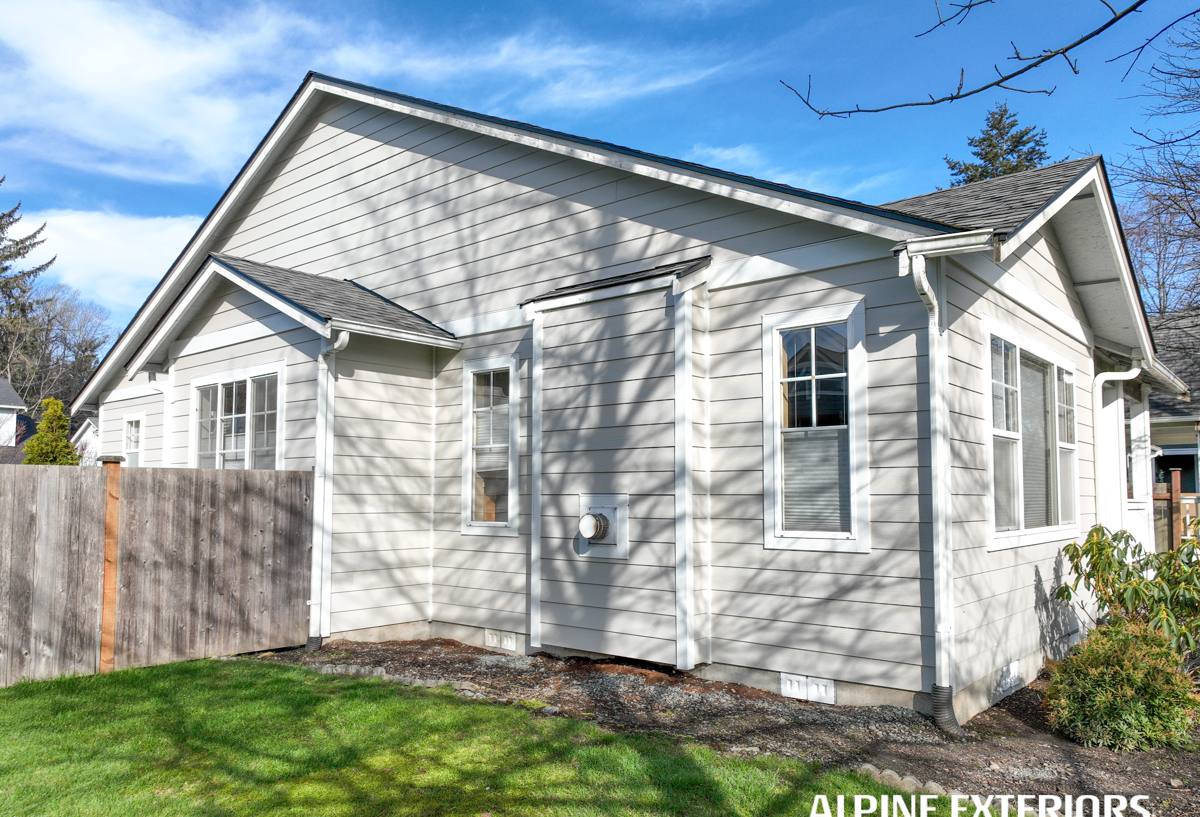
What Coastal Exposure Does to Common Siding Materials
Salt air is mildly corrosive to metal fasteners and trim, and it leaves a fine residue on exterior surfaces that holds moisture longer than plain rainwater would. Combine that with driving rain that gets pushed sideways into laps, seams, and trim joints, and you have conditions that expose every weak point in a siding system over time.
Wood and wood-composite sidings are the most vulnerable — they absorb moisture at cut edges and fastener holes, and in a climate where things rarely get a chance to fully dry out between rain events, that moisture has nowhere to go. Vinyl siding doesn't rot, but it expands and contracts with temperature swings, can warp or bow over time, and tends to chalk and fade faster under sustained salt exposure. These are trade-offs we take seriously, which is why our crews install James Hardie fiber cement exclusively. It's not the only siding product on the market, but for coastal Whatcom County conditions it's the one we're willing to put our name behind.
Why James Hardie Fiber Cement Fits Blaine Homes
Fiber cement is made from cement, sand, and cellulose fiber, fired and cured into a dense, dimensionally stable board. It doesn't absorb bulk water the way wood does, it won't warp or sag the way vinyl can in temperature swings, and it's non-combustible. The factory-applied ColorPlus finish is baked on rather than field-painted, which matters directly for a salt-air environment — a factory finish resists fading and chalking far better than most site-applied paint systems exposed to the same UV and salt cycle year after year.
Built for the Wetter Side of the Climate Map: HZ5
James Hardie engineers its siding by climate zone, and Western Washington falls into the HZ5 category — the product line built for regions with sustained moisture, freeze-thaw cycling, and higher humidity. HZ5 boards are formulated and tested for exactly the kind of weather pattern Blaine sees: long wet stretches, real rain volume, and enough cold snaps in winter to matter. It's a meaningfully different product than the boards Hardie makes for hot, dry climates, and it's the one we install throughout Whatcom County.
What a Correct Installation Involves
Fiber cement siding is only as good as the installation behind it. Most of the siding failures we get called out to inspect — on any brand — trace back to installation shortcuts, not the product itself. In a coastal environment those shortcuts show up faster.
Clearance and Drainage
Siding needs a gap from grade, decks, patios, and roof lines so water doesn't wick up into the bottom edge of the board. On waterfront and near-waterfront lots where humidity and splashback are already elevated, that clearance isn't optional — it's the difference between a board that sheds water and one that stays damp against its own bottom edge.
Fasteners, Flashing, and the Weather-Resistive Barrier
We use corrosion-resistant fasteners driven to the manufacturer's specified depth and pattern — over- or under-driven nails are one of the most common causes of early siding trouble, and salt air punishes the wrong fastener choice quickly. Flashing at windows, doors, and every horizontal transition has to actually direct water out and away, and it goes behind, not just over, the weather-resistive barrier. A rain-screen gap behind the siding, where the assembly calls for one, gives incidental moisture a way to drain and the wall a way to dry.
Caulking and Joints
Fewer joints and tighter, correctly caulked seams matter more here than in a drier climate, since every open seam is a place driving rain can find its way behind the board. We treat joint layout and sealant selection as part of the install, not an afterthought.
Our Process for a Blaine Siding Project
We start with an on-site walk of the exterior, not just a measurement — on coastal homes we're specifically checking existing siding, trim, and sheathing for moisture damage that isn't always visible from the ground, since a home near the water can hide rot behind siding that still looks intact. From there:
- Assessment of existing siding, trim, flashing, and sheathing condition, with photos and notes shared with you
- A written scope covering board selection, trim details, color, and any sheathing repair needed before new siding goes on
- Removal of old siding and correction of any flashing or weather-barrier issues found underneath
- Installation to James Hardie's published specifications for clearance, fastening, and joint treatment
- A final walk-through so you can see the finished work and ask questions before we consider the job done
Living With Fiber Cement Siding in a Moss-Prone Climate
Fiber cement doesn't feed moss and algae the way wood does, but nothing installed outdoors in Whatcom County's moss season is entirely maintenance-free. Shaded, north-facing walls and areas near mature trees will still collect organic growth on the surface over time. The upkeep is straightforward:
- A gentle rinse once or twice a year keeps salt residue and organic buildup from taking hold — no pressure-washing directly into joints or seams
- Keep gutters and downspouts clear so overflow isn't repeatedly splashing the same section of wall
- Trim back vegetation that's shading siding or blocking airflow along a wall
- Have caulk lines and trim joints checked every few years, since sealant is the one component that wears out well before the siding itself
None of this is heavy work, but it's real, and it's worth planning for on a coastal property rather than assuming the siding will simply take care of itself.
Cost Factors for a Blaine Fiber Cement Project
Every home is different, but the factors that move the price on a Blaine project tend to be the same handful of things:
| Factor | Why It Matters Here |
|---|---|
| Existing sheathing condition | Waterfront-adjacent homes more often need sheathing repair discovered once old siding comes off |
| Board profile and trim complexity | Lap, shingle-style, and panel systems, plus trim detail, affect labor and material |
| Wall exposure | Sides facing prevailing wind and rain need extra care at seams and flashing, which affects labor time |
| Color and finish | Factory ColorPlus finishes cost more upfront than field-painted primed board but remove a recurring repaint cycle |
| Access and site conditions | Waterfront lots, retaining walls, and tight lots can affect staging and equipment access |
We give a written, itemized estimate before any work starts, so you know exactly what's driving the number rather than a single lump figure.
Why a Crew That Already Works Blaine Matters
A siding installer who mostly works drier, inland projects can still do competent work, but a crew that regularly installs on Blaine and other Whatcom County waterfront and near-waterfront properties has already seen how this specific combination of salt air, wind-driven rain, and long moss season plays out over years, not just at the moment of installation. That shows up in small decisions — where to add extra flashing attention, which walls need tighter joint spacing, how much clearance to build in near grade — that a generic install spec doesn't fully capture on its own.
It also means we're a known, reachable local crew if a question comes up two or five years after installation, not a company that did one job in the area and moved on.
Questions to Ask Before Hiring a Siding Contractor in Blaine
- Do you install to the manufacturer's published specifications for clearance, fastening, and flashing, and can you explain what those are?
- Will you check the sheathing and existing flashing once old siding is removed, and how is that handled if a problem is found?
- What siding product and product line do you install, and why did you choose it?
- How do you handle joints, seams, and caulking in areas exposed to driving rain?
- Can I get a written, itemized estimate before work begins?
If your Blaine home is due for new siding, we're glad to walk the exterior with you, point out anything driving rain and salt air have already affected, and put together a straightforward, no-pressure estimate for James Hardie fiber cement siding done right. Use the form below to get started.