 Bellingham Exterior
 Why Fairhaven Decks Take More Thought Than a Standard Build
Fairhaven sits right up against Bellingham Bay, tucked in among mature trees and older homes on sloped lots. That combination — salt-laden air off the water, heavy tree canopy that keeps things shaded and damp, and a wet season that runs long even by Pacific Northwest standards — puts more stress on an outdoor deck than most homeowners realize. A deck built with the same materials and methods you'd use in a dry inland town will show its age in Fairhaven years before it should: rusted fasteners, soft spots where moss has held moisture against the wood, railings that start to wobble because the hardware corroded from the inside out.
None of that is inevitable. It just means the deck has to be built for the specific conditions of this neighborhood, not for a generic weather assumption. That starts with material choices and goes all the way through framing, fastener selection, and how the deck is designed to shed water and dry out between rains.
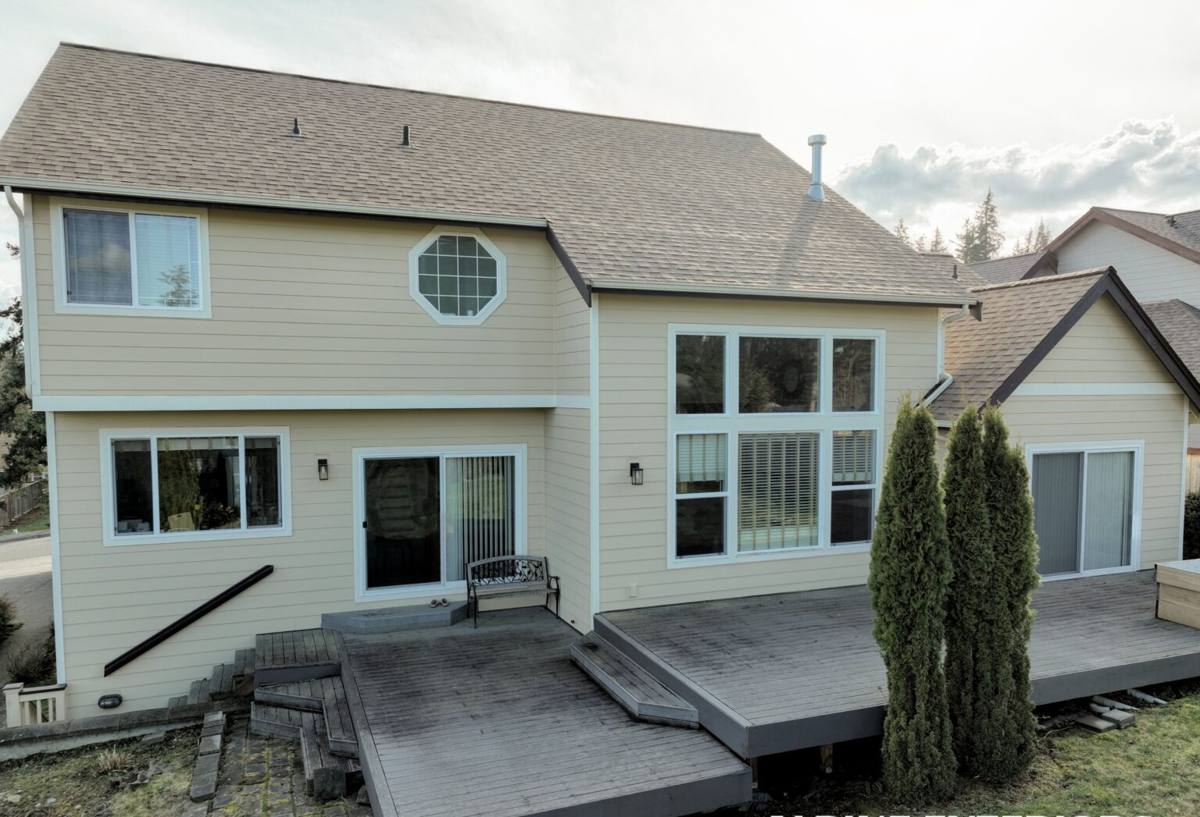
What Bellingham Bay's Climate Actually Does to a Deck
It helps to be specific about what's working against a deck here, because it changes what "quality" actually means in this location.
Salt Air
Proximity to the bay means airborne salt settles on every exposed surface, including metal hardware, fastener heads, and any unprotected steel in railings or structural connectors. Ordinary carbon-steel screws and brackets corrode faster near the water than they would even a few miles inland. Once a fastener starts rusting, it weakens at exactly the point where it's doing the most work — holding your deck boards, joists, or railing posts together.
Driving Rain
Wind-driven rain off the bay doesn't just fall straight down — it gets pushed sideways into ledger connections, under railing base plates, and into any gap where water can collect instead of running off. A deck design that works fine in a calmer inland yard can trap water in Fairhaven simply because the rain is coming from a different angle.
A Long Moss Season
Shade from mature trees plus near-constant moisture is exactly what moss needs to establish itself, and once moss gets a foothold on a deck surface or in the gaps between boards, it holds water against the wood far longer than open air would. That trapped moisture is what actually causes rot — the moss is just the mechanism that keeps things wet.
What a Deck Built for This Climate Needs to Get Right
Fasteners and Hardware
This is the detail that separates a deck that lasts from one that doesn't, and it's easy to overlook because it's not visible once the deck is finished. Near the bay, we use stainless steel or hot-dip galvanized fasteners and structural connectors rated for coastal or high-moisture exposure, not the standard-grade hardware that's fine for a dry, inland lot. It costs more up front. It's also the difference between a deck that's still solid in fifteen years and one where the railing posts are loose in five.
Framing and Ledger Attachment
The ledger board — where the deck attaches to the house — is the single most common failure point on any deck, and it's under more pressure in a wet climate because water intrusion at that joint is harder to spot until damage has already spread. Proper flashing, correct fastener spacing, and a gap that lets water drain instead of pooling against the house are non-negotiable here.
Airflow Underneath
A deck that sits low to the ground with poor airflow underneath stays damp longer after every rain, which speeds up rot in framing and gives moss more time to establish on the surface above. Where the lot allows it, we build in enough clearance and, where that's not possible, we pay closer attention to drainage and material choice to compensate.
Surface Drainage
Board spacing, a slight slope away from the house, and gaps that don't clog with debris all matter more here than in a drier climate, because the deck simply doesn't get long dry stretches to make up for a design that holds water.
Decking Material Options for a Fairhaven Lot
There's no single "correct" decking material for every Fairhaven home — it depends on your budget, how much upkeep you're willing to do, and how much sun versus shade your specific lot gets. Here's how the common options actually compare in this environment.
| Material | How It Handles This Climate | Maintenance |
|---|---|---|
| Pressure-treated wood | Affordable and workable, but needs consistent sealing to resist moisture and moss; most prone to warping if neglected | Annual cleaning and re-sealing |
| Cedar | Naturally more rot-resistant than treated pine and ages well visually, but still needs regular care in a shaded, damp yard | Periodic cleaning and finish maintenance |
| Composite decking | Resists moisture absorption and won't rot, though moss and algae can still grow on the surface in heavy shade and need occasional cleaning | Low — occasional washing |
| PVC/capped composite | Best moisture resistance of the common options; performs well in shaded, wet conditions but costs more up front | Lowest — surface cleaning only |
We'll walk through these trade-offs honestly during your estimate rather than pushing whatever has the best margin. A shaded, tree-covered lot near the water changes the math compared to a sunnier yard even a few blocks away.
Design Considerations for Fairhaven's Older Homes and Sloped Lots
A lot of homes in this part of Bellingham are older builds on lots that slope toward the water or have mature landscaping that limits where a deck can reasonably go. That affects the build in a few practical ways:
- Ledger attachment to an older house may require extra care if the existing siding, sheathing, or framing isn't in the condition modern code assumes
- Sloped lots often call for taller supports, which changes the engineering for footings and bracing
- Mature trees mean roots to work around and shade patterns that should inform which decking material makes sense
- Railing height and spacing requirements apply regardless of how "custom" the design is — this isn't optional, it's code
- View decks that gain height to see the bay need extra attention to wind exposure and railing security
None of this is a reason to avoid a custom design — it's just why "custom" has to mean "custom to your actual lot," not a standard plan dropped onto whatever ground is available.
Our Process for a Fairhaven Deck Project
We keep the process straightforward and avoid surprises, which matters most on a job where site conditions vary as much as they do in this neighborhood.
- On-site assessment. We look at your specific lot — slope, shade, existing structure condition, and how the deck will tie into your house — before we talk materials or design.
- Design and material discussion. We go over honest trade-offs between wood and composite options based on your budget and how much upkeep you want to take on, not a one-size answer.
- Permitting. Deck construction in Bellingham typically requires a permit through the city, especially for decks attached to the house or above a certain height. We handle that process as part of the job.
- Build. Proper ledger flashing, coastal-grade fasteners, correctly spaced framing, and drainage-conscious surface layout — the details covered above, actually applied.
- Final walkthrough and inspection. We confirm the work passes any required city inspection and walk you through basic care for whatever material you chose.
Cost Factors for a Custom Deck in This Area
Every deck is priced around its specific footprint, framing needs, and material choice, so we won't put a number on this page that doesn't apply to your project. What we can tell you is what actually drives the cost up or down.
| Factor | Why It Affects Cost |
|---|---|
| Decking material | Wood costs less upfront; composite and PVC cost more but need less maintenance over time |
| Height and support needs | Sloped lots near the water often need taller posts and additional footings or bracing |
| Ledger and structural condition | Older homes sometimes need extra work at the attachment point before the deck itself can go up |
| Railing style and code requirements | Height and design of railings affect both material cost and labor |
| Size and layout complexity | Multi-level decks or irregular shapes take more time and material than a simple rectangle |
Keeping a Fairhaven Deck Sound Through the Wet Season
The build quality gets you most of the way there, but a little seasonal upkeep goes a long way in a climate that stays damp this much of the year.
- Sweep debris and standing leaves off the surface regularly — trapped organic matter is what feeds moss growth
- Rinse or gently scrub visible moss before it spreads rather than waiting until it covers a large area
- Check fastener heads and railing connections once a year for early signs of rust or looseness
- Confirm gaps between boards stay clear so water can drain instead of pooling
- Re-seal wood decking on the schedule appropriate to that product — don't wait until it looks weathered
- Keep nearby vegetation trimmed back enough to let air and some light reach the deck surface
Why Hiring a Crew That Already Works in Fairhaven Matters
A contractor who mostly builds decks in drier, sunnier parts of Whatcom County is going to make different default assumptions than one who works this specific stretch near Bellingham Bay regularly. That shows up in small decisions — which fastener grade gets specified without having to think about it, how ledger flashing gets detailed, whether the framing plan accounts for the shade and moisture this particular neighborhood gets. It also shows up in familiarity with the City of Bellingham's permitting process, so your project doesn't stall waiting on paperwork nobody anticipated.
We're not asking you to take our word for the climate concerns above — they're the same physical realities any experienced local builder will point to. What matters is choosing a crew that builds to that reality by default, rather than one that treats a coastal, tree-shaded lot the same as any other job.
If you're planning a new deck or replacing one that didn't hold up in Fairhaven's conditions, we're happy to come take a look and give you a straightforward, no-pressure estimate — no upsell, just an honest read on what your specific lot needs.