 Bellingham Exterior
 Deck Replacement Built for Columbia's Weather, Not Just Its Looks
Homes in Columbia deal with a specific combination of punishment that a lot of decking simply isn't built to handle: salt-tinged air drifting in off Bellingham Bay, long stretches of driving rain through fall and winter, and a moss season that can run eight months or more if a deck sits in shade or under tree cover. A deck that looked fine when it was installed ten or fifteen years ago is often quietly failing underneath by the time it shows obvious problems on the surface. Replacement, done right, isn't about swapping old boards for new ones — it's about rebuilding the structure so it actually holds up to Whatcom County's climate for the next couple of decades.
We work on decks throughout Bellingham, and Columbia's mix of older homes and mature tree cover means we see a fairly consistent pattern: framing that's outlasted its usefulness, ledger boards that were never properly flashed, and surface boards that trapped moisture instead of shedding it. A good replacement fixes all three, not just the part you can see from the yard.
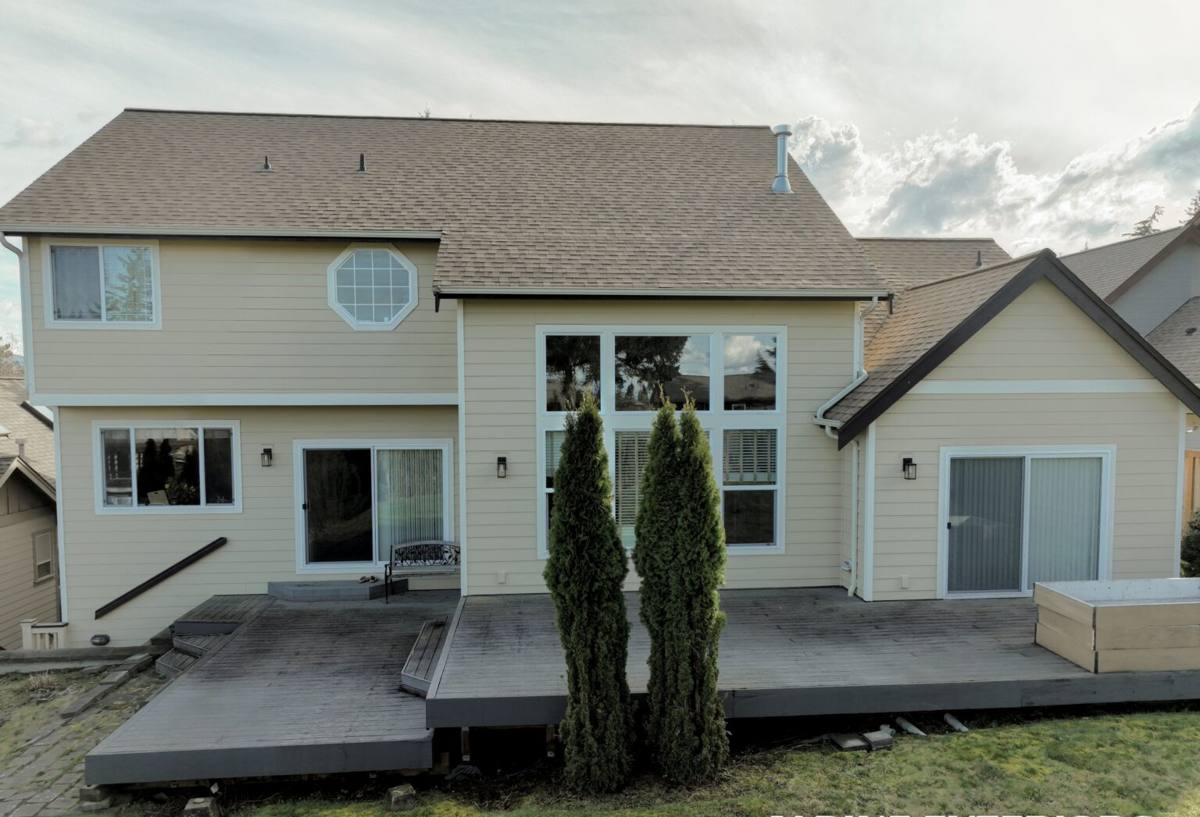
Signs a Columbia Deck Needs Replacing, Not Patching
Not every tired-looking deck needs a full teardown. But there's a point where repair stops making sense — where you're spending real money to patch a structure that's still going to fail within a few years. Here's what tells us a deck has crossed that line:
- Soft, spongy, or spring-back decking when you walk across it, especially near the house or in shaded corners
- Visible rot or dark staining where the deck meets the ledger board (the board bolted to the house)
- Support posts that have shifted, settled unevenly, or show rot at the base where they meet the ground or a footing
- Persistent moss or algae growth that keeps coming back within weeks of cleaning
- Fasteners that are rusted, bleeding stains into the wood, or backing out of the boards
- Railings that flex or feel loose when leaned on — a safety issue, not just a cosmetic one
- A deck more than 15–20 years old that's never had the substructure inspected
If you're only seeing one or two of these and the framing underneath is sound, repair may still be the right call. We'll tell you that honestly if it's the case — replacement is a bigger investment and we don't recommend it when it isn't needed.
What a Correct Deck Replacement Actually Involves
The Substructure Comes First
The framing — joists, beams, posts, and footings — is what actually holds the deck up, and it's also what fails first in this climate when it's not detailed correctly. We check footing depth and condition, joist spacing and species, and whether the original structure was ever sized for the loads it's carrying (a common issue on older Columbia homes where decks were added or extended over the years without re-engineering the frame underneath).
Ledger Board and Flashing
This is the single most common failure point we find on decks in this area. The ledger board — where the deck attaches to the house — has to be properly flashed to keep water from working its way behind it and into the house's wall framing. In a region with as much sustained rain as Whatcom County gets, a poorly flashed ledger doesn't just rot the deck, it can rot the house. We treat this detail as non-negotiable on every replacement.
Fasteners and Hardware
Salt air near the bay accelerates corrosion on standard hardware. We use corrosion-resistant, code-rated fasteners and structural connectors rated for exterior and coastal-adjacent exposure — not because it's the cheapest option, but because rusted-out hardware is one of the leading causes of premature deck failure we see on replacement jobs.
Railings and Code Compliance
Railing height, baluster spacing, and guard requirements are governed by building code, and older decks are frequently out of compliance simply because they predate current standards. A full replacement is the right time to bring these up to code, both for safety and so the work passes inspection cleanly.
Choosing Decking Material for This Climate
There's no single "best" decking material — there's a best material for your budget, your maintenance appetite, and how much sun or shade your deck sits in. Given how much moisture and moss pressure Columbia decks deal with, here's how the common options stack up:
| Material | Moisture & Moss Behavior | Maintenance | Typical Lifespan |
|---|---|---|---|
| Pressure-treated wood | Absorbs water; needs sealing to resist moss and rot | Annual cleaning and re-sealing | 10–15 years with upkeep |
| Cedar | Naturally rot-resistant but still absorbs moisture over time | Regular cleaning, periodic oiling or staining | 15–20 years with upkeep |
| Capped composite | Shell resists moisture absorption; still needs cleaning to prevent surface moss | Occasional washing, no sealing or staining | 25+ years |
| PVC / cellular decking | Fully non-absorbent; best resistance to moss and moisture damage | Occasional washing | 25–30+ years |
We don't push composite or PVC because wood is a bad product — a well-maintained cedar deck can look great for years. We bring it up because "well-maintained" is the operative phrase, and a lot of homeowners underestimate how often that maintenance needs to happen in a climate this wet. If you want the lowest-maintenance option and shade is unavoidable on your lot, capped composite or PVC will fight moss and moisture better than any wood species. If you like the look and feel of real wood and don't mind the upkeep, we'll build it to the same structural standard either way.
How Our Deck Replacement Process Works
1. On-Site Assessment
We inspect the existing deck from the ground up — framing, footings, ledger attachment, and surface condition — and tell you honestly whether you're looking at replacement or repair.
2. Permitting
Deck replacement in Bellingham typically requires a building permit, especially when the structure is being rebuilt or the footprint changes. We handle that process so you're not stuck navigating city requirements on your own.
3. Demolition and Disposal
Old decking, railings, and framing are removed and hauled off. We check the condition of ledger flashing and house sheathing at this stage, since it's the one point in the project where that area is fully exposed.
4. Rebuild
New framing, flashing, decking, and railings go in to code, with materials matched to the decisions we made together during the assessment.
5. Final Walkthrough
We walk the finished deck with you, cover basic care for whatever material you chose, and make sure everything's been signed off if a permit was involved.
What Drives the Cost of a Deck Replacement
Every deck is different, so we don't quote a number without seeing the site, but these are the factors that move the price most:
| Factor | Why It Matters |
|---|---|
| Size and shape | Square footage and complexity (multiple levels, angles, built-in seating) both add material and labor |
| Decking material | Composite and PVC cost more up front than wood but less over the deck's lifespan |
| Height and stairs | Elevated decks need more substantial framing, railings, and stair structures |
| Substructure condition | Rotted footings or posts found during demo add scope that a surface-level quote can't predict |
| Permit requirements | Structural changes or footprint expansion can trigger a more involved permitting and inspection process |
A straightforward, ground-level deck replacement is a very different project from a large, elevated multi-level deck with stairs — the honest range for either is wide until we've actually seen your site.
Keeping Moss and Moisture From Coming Back
A new deck in Columbia will still be exposed to the same rain and shade patterns that wore out the old one — the difference is that it's now built to shed water and resist moss instead of trap both. A few habits keep it that way:
- Sweep debris and leaves off the surface regularly, especially in fall — trapped organic matter is what moss feeds on
- Keep gutters and downspouts clear so runoff isn't dumping directly onto or under the deck
- Trim back overhanging branches where possible to reduce shade and let the surface dry between rain events
- Rinse or lightly clean the surface a couple of times a year to stay ahead of algae before it takes hold
- If you chose wood, keep up with the sealing or staining schedule — this is the single biggest factor in how long wood decking actually lasts here
Why It Matters to Hire a Crew That Already Works in Columbia
A deck built to a generic spec sheet doesn't always hold up the same way in a wetter, shadier Pacific Northwest lot as it does somewhere drier. We already know how Whatcom County's rain patterns, moss pressure, and coastal air affect decking, because we're building and replacing decks in this exact climate on a regular basis — not adapting advice written for a different region. That local familiarity also means we're not guessing at Bellingham's permitting process or relearning code requirements on your job; we've already been through it.
If your deck in Columbia is showing its age — soft spots, moss that won't quit, a railing that's gotten a little too flexible — we're happy to take a look and give you a straight answer about whether it needs full replacement or just targeted repair. Reach out for a free, no-pressure estimate using the form below.