 Bellingham Exterior
 Birch Bay's Climate Is Hard on Decks — Here's Why
Birch Bay sits right on the water, and that changes what a deck has to survive year after year. Salt-laden air off the bay works its way into fasteners, hinges, and any exposed metal, corroding hardware faster than it would a few miles inland. Add Whatcom County's long, wet fall-through-spring stretch — driving rain that comes in sideways off the water, combined with short winter days that keep everything damp — and you get months where a deck surface barely has a chance to dry out between storms.
That dampness is also what feeds moss and algae. On a shaded deck near tree cover or on the north side of a house, green growth can take hold on a wood deck within a season or two, and once it's established it holds moisture against the boards and makes the surface slick. A deck built for Birch Bay needs to handle salt exposure, near-constant moisture cycling, and a long moss season — not just look good on a dry August afternoon.
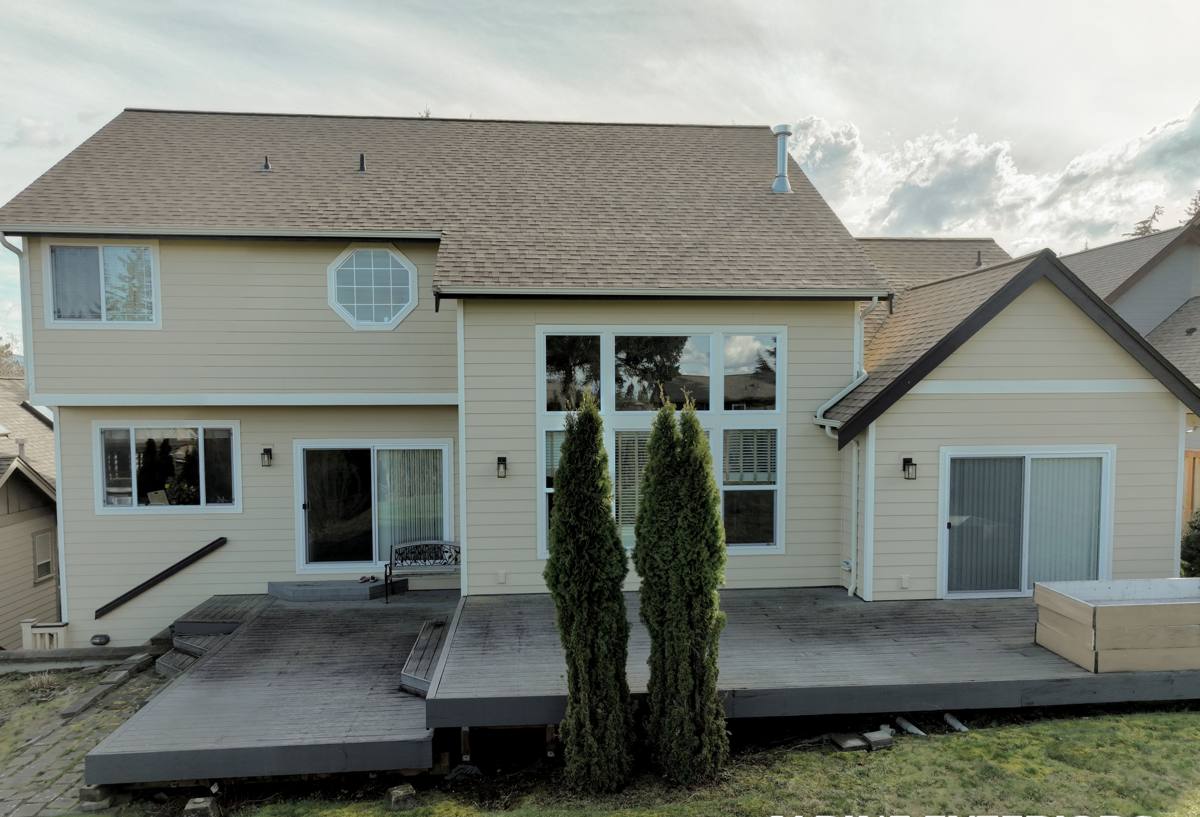
Why Composite Decking Fits This Environment
Composite decking — boards made from a blend of wood fiber and recycled plastic, usually with a protective cap layer — doesn't absorb water the way solid wood does. That matters enormously in a coastal, high-rain climate like Whatcom County's. Solid wood decking swells when wet and shrinks when it dries, and that repeated cycle is what eventually splits boards, pulls fasteners loose, and opens up the checking and cupping that turns into a maintenance headache within a few years near the water.
Capped composite boards resist that moisture cycling, resist rot outright, and don't need the yearly sanding, staining, or sealing that wood decking demands to survive salt air. That doesn't mean composite is maintenance-free — nothing exposed to Birch Bay weather truly is — but it shifts the maintenance burden from structural upkeep (sealing to prevent rot) to surface upkeep (washing off moss and salt film), which is a much more manageable trade for most homeowners.
Where Composite Still Has Trade-Offs
We tell clients this straight: composite boards run warmer underfoot in direct summer sun than some wood species, the upfront material cost is higher than pressure-treated lumber, and color consistency between manufacturer lots can vary slightly if a deck is expanded years after the original install. None of these are deal-breakers for a Birch Bay project, but they're worth knowing before you commit.
Composite vs. Wood vs. PVC: How They Compare in a Coastal Climate
| Material | Moisture & Salt Resistance | Maintenance | Typical Lifespan | Upfront Cost |
|---|---|---|---|---|
| Pressure-treated wood | Absorbs moisture, needs sealing to resist salt-driven decay | Annual cleaning, sealing every 1-2 years near the water | 10-15 years in this climate | Lowest |
| Cedar / natural wood | Naturally decay-resistant but still absorbs moisture | Regular sealing, more frequent replacement of worn boards | 12-18 years | Moderate |
| Capped composite | Strong resistance to moisture and salt film | Periodic washing, no sealing or staining | 25-30+ years (manufacturer-backed) | Moderate-High |
| PVC decking | Excellent moisture resistance, fully synthetic | Low; occasional washing | 25-30+ years | Highest |
For most Birch Bay homes, capped composite is the sweet spot: it holds up to salt air and constant moisture far better than wood, without the premium cost of full PVC systems. We'll walk through all three with you honestly, including where PVC might make more sense for a specific application, like a covered porch deck with heavy sun exposure.
What a Correctly Built Composite Deck Actually Involves
The composite boards get most of the attention, but in a coastal environment the substructure and fastening details matter just as much — arguably more, since that's what fails first when it's done wrong.
Substructure and Framing
We frame with either pressure-treated lumber rated for ground contact where it applies, or composite/composite-compatible joists on larger builds, and we pay close attention to ledger board flashing where the deck ties into the house. A poorly flashed ledger is one of the most common sources of hidden water damage on any deck, and it's especially unforgiving in a climate that gets as much driving rain as Birch Bay does.
Fasteners and Hardware
Standard fasteners corrode fast in salt air. We use stainless steel or coated hardware rated for coastal exposure on brackets, joist hangers, and structural connectors — not because it looks nicer, but because rusted hardware is a slow-motion structural problem that's expensive to fix once boards are already down.
Board Spacing and Drainage
Composite boards need consistent gapping for expansion and drainage, and that gapping has to account for the moisture and temperature swings specific to this area. Too tight, and boards can buckle when they expand in a warm spell after a soaking rain. Too loose, and debris collects in the gaps, which feeds the moss and algae growth we mentioned earlier.
Ventilation Underneath
Low-clearance decks near grade are common on Birch Bay lots, and without adequate airflow underneath, moisture gets trapped below the deck surface even when the boards themselves are moisture-resistant. We check clearance and, where needed, adjust framing height or add ventilation gaps so the whole system can breathe.
Design Considerations Specific to Birch Bay Properties
A lot of Birch Bay homes are built to take advantage of water views or sit on lots with real wind exposure, and both of those things affect deck design decisions beyond just picking a board color.
- Wind exposure: Open, elevated decks near the water see stronger sustained wind than a typical inland Bellingham lot. Railing systems and post spacing need to be solid, not just code-minimum.
- Elevation and grading: Sloped or uneven lots near the shoreline often need custom framing heights and additional footings rather than a standard deck kit approach.
- Railing material: Metal cable or aluminum railings look great on a view deck but need corrosion-resistant hardware in this environment, same as the deck fasteners themselves.
- Sun and shade patterns: Homes tucked under tree cover need extra attention to drainage and board spacing since those areas dry out slower and hold onto moss longer.
Permits and Whatcom County Code
Most new deck construction and many deck replacements in Whatcom County require a building permit, particularly when the deck is attached to the house, exceeds a certain height off grade, or involves structural changes like new footings. Requirements can also shift depending on whether a property falls near shoreline jurisdiction, which is worth checking on Birch Bay lots specifically given the proximity to the water. We handle the permit process as part of the job — pulling the right permit, meeting inspection points, and building to the guardrail height, baluster spacing, and stair requirements the code calls for — so you're not left guessing whether your new deck is actually compliant.
Our Process, Start to Finish
- On-site assessment: We look at the existing structure (if any), grading, sun/shade exposure, and how close the deck sits to salt spray or standing moisture.
- Material and layout discussion: We go over composite board options, railing choices, and layout with you honestly, including cost trade-offs, not just the upsell options.
- Permit and planning: We pull the required Whatcom County permits and finalize the structural plan before any demo begins.
- Demo and framing: Old decking is removed, framing is inspected or rebuilt as needed, and ledger flashing is corrected if it wasn't done right originally.
- Installation: Composite boards are installed with proper spacing, hidden or approved fastening systems, and coastal-rated hardware throughout.
- Final walkthrough: We inspect the finished deck with you, cover basic care, and make sure everything passes final inspection.
Keeping a Composite Deck in Shape Through Birch Bay's Moss Season
Composite decking cuts down on maintenance, but "low-maintenance" isn't "no-maintenance," especially this close to the water. A simple seasonal routine keeps a composite deck looking and performing the way it should for decades.
- Sweep off debris regularly, especially in fall when leaves and needles trap moisture against the boards.
- Wash the deck surface a few times a year with a soft-bristle brush and mild soap and water to clear salt film and early moss growth before it takes hold.
- Avoid pressure washers on high settings directly against composite boards — it can wear the cap layer over time.
- Check railing hardware and fasteners once a year for any early signs of corrosion, particularly on decks with direct water exposure.
- Keep gutters and downspouts near the deck clear so runoff isn't dumping extra water onto or under the deck surface.
Why Hiring a Crew That Already Works in Birch Bay Matters
A deck built to a generic spec sheet doesn't always hold up the same way in a coastal Whatcom County microclimate as it would inland. Salt air corrosion, moss growth patterns, wind loading on elevated view decks, and shoreline-adjacent permitting are all things you learn by actually building and maintaining decks in this specific area, not from a manufacturer's install guide alone. A crew that's worked Birch Bay before knows which hardware actually holds up, which framing details prevent hidden rot near the ledger, and where local code tends to get strict versus where it's more flexible.
That local experience shows up less in the finished look of the deck and more in how it performs five, ten, and twenty years down the road — which is really the whole point of paying for a properly built deck in the first place.
If you're planning a new composite deck or replacing an aging one in Birch Bay, we're happy to take a look and put together a straightforward, no-pressure estimate. Use the form below to get started.