 Bellingham Exterior
 Why Decks Wear Out Faster in Blaine
Blaine sits right at the edge of Semiahmoo Bay, which means homes here deal with a combination of conditions that most inland Whatcom County properties don't face to the same degree. Salt-laden air off the water accelerates corrosion on fasteners, joist hangers, and any exposed metal hardware. Combine that with the long stretches of driving rain typical of a Pacific Northwest fall and winter, and you've got moisture working its way into end grain, ledger connections, and any spot where two boards meet. Add in the region's extended moss season — often eight months or more of the right temperature and moisture for moss and algae to take hold — and a deck that isn't built or maintained correctly can look tired within a few years instead of lasting decades.
None of this means a deck can't hold up well in Blaine. It means the build has to account for these conditions from the ground up, not just at the surface level with a fresh coat of stain.
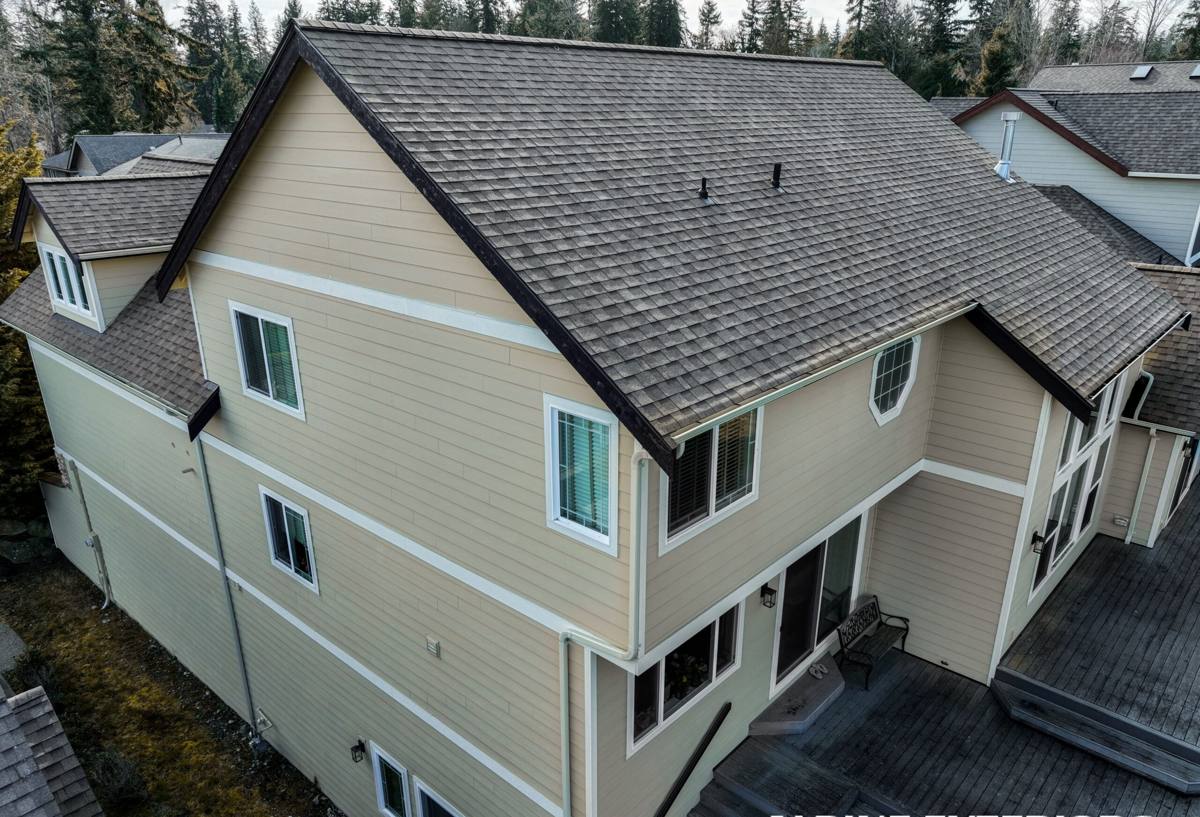
Signs Your Deck Needs Replacement, Not Just Repair
Homeowners often ask whether a deck can be patched instead of replaced. Sometimes it can. But there's a point where repair becomes a short-term fix on a structure that's already failing underneath. Here's what tells us a full replacement is the honest recommendation:
- Soft, spongy, or discolored spots in the decking boards, especially near the house
- Rust streaks or corrosion around fasteners, post bases, or joist hangers
- Visible gaps, sagging, or bounce when you walk across the deck
- A ledger board that's separating from the house or shows water staining behind it
- Persistent moss or algae that returns within weeks of cleaning, even after treatment
- Posts or footings that feel loose or have shifted from the original layout
- A deck older than 15-20 years built without proper flashing at the house connection
If you're only seeing one or two of these and the framing underneath is solid, targeted repair may be enough. Once the ledger connection, footings, or structural framing are compromised, repair usually costs more over time than starting fresh with a properly built deck.
What a Correct Deck Replacement Actually Involves
It Starts Below the Surface
A deck is only as good as what's underneath it. Footings need to be sized and set to reach stable soil, not just poured to whatever depth is convenient. Posts need to be properly anchored, and the ledger board — the piece that attaches the deck to your house — needs correct flashing so water is directed away from the wall framing, not trapped behind it. This last point matters more in a climate like ours than almost anywhere else, because a poorly flashed ledger is one of the most common sources of hidden rot behind decks in the Pacific Northwest.
Hardware Choice Isn't Optional
Given the salt air near the water, we don't cut corners on fasteners and connectors. Stainless steel or high-grade corrosion-resistant coated hardware costs more up front than standard galvanized options, but in a coastal-influenced environment, the difference in service life is significant. Using the wrong hardware here is one of the fastest ways to get premature rust staining and weakened connections.
Drainage and Airflow
Moss and rot both thrive where water sits and air doesn't move. A correct replacement accounts for proper board spacing, joist spacing that matches the decking material's requirements, and grading beneath the deck so water doesn't pool against posts and footings.
Material Options for Blaine's Climate
There's no single "best" decking material — it depends on your budget, how much upkeep you want to do, and how close your home is to the water. Here's an honest comparison of the main options we install:
| Material | Upfront Cost | Maintenance | Moisture & Salt-Air Behavior |
|---|---|---|---|
| Pressure-treated wood | Lowest | Annual cleaning, periodic sealing/staining | Prone to graying, splintering, and moss growth if not maintained; needs corrosion-resistant hardware |
| Cedar | Moderate | Regular sealing to preserve color and resist moisture | Naturally rot-resistant but still needs upkeep in coastal air; ages gracefully if maintained |
| Composite decking | Higher | Occasional washing, no staining/sealing | Resists moisture and moss buildup well; quality varies significantly by brand and product line |
| PVC/capped polymer | Highest | Minimal — periodic washing only | Best resistance to moisture, salt exposure, and moss staining, at the highest material cost |
We install all of these depending on what fits your home and budget. Our standard is that whatever material you choose, the substructure and hardware underneath it are built to the same durable standard — a premium composite board on undersized footings or corroding hardware is still a deck that will fail early.
Our Deck Replacement Process
- On-site assessment. We look at the existing structure, footings, ledger connection, and any signs of hidden moisture damage before quoting anything.
- Demolition and inspection. Once the old decking and framing are removed, we can confirm what's actually going on with the posts, footings, and house connection — this is where we sometimes find issues that weren't visible from the surface.
- Framing and footings. We rebuild or reinforce footings and framing to current standards, sized appropriately for the deck's use and Blaine's soil and moisture conditions.
- Flashing and waterproofing at the ledger. This step gets skipped or done poorly more often than any other part of a deck build, and it's the one most responsible for hidden rot down the road.
- Decking installation. Boards are installed with correct spacing and fastening for the material chosen, with attention to drainage beneath.
- Railings, stairs, and finishing details. Built to current code requirements for height, spacing, and load.
- Final walkthrough. We go over the finished deck with you, including what maintenance it will need going forward.
Permits and Code in Whatcom County
Deck replacements in Blaine and the surrounding Whatcom County area generally require a permit, particularly when the work involves structural changes, new footings, or decks above a certain height. Requirements can vary based on your specific property and the scope of work. We handle the permitting process as part of the job so you're not left navigating it on your own, and we build to the code requirements that apply at the time of construction — not just what was acceptable when the original deck went in years ago.
Cost Factors to Understand Before You Budget
Every deck project is different, so we won't throw out a number that doesn't reflect your actual property. What we can tell you is what tends to move the price:
- Deck size and shape — multiple levels, angles, or curves cost more than a simple rectangle
- Material choice — pressure-treated wood is the most economical, PVC and premium composites cost more
- Condition of the existing structure — if footings or framing need full replacement versus reinforcement
- Railing style and stair complexity
- Site access — decks that are hard to reach with equipment or material can add labor time
- Height above grade, which affects both structural requirements and code compliance
We provide a written estimate that breaks these factors down so you know what you're paying for, not just a lump sum.
Why Hiring a Crew That Already Works in Blaine Matters
A contractor who regularly works this part of Whatcom County already knows how the salt air off the bay affects hardware choices, how much moss pressure a deck will realistically face through the wet months, and what kind of drainage and flashing details hold up here versus in a drier inland climate. That's not something you get from a generic build spec — it comes from having built and maintained decks in these specific conditions. It also means we're a known, reachable contractor if you ever have a question about your deck down the road, not a crew that disappears once the invoice is paid.
Keeping Your New Deck in Good Shape
Whatever material you choose, a little seasonal attention goes a long way in this climate. Clear leaves and debris before the wet season sets in, keep an eye on moss starting to form in shaded or low-airflow areas, and check railings and stairs periodically for looseness. Wood and cedar decks need re-sealing on a schedule; composite and PVC decks mainly just need washing to stay looking new. We'll walk you through exactly what your specific deck needs when the project is complete.
If your Blaine deck is showing its age or you're planning ahead for a replacement, we're happy to take a look and put together a free, no-pressure estimate. Fill out the form below and we'll get in touch to schedule a time that works for you.