 Bellingham Exterior
 Deck Repair Built for Blaine's Coastal Climate
Blaine sits right up against the water, close to the Canadian border, in a stretch of Whatcom County that gets a steady diet of salt air, driving rain off the Strait, and a moss season that can run from October clear through May. That combination is hard on decks. Salt-laden air accelerates corrosion on fasteners and hardware. Wind-driven rain finds its way into every seam, joint, and screw hole that isn't properly flashed or sealed. And moss and algae hold moisture against wood and composite surfaces for months at a time, turning a simple maintenance issue into a structural one if it's ignored long enough.
We repair decks in Blaine regularly, and the failures we see here follow a pattern that's a little different from what shows up on a dry, inland job. Coastal exposure means we're paying closer attention to fastener corrosion, ledger board attachment, and drainage than a contractor who mostly works fifteen miles inland. This page walks through what we actually look for, what a correct repair involves, and how to think about whether your deck needs a repair or a rebuild.
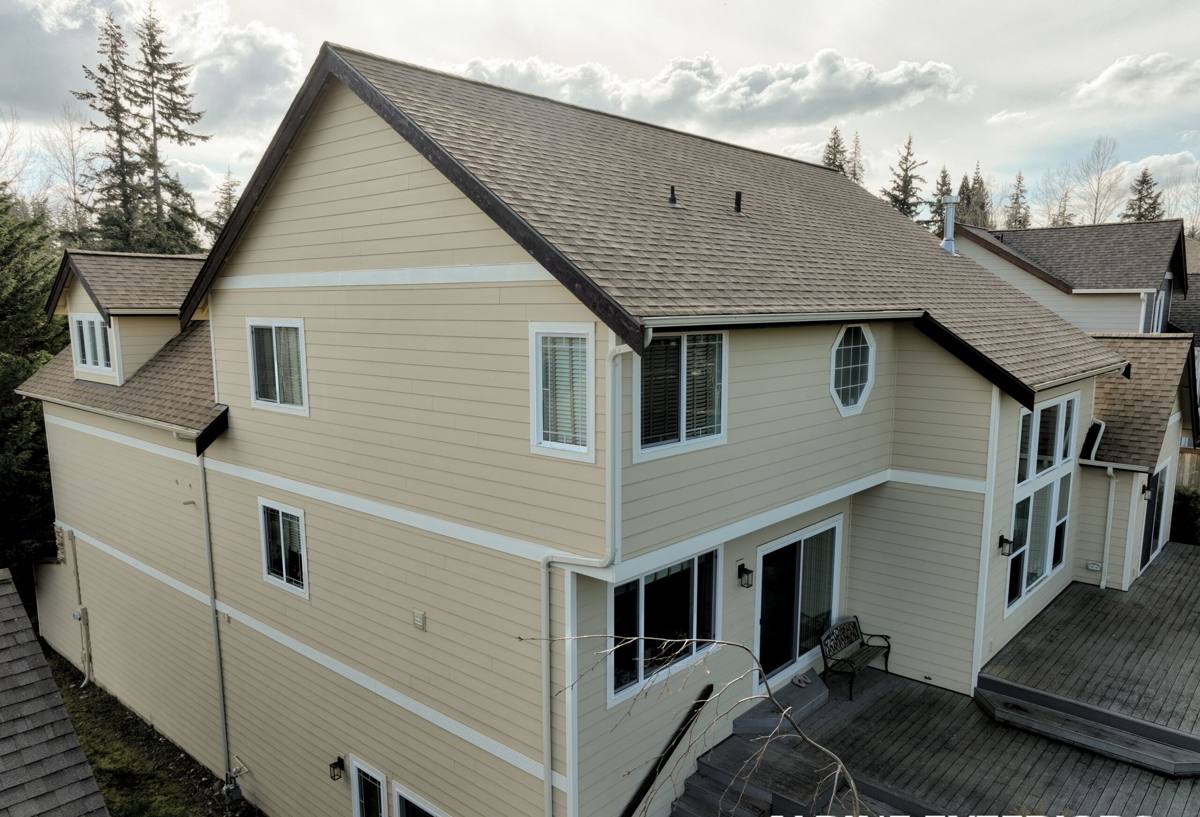
Why Blaine Decks Fail Faster Than You'd Expect
A deck built with the same materials and the same design can last noticeably longer — or noticeably less long — depending on exposure. Homes closer to the water in Blaine take the brunt of salt air and wind-driven rain, and that shows up in a few predictable ways.
Salt Air and Metal Fasteners
Standard galvanized nails, screws, and joist hangers hold up fine in a lot of the country. Near Blaine's waterfront, that same hardware can start showing rust and pitting years ahead of schedule. Once a fastener corrodes, it loses holding strength — and a deck's structural integrity depends on every ledger bolt, joist hanger nail, and post connector doing its job. We check hardware condition on every repair visit, not just the decking boards, because hidden fastener failure is one of the more common reasons a deck that "looks fine" turns out to have a real safety issue underneath.
Driving Rain and Hidden Rot
Rain that comes in sideways off the water doesn't just hit the top of a deck — it gets pushed into vertical seams, under rail caps, around post bases, and behind ledger boards. The ledger board, where the deck attaches to the house, is one of the most common failure points we find. If flashing was skipped or installed wrong when the deck was built, water tracks behind the ledger year after year, and by the time you see staining or soft wood on the surface, there can already be significant rot in the framing behind it.
Moss, Algae, and a Long Wet Season
Whatcom County's moss season is long, and a north-facing or shaded deck in Blaine can stay damp for weeks without a real drying window. Moss and algae aren't just cosmetic — they hold moisture against the wood surface, which speeds up decay in real wood decking and can make composite and capped surfaces dangerously slick. Left alone, a mossy deck surface also tends to hide early signs of board cupping, splitting, or fastener pop that would otherwise be easy to catch.
What a Correct Deck Repair Actually Involves
"Deck repair" covers a wide range of work, from swapping a handful of boards to rebuilding the substructure. A repair done right always starts with an honest structural assessment, not just a look at the surface.
Our Inspection Process
- Check the ledger board connection and flashing — the single most important structural point on most decks
- Test joists, beams, and posts for soft spots, checking, and rot, especially where they contact the ground or house
- Inspect all fasteners and hardware for corrosion, looseness, or missing components
- Evaluate rail and guard post connections for wobble or inadequate blocking
- Look at drainage — where water pools, where it's supposed to shed, and whether it actually does
- Assess the decking surface itself for cupping, splitting, delamination, or moss buildup
- Check stair stringers and connections, which take repeated stress and are easy to overlook
Once we know what's actually going on structurally, we can tell you honestly whether you're looking at a targeted repair, a partial rebuild of the substructure with new decking on top, or a full replacement. We'd rather give you that answer straight than sell a surface-level fix on top of a structural problem.
Common Repairs We Handle
Most Blaine deck repair calls fall into a handful of categories:
- Ledger board reattachment and proper flashing to stop water intrusion at the house connection
- Joist and beam sistering or replacement where rot or corrosion has weakened the frame
- Post base repair or replacement, particularly where posts contact soil or concrete without proper standoff
- Fastener and hardware upgrades to corrosion-resistant stainless or coated hardware rated for coastal exposure
- Board replacement for cupped, split, or rotted decking, matched as closely as possible to existing material
- Rail and guard repair to bring loose or undersized railings up to a safe, secure standard
- Stair repair, including stringer reinforcement and tread replacement
- Drainage correction, including regrading, flashing adjustments, or adding gaps and venting where moisture has been trapped
Repair vs. Rebuild: How We Help You Decide
Not every deck problem needs a full rebuild, and not every deck can be safely patched. The honest answer usually comes down to how much of the load-bearing structure is compromised versus how much is cosmetic.
| Factor | Leans Toward Repair | Leans Toward Rebuild |
|---|---|---|
| Ledger board | Solid, properly flashed, minor surface wear | Rotted, poorly flashed, or improperly fastened to the house |
| Framing (joists/beams) | Localized soft spots or a few damaged members | Widespread rot, corrosion, or undersized framing throughout |
| Posts and footings | Stable, adequate footing depth, minor surface issues | Settling, inadequate footings, or rot at ground contact |
| Decking surface | Isolated cupped or split boards | Majority of boards failing or badly weathered |
| Age and code | Built to current code, reasonably recent | Older deck with outdated rail height, spacing, or attachment methods |
| Overall cost | Repair cost is a fraction of replacement | Repair cost approaches or exceeds a large share of rebuild cost |
If your deck's framing and ledger are sound and the issues are limited to surface boards, hardware, or rail sections, a repair is usually the right call and the more cost-effective one. If the substructure itself is compromised, we'll tell you that plainly rather than patch over a problem that's going to come back.
Materials That Hold Up Near the Water
Material choice matters more in a coastal environment like Blaine than it does further inland. When we're repairing or replacing sections of a deck, we look at how each option actually performs under salt exposure and long wet stretches, not just how it looks on day one.
Wood Decking
Pressure-treated lumber and cedar both remain common and can perform well when properly maintained — sealed or stained on a regular schedule, kept clear of debris, and inspected for early signs of moisture damage. The tradeoff is maintenance: wood near the water needs more frequent attention than the same wood inland, because the combination of salt air and prolonged dampness accelerates weathering.
Composite and Capped Composite
Composite decking resists rot and doesn't need staining, which appeals to a lot of homeowners dealing with Whatcom County's wet season. Our standard is to be upfront about the tradeoffs: composite can still be slick when mossy or wet, board expansion and contraction needs to be accounted for in the install, and not all composite products handle repeated wet-dry cycling the same way. We'll walk you through the specific product options and their warranty structures rather than pushing one brand as a blanket answer.
Hardware and Fasteners
Regardless of decking material, we treat fastener selection as a coastal-specific decision in Blaine. Stainless steel or heavy-duty coated fasteners cost more upfront than standard galvanized hardware, but in a salt-air environment the difference in service life is significant enough that we consider it a baseline standard, not an upsell.
Our Repair Process, Start to Finish
- Assessment: A hands-on inspection of the structure, hardware, and surface — not just a visual walk-around
- Honest scope and estimate: A clear breakdown of what needs repair, what's optional, and what we'd flag for the future
- Structural work first: Ledger, framing, post, and footing repairs completed and verified before any surface work begins
- Hardware upgrade: Corrosion-prone fasteners and connectors replaced with coastal-appropriate hardware where needed
- Surface repair or replacement: Decking, rail, and stair work completed to match the existing deck as closely as possible
- Final walkthrough: We go over the completed work with you directly, including any maintenance recommendations specific to your deck's exposure
Maintenance That Extends Repair Life in Blaine
A good repair lasts longer with a little seasonal attention, especially given how long the wet season runs here.
- Clear leaves, needles, and debris from between boards before fall rains set in
- Treat moss and algae buildup early rather than letting it sit through the winter
- Check rail and post connections annually for looseness, which shows up faster in coastal wind exposure
- Reseal or restain wood decking on the schedule appropriate for its exposure — shaded, north-facing sections often need more frequent attention
- Keep gutters and downspouts clear so roof runoff isn't dumping extra water onto or near the deck
- Watch for standing water after storms, which points to a drainage issue worth addressing before it causes rot
Why Hire a Crew That Already Works in Blaine
Deck repair done by a crew unfamiliar with coastal Whatcom County conditions can miss the details that actually matter here — the ledger flashing detail that stops water intrusion in driving rain, the hardware grade that won't corrode in salt air, the drainage slope that accounts for a genuinely long wet season rather than an average one. We work on homes throughout Bellingham and Whatcom County, including Blaine, and that regional experience shapes how we approach every repair: what we check first, what hardware we default to, and what we flag as a future risk even if it's not part of the current repair scope.
We also believe in giving straight answers. If a deck needs a full rebuild instead of a repair, we'll say so and explain why. If a repair will genuinely hold up for years, we won't upsell you into more work than the deck needs. That's the standard we hold ourselves to on every Blaine deck we look at.
If your deck in Blaine has soft spots, loose rails, rusted hardware, or just needs an honest structural check before another wet season, we're happy to take a look. Reach out for a free, no-pressure estimate using the form below.