 Bellingham Exterior
 Why Birch Bay Homes Need a Different Approach to Windows
Birch Bay sits right on the water, and that changes what a window has to survive. Homes here deal with salt-laden air coming off the bay, wind-driven rain that hits siding and glass at an angle instead of falling straight down, and long stretches of the year when moisture just doesn't fully dry out. Add in the shade and dampness that let moss and algae take hold on north-facing walls and rooflines, and you've got a set of conditions that's noticeably harder on windows than what you'd see a few miles inland in Bellingham proper.
That doesn't mean Birch Bay needs exotic products. It means the window package, the installation details, and the maintenance expectations all need to be matched to a coastal Whatcom County climate rather than a generic Pacific Northwest one. A window that's fine in a sheltered subdivision can fail early on a bay-facing wall if it wasn't specified or installed with that exposure in mind.
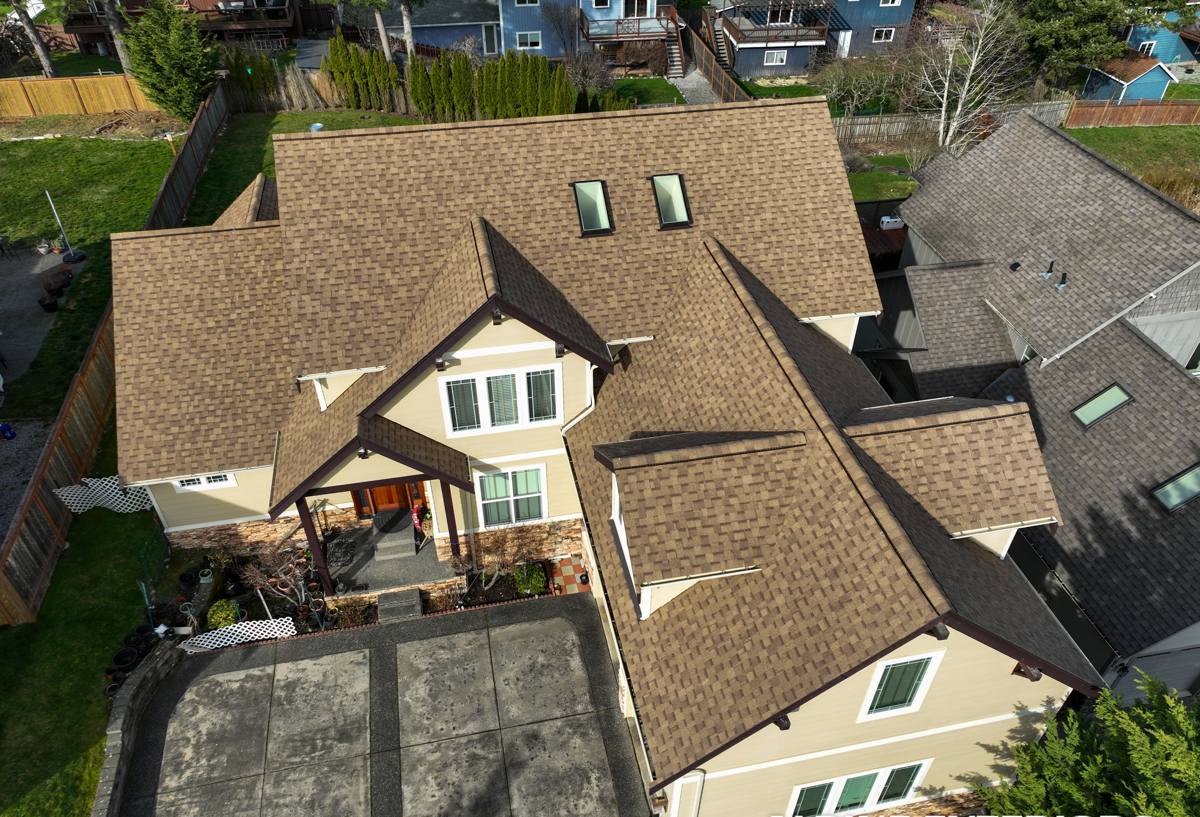
What Salt Air, Rain, and Moss Actually Do to Windows
Salt Air and Hardware
Salt in the air accelerates corrosion on anything metal — hinges, cranks, balance systems, and low-grade fasteners. On homes closest to the water, we see hardware bind up or corrode years before it should on the same window model installed further inland. This is a material and finish issue, not a brand issue: some hardware and cladding finishes are simply rated for coastal exposure and some aren't.
Driving Rain and Seals
Wind-driven rain pushes water sideways against a window in a way vertical rain doesn't. If the seal around the sash, the weatherstripping, or the flashing behind the frame isn't right, water finds its way in — not as an obvious leak at first, but as slow moisture intrusion into the framing around the window. That's a bigger problem than a drafty window; it's a rot and mold risk.
Moss, Shade, and Trapped Moisture
Shaded, damp walls in Birch Bay grow moss and algae readily, and that green film holds moisture against siding and trim longer than a dry, sun-exposed wall would. Around windows, that means the sealant joints and sill areas are wet more often than they're dry. Over time, that shortens the life of caulking, wood trim, and even some composite materials if they weren't installed with drainage in mind.
What "Energy-Efficient" Actually Means Here
Energy efficiency isn't one number — it's a combination of factors that matter differently depending on which direction your walls face and how exposed they are. For Birch Bay, we weigh these in a specific order:
- U-factor — how well the window resists heat loss. This matters most on north- and west-facing walls that take the brunt of winter wind off the water.
- Low-E glass coatings — help control both heat loss in winter and glare/heat gain on the sunnier, south-facing sides of a home.
- Gas-filled sealed units (argon or krypton) — improve insulation value, but only if the seal holds up over years of salt air and temperature swings, so seal quality matters as much as the gas fill itself.
- Frame material — affects both insulation and how the window handles years of damp, salt-exposed conditions without warping, corroding, or needing constant upkeep.
A window with excellent lab-tested ratings won't perform as advertised if it's the wrong frame material for a bay-facing wall, or if it's installed without proper flashing. Efficiency and durability are connected here, not separate decisions.
Comparing Frame Materials for Coastal Exposure
There's no single "best" frame material for every wall of every house — it depends on exposure, budget, and how much upkeep you want to take on. Here's how the common options generally compare for a Birch Bay setting:
| Frame Material | Coastal/Moisture Behavior | Maintenance | Relative Cost |
|---|---|---|---|
| Vinyl | Doesn't corrode or rot; performs well in salt air and damp conditions | Low — occasional cleaning | Lower |
| Fiberglass | Very stable in temperature and moisture swings; strong long-term durability near water | Low | Higher |
| Aluminum | Prone to conductivity-related condensation and, without a marine-grade finish, more susceptible to corrosion in salt air | Moderate | Moderate |
| Wood / Wood-clad | Best appearance for some homes, but the most vulnerable to rot if seals or cladding fail in a wet, shaded location | High — regular inspection and finish upkeep | Higher |
Our general standard for direct bay exposure or shaded, damp walls is to steer clients toward vinyl or fiberglass, simply because they hold up with the least ongoing maintenance. That's a practical trade-off, not a knock on wood or aluminum windows — they can still be the right call on a sheltered, sun-exposed wall where appearance matters more and moisture exposure is lower.
Rough Cost Expectations
Whole-house pricing depends heavily on window count, size, frame material, and glass package, and can range from a modest per-window cost for a straightforward vinyl replacement up to a considerably higher figure for larger fiberglass units with upgraded glass. We'll always walk through the real numbers for your specific home during the estimate rather than quoting off a generic price list.
What a Correct Installation Involves
In a climate like this, the installation matters as much as the window itself. A quality install for a Birch Bay home should include:
- Removing the old window and inspecting the framing and sill for any existing moisture damage before anything new goes in.
- Repairing or replacing any compromised framing — installing a new window over rotten wood just seals the problem behind new trim.
- Installing proper flashing and a drainage path so any water that does get behind the siding has somewhere to go, rather than sitting against the frame.
- Using sealants and weatherstripping rated for exterior, high-moisture exposure — not general-purpose caulk that breaks down after a season or two of salt air and rain.
- Shimming and leveling the window correctly so the sash operates smoothly and the seal stays consistent under years of wind pressure.
- A final check of operation, drainage, and exterior trim before we consider the job finished.
Skipping any one of these steps is how a good window ends up with a bad reputation — the failure is almost always in the installation, not the manufacturing.
How Our Process Works
1. On-Site Assessment
We look at each window individually — its exposure, its current condition, and any signs of moisture or hardware wear — rather than assuming every window on the house needs the same solution.
2. Straightforward Recommendation
You'll get a clear explanation of what we'd recommend for each window or area of the house, including why, and what it would cost. No pressure to upgrade everything at once if a phased approach makes more sense for your budget.
3. Scheduled Installation
We work around Whatcom County's weather patterns when scheduling exterior work, since a dry install window matters for sealing and flashing to cure and set properly.
4. Cleanup and Walkthrough
We walk you through the finished windows — how to operate any new hardware, what maintenance to expect, and what's covered under warranty.
Signs Your Birch Bay Home's Windows Need Attention
Coastal homes often show wear in ways that are easy to write off as cosmetic until they become bigger problems. Watch for:
- Hardware — cranks, latches, or hinges — that feels stiff, corroded, or has visibly rusted
- Condensation forming between the panes of a double-pane window, which usually means the seal has failed
- Drafts you can feel near the frame even when the window is fully latched
- Soft or discolored wood trim or sill around the window opening
- Visible moss or persistent green staining on the siding or trim directly around a window
- Difficulty opening or closing a window that used to operate smoothly
- Noticeably higher heating bills without another clear explanation
Any one of these on its own isn't necessarily an emergency, but a few of them together on the same window usually means it's time for a closer look before the surrounding framing takes on damage.
Why Local Experience in Birch Bay Matters
A crew that mostly works drier, more sheltered neighborhoods can still do a technically correct install and have it underperform on a bay-facing wall, simply because they haven't had to account for that level of wind-driven rain and salt exposure day to day. Working regularly in Birch Bay and along the greater Bellingham and Whatcom County coastline means we've seen how different frame materials, sealants, and flashing details actually hold up here over time — not just how they're rated on paper.
It also means we're realistic with you about what a given wall actually needs. Not every window on a Birch Bay home requires the top-tier coastal spec — interior, sun-exposed walls often don't face the same conditions as a wall taking direct wind off the water. Matching the right product and installation approach to each specific exposure is how you avoid both premature failure and paying for more protection than a given window actually needs.
Ready to Talk About Your Windows?
If you're dealing with drafty, foggy, or hard-to-operate windows anywhere in Birch Bay, we're happy to take a look and give you an honest read on what's going on and what your options are. Use the form below to request a free, no-pressure estimate — there's no obligation, and we'll walk the property with your specific exposure and budget in mind before recommending anything.