 Bellingham Exterior
 Cordata's Roofs Work Harder Than Most
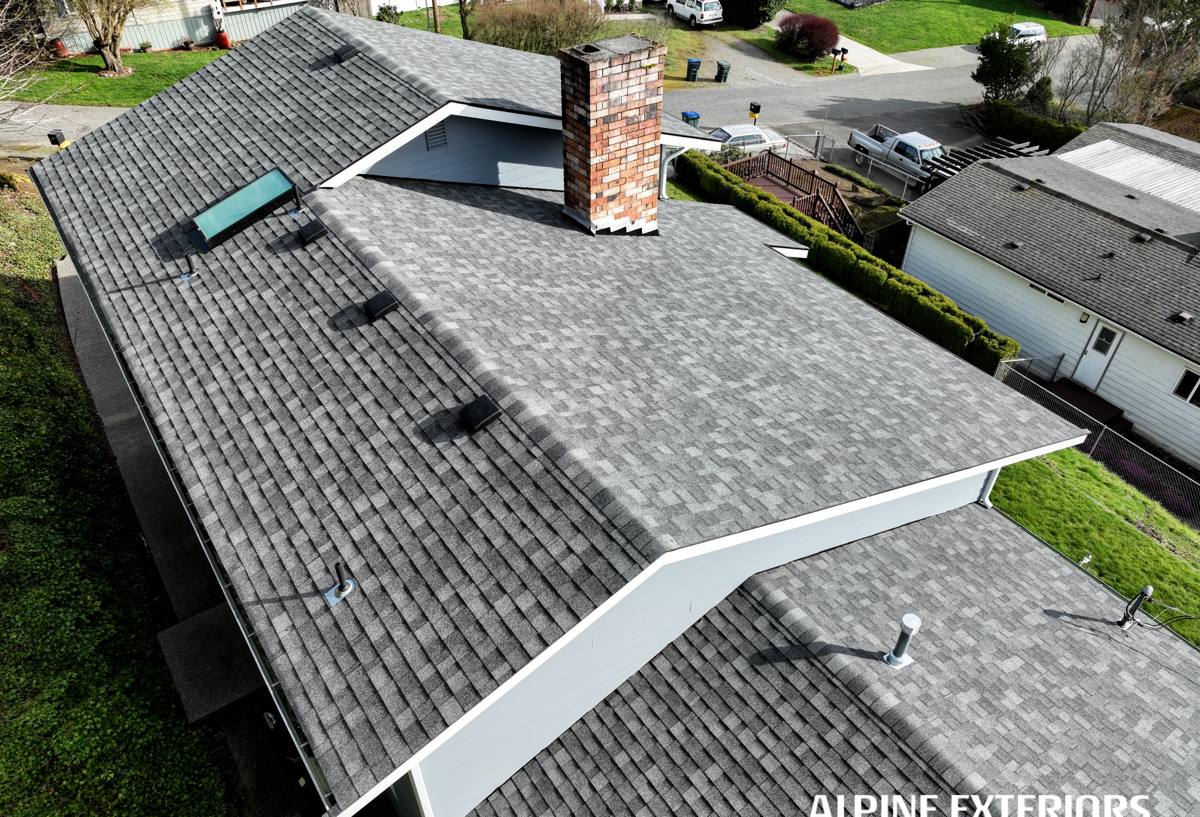
Cordata sits in north Bellingham, close enough to the water and the low marine cloud deck that its roofs live in near-constant dampness for much of the year. Add Whatcom County's long wet season, the salt-tinged air that drifts in off Bellingham Bay and the Strait, and the shade from mature evergreens common in this part of town, and you get a roofing environment that punishes shortcuts. Asphalt shingles are still one of the best value options for this climate when they're specified and installed correctly. The problems we see almost always trace back to one of three things: the wrong shingle for the exposure, ventilation that wasn't sized for the home, or an installation that skipped a step nobody can see from the ground.
What This Climate Actually Does to a Shingle Roof
Homeowners in Cordata aren't dealing with one climate stress — they're dealing with three layered on top of each other, and each one attacks a roof differently.
Driving Rain
Bellingham storms rarely come straight down. Wind off the water pushes rain sideways and up under shingle tabs, which is exactly where a lot of "mystery leaks" start. Standard nailing and standard underlayment can pass for years in a calmer climate and still fail here, because the water is finding its way in laterally at valleys, headwalls, and rake edges rather than through the open field of the roof.
Salt Air
Proximity to the bay means metal roof components — flashing, nail heads, vent housings, gutter hardware — corrode faster than they would inland. A shingle roof is only as good as its metal details, and in a salt-air environment those details need to be chosen and installed with corrosion in mind, not just cost.
Moss and Sustained Shade
Whatcom County's moss season is long, and Cordata's tree cover keeps parts of many roofs shaded and damp well after storms have passed elsewhere. Moss doesn't just look bad — it holds moisture against the shingle mat, works its way under tab edges as it grows, and can lift shingles enough to let wind-driven rain underneath. Left unaddressed for a few seasons, moss growth shortens a roof's service life more than almost anything else we see locally.
Choosing the Right Shingle for a Cordata Home
Not every asphalt shingle product is built the same way, and the differences matter more here than in a dry climate. We generally steer Cordata homeowners toward algae-resistant, laminated architectural shingles rather than basic 3-tab products, for reasons that come down to moisture behavior and longevity rather than looks alone.
| Factor | 3-Tab Shingles | Architectural (Laminated) Shingles |
|---|---|---|
| Typical lifespan in this climate | Shorter — flatter profile sheds less water at the tab edge | Longer — thicker laminate holds up better under sustained moisture |
| Moss/algae resistance | Available, but coating wears thinner over time | Usually comes with stronger algae-resistant granule treatment |
| Wind rating | Lower rated in most product lines | Higher rated — better fit for exposed or wind-funneled lots |
| Upfront cost | Lower | Moderate premium, generally worth it over the roof's life |
We install algae-resistant shingles as our standard on shaded, moss-prone lots — which describes a good share of Cordata. It's not a marketing upgrade; it's a maintenance-burden decision. A roof that fights moss growth on its own needs far less intervention from the homeowner over its lifespan.
What a Correct Installation Actually Involves
The shingle itself is maybe 40% of how long a roof lasts here. The rest is in details that aren't visible once the job is done — which is exactly why they get skipped by crews trying to move fast.
- Ice-and-water membrane at vulnerable points — valleys, eaves, and around every penetration, not just where code minimums require it
- Synthetic underlayment across the full deck, sealed and lapped correctly, as the real secondary water barrier under driving rain
- Corrosion-resistant flashing at chimneys, walls, and roof-to-wall transitions, sized and formed for this specific roof rather than a generic bent piece
- Balanced intake and exhaust ventilation so the attic can actually dry out between storms instead of trapping condensation under the deck
- Correct nailing pattern and placement for the specific shingle's wind rating — not just "enough nails," but the right count in the right zone
- Drip edge at eaves and rakes to direct water away from the fascia instead of behind it
Any one of these done wrong won't fail the roof immediately. It fails it in year six or eight, quietly, in a way that looks like "the shingles just wore out" but is really an installation gap catching up with the climate.
How We Approach a Cordata Roofing Job
We keep the process straightforward because homeowners deserve to know exactly what's happening on their roof and why.
1. On-Site Assessment
We walk the roof and the attic, not just the roof. Ventilation problems, deck moisture, and past leak damage almost always show up from the inside before they're visible outside.
2. Straightforward Scope and Estimate
You get a written scope that spells out the shingle product, underlayment, flashing plan, and ventilation approach — so you know what you're paying for, not just a lump-sum number.
3. Tear-Off and Deck Check
Full tear-off lets us actually see the deck. Soft or water-stained sheathing gets flagged and repaired before anything new goes down — covering over a compromised deck just hides the problem for the next owner to find.
4. Installation to the Details Above
Underlayment, flashing, ventilation, and shingles installed in the sequence and to the standard described above — not a shortened version of it.
5. Final Walkthrough
We review the finished roof with you, including what was found and fixed along the way, before we consider the job done.
Ventilation: The Step Most Homeowners Never See Discussed
A shingle roof's warranty and lifespan assume the attic underneath is ventilating properly. In a climate as wet as Whatcom County's, an under-ventilated attic traps moist air against the underside of the roof deck, which can cause premature shingle failure, deck rot, and moss-friendly surface moisture — all things a homeowner will blame on the shingles when the real cause is airflow. Before we quote a re-roof, we look at existing intake vents (usually at the soffit) and exhaust vents (ridge or box vents) and tell you honestly if the balance is off, rather than just matching what's already there.
What Homeowners Can Do Between Services
A well-installed roof still benefits from basic seasonal attention, especially with Cordata's tree cover and moss pressure.
- Keep gutters clear so water isn't backing up under the eave edge during heavy rain
- Have overhanging branches trimmed back to reduce shade and debris buildup on the roof plane
- Address visible moss early — a light application before it establishes is far easier than removal after it's taken hold
- Have the roof looked at after any major windstorm, even if nothing looks obviously wrong from the ground
- Check attic ventilation isn't blocked by insulation or storage that's crept over the soffit vents
Cost Factors for a Cordata Re-Roof
Every roof is different, but these are the variables that actually move the price, so you can ask an informed question of any contractor you're comparing.
| Factor | Why It Matters |
|---|---|
| Roof size and number of planes | More cuts, valleys, and hips mean more labor and material waste |
| Existing deck condition | Rotted sheathing found at tear-off adds material and labor to replace safely |
| Shingle line chosen | Architectural, algae-resistant products cost more upfront than basic 3-tab |
| Flashing and penetration count | Chimneys, skylights, and multiple vents each need individually formed flashing |
| Ventilation upgrades needed | Adding or rebalancing intake/exhaust vents is often the difference between a roof lasting or not |
| Access and pitch | Steeper or harder-to-access roofs take longer and require more safety setup |
Be cautious of any quote that's dramatically lower than others without an explanation — it's usually missing one of the line items above, not delivering a better deal.
Why Local Cordata Experience Matters
A roof installed by a crew that already works this specific area understands, without being told, that a shaded north-Bellingham lot needs stronger moss resistance, that a home exposed to bay winds needs a higher wind-rated shingle, and that "code minimum" underlayment isn't enough given how sideways the rain comes in during a real Whatcom County storm. That local pattern-recognition is what separates a roof that looks fine at handoff from one that's still performing a decade later.
If you're weighing options for a shingle roof in Cordata, we're happy to walk the roof and attic with you and give you a straightforward, no-pressure estimate — just fill out the form below to get started.